

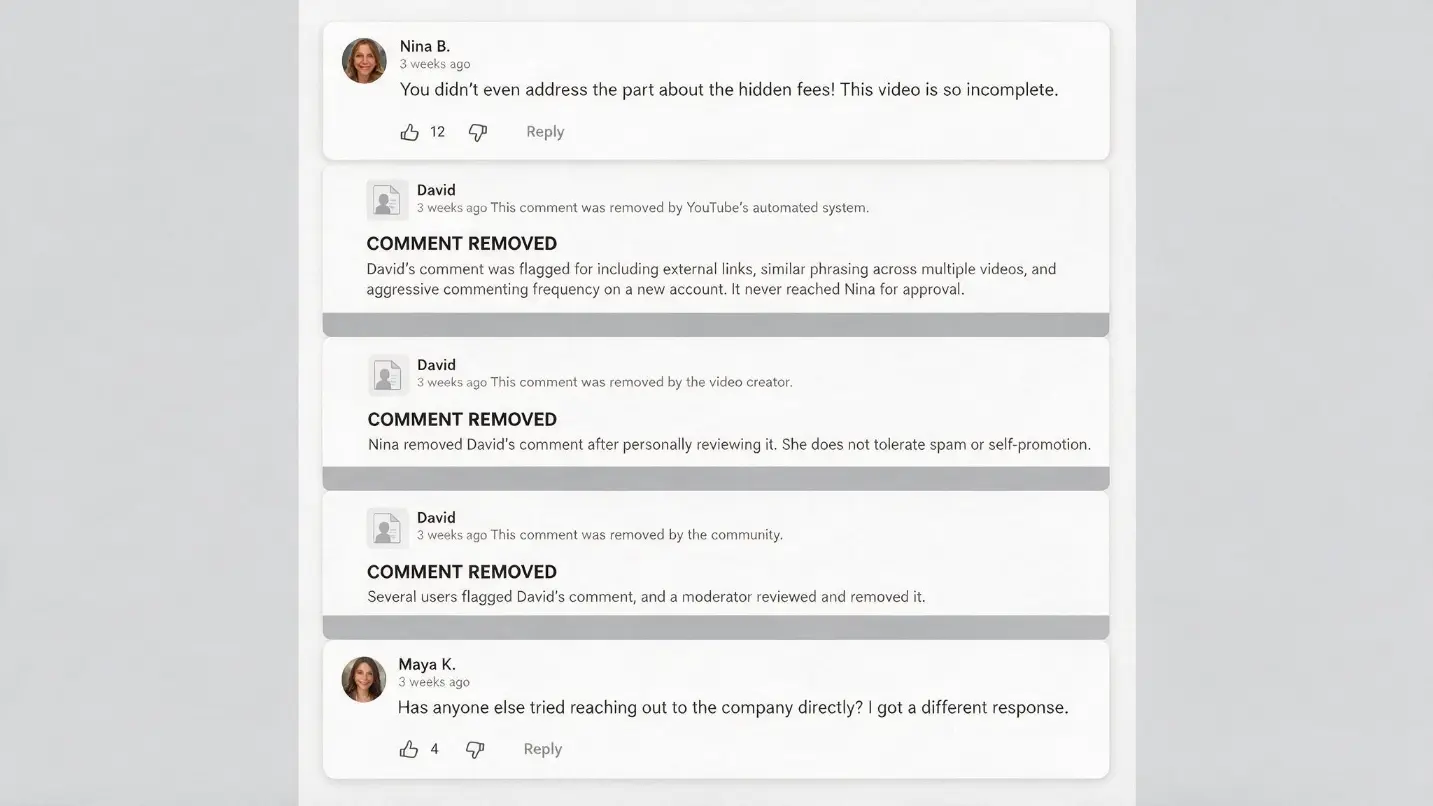
Two weeks ago I saw my friend David super frustrated because YouTube kept deleting his comments.
He had been commenting on videos in his niche for months — discussion videos, educational channels, creator content. His comments were substantive, usually 2–3 sentences, and they added to the conversation, asked real questions, and shared relevant experience. Then YouTube started taking them down. Not all of them. Some. It seemed arbitrary. He would leave a comment, see it appear, return an hour later, and it was gone. The video's creator hadn't taken it down. It was just deleted by the YouTube system.
"What am I doing wrong?" he said, sounding genuinely puzzled. "I'm not mean. I'm not spamming. I don't advocate for anything weird. Why is YouTube deleting my comments?" He started searching for answers. Found theories about keyword triggers. Found conspiracy theories that YouTube was suppressing certain views. People claiming YouTube was deliberately censoring them to silence them. He was about to quit YouTube altogether.
YouTube comments can be deleted, and usually it's nothing personal. But most theories explaining why are either exaggerated or just plain wrong. Before you panic — learn what really causes deletion, how YouTube's system really works, and what you can really do about it. His real problem was found, and it was not a YouTube conspiracy. A combination of seemingly innocent habits were triggering the automated filters. He changed his approach and his comments stayed.
"I nearly gave up engaging on YouTube thinking the system was against me," he told me later. "But it was just me not understanding how their filters work."
Why YouTube Actually Deletes Comments
Understand what's happening before you get frustrated. YouTube's comment moderation operates on three distinct layers — and knowing which layer is affecting you completely changes how you fix it.
🤖 Automated Filters
- Searches for links, keywords, patterns in comments
- Detects obvious spam, harassment, copyright infringement
- Works 24/7 automatically
- Removes or holds comments for review
- Responsible for most comment deletions
👤 Creator Moderation
- Creator can delete comments manually
- Creator can set comment filters and preferences
- Creator can ban specific users
- Comments removed by their own rules
- Independent of YouTube's system
🚩 Community Flagging
- Users mark comments as inappropriate
- Multiple flags trigger YouTube review
- Flagged content reviewed by YouTube's team
- Removed if found in violation of Community Guidelines
- Less common than automated deletion
The vast majority of deleted comments are caught by Layer 1 automated filters — not because YouTube has a personal problem with you, not because of political bias, and not because of specific words. Automated filters evaluate patterns. A comment that looks innocent to a human can look like spam to a pattern-matching system — which is exactly what happened to David.
What Actually Triggers Automated Deletion
🚨 Real Triggers (Justify Removal)
⚠️ False Triggers (Innocent but Trips Filters)
David's Real Problem — A Real-World Case Study
His posts were being removed not because of any single violation, but because a combination of innocent-seeming habits together created a pattern the automated filters were trained to catch.
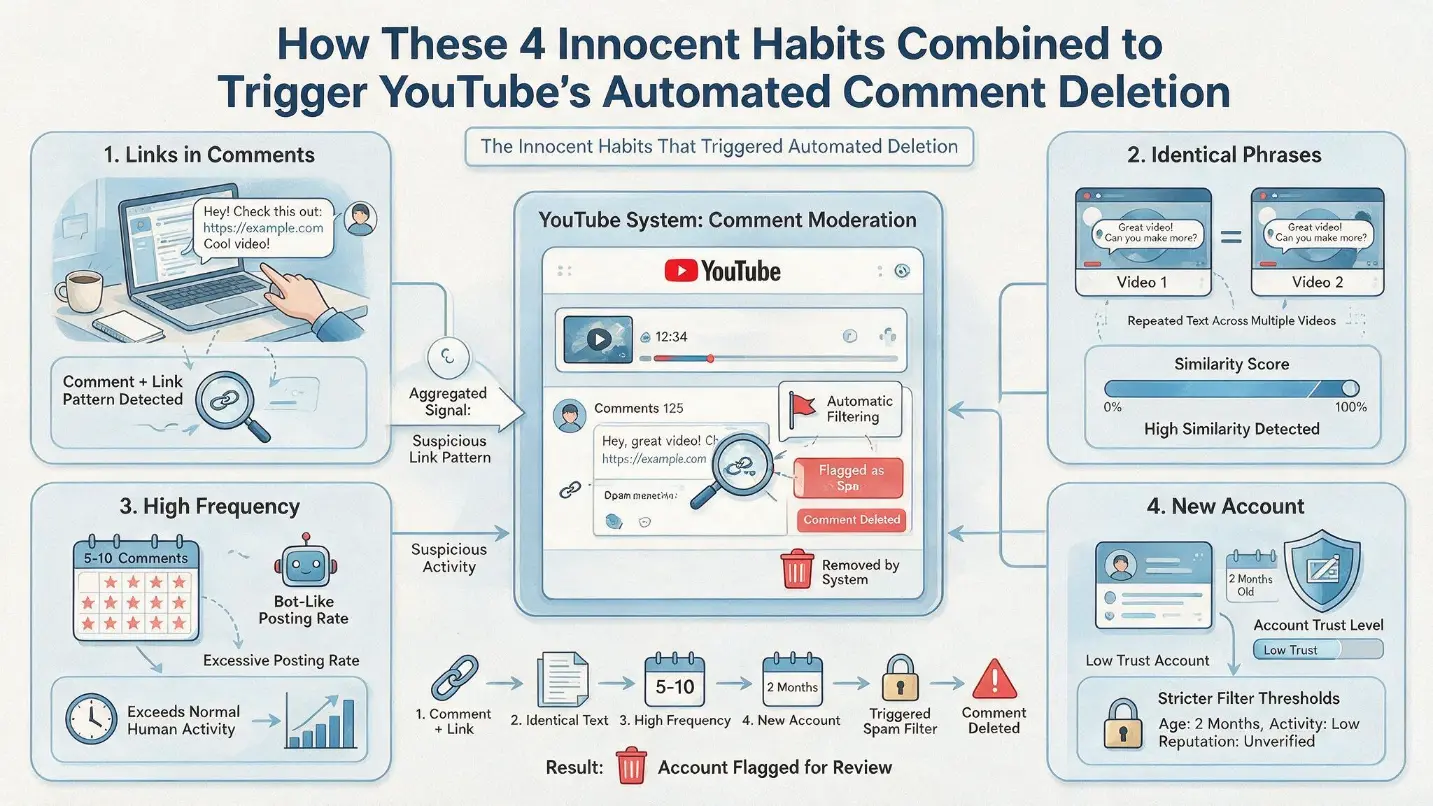
David's Four Filter Triggers
None individually severe — combined they looked like spam to the automated systemEach comment contained a link to a related blog or resource. Comment + link = spam filter trigger. Not malicious, but a pattern that looks exactly like the spam the filter was designed to catch.
"Great content! Here's my take: [link]" — the same style and phrasing across many videos. The pattern-matching algorithm observed this repetition as coordinated spam behaviour rather than genuine engagement.
5–10 comments per day on a single creator's videos looked like bot activity to the filters. Legitimate viewers don't typically leave that volume of comments on one channel in one day.
A two-month-old YouTube account faces stricter automated filter thresholds than established accounts. The same behaviour from an older account with more history would have been treated differently.
Nothing David was doing was intentionally malicious. The filters were triggered by the combination — each habit was borderline on its own, but together they added up to a pattern that matched what the automated system was trained to catch. This is the most common cause of innocent comment deletion. Understanding this is the first step to fixing it.
How to Prevent Comment Deletion
What Works — Comments That Stay Up
✅ Do This — Comments Stay Up
❌ Don't Do This — Comments Get Removed
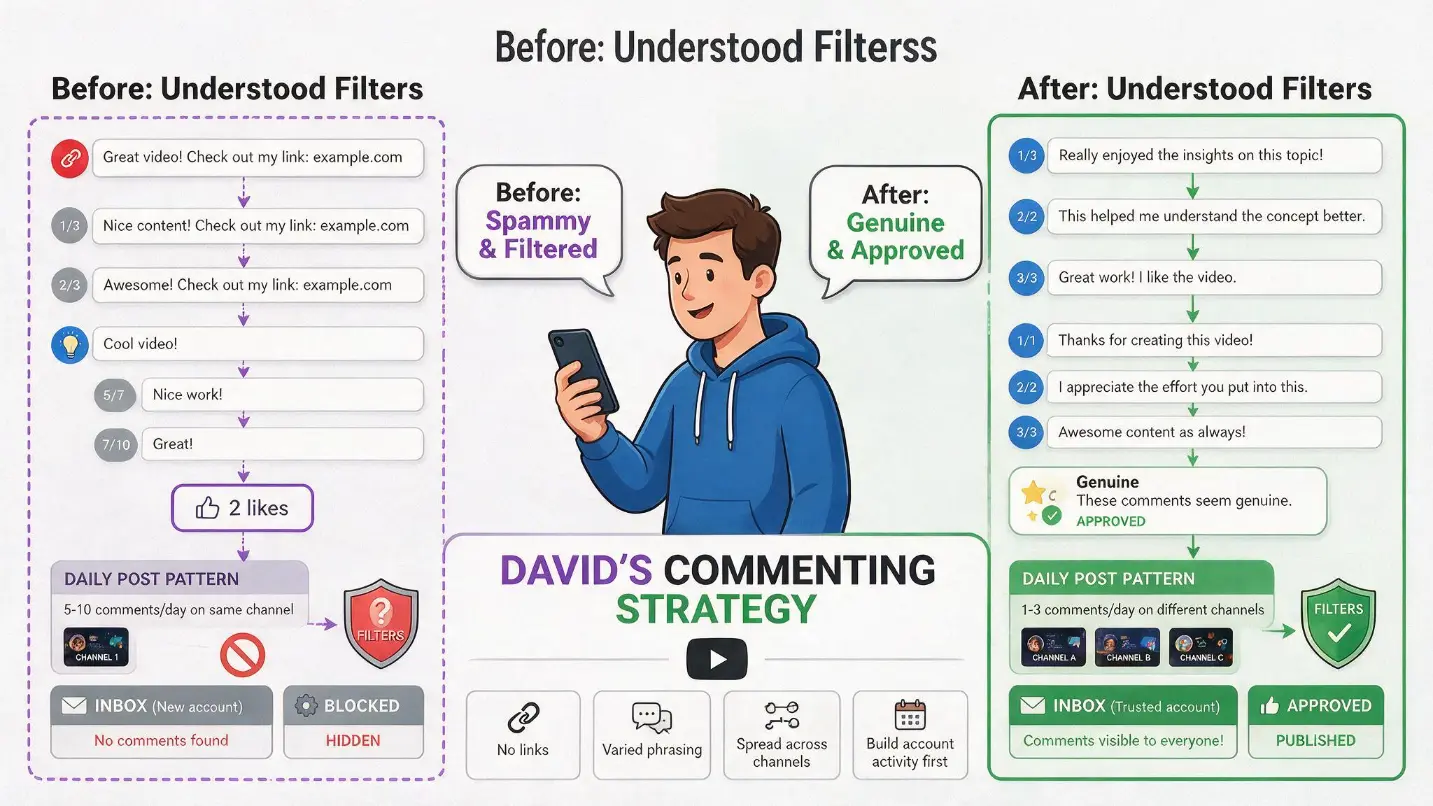
1–5 comments per day is normal YouTube commenting behaviour. 10+ comments per day, especially concentrated on a single channel, looks bot-like to automated systems. The fix is simple: spread your engagement across multiple channels and limit daily comment volume to what a genuine viewer would naturally leave.
Myths — Things That Won't Actually Cause Deletion
The internet is full of YouTube comment deletion misinformation. Here's what's actually false.
Despite many conspiracy theories, YouTube does not have a political bias in comment removal. They don't remove opinions.
YouTube's automated filters only remove comments that match patterns associated with violations of Community Guidelines — spam, harassment, explicit content. Your political opinion isn't in the filter logic.
No specific word list is a guaranteed trigger for deletion (except in extreme cases of slurs, threats, etc.).
It's context and pattern, not individual words. The same word in a natural conversational comment behaves completely differently to that word in a comment with links, repetition, and promotional language.
Deleting comments has more to do with account age and behaviour patterns than channel size.
The size of the channel you're commenting on doesn't affect whether your comment stays. What affects it is your account's age, history, and the pattern of your behaviour — not the size of the creator you're engaging with.
Comments removed by YouTube's system are gone permanently.
Once removed they're gone. There's no way to retrieve them. If a creator manually approved a held comment before deletion it may persist — but this is rare. Move forward with better-formatted comments rather than trying to recover old ones.
YouTube is not targeting any particular creator's comments section or individual users.
Rules are applied equally by an automated system. There is no individual comment-level targeting. The system sees patterns, not people — which is why understanding the patterns is the only lever you actually have.
How to Fix It — Step by Step
Read Your Recent Comments for Patterns
Go through your last 10–20 comments and observe the trends honestly. Ask yourself:
- Are you adding links to every post?
- Do your comments stay the same from video to video?
- Are you over-commenting on one channel?
- Are you using ALL CAPS or too many exclamation points?
- Is this a newer account with limited history?
Change Your Approach Based on the Diagnosis
Address whatever pattern you identified in Step 1:
- If you've been adding links: remove links from comments entirely, or include one only if genuinely necessary
- If you've been repetitive: vary your comment format meaningfully from video to video
- If you've been commenting too often: reduce to max 1–3 per video and spread across different channels
- If you've been using caps or excessive emojis: switch to standard capitalisation and natural conversational language
- If you're on a new account: spend a week or two watching videos and liking content before heavy commenting
Try Again — But Differently
Post 5–10 comments using your adjusted approach, following the guidelines above. Use human voice, reference specific video content, avoid links, vary the format. Then check if they stay up after an hour, after a day. If yes: you found the problem. If not: there may be a different underlying issue to investigate.
If It Still Happens — Check Whether It's the Creator, Not YouTube
Some creators have aggressive comment moderation independent of YouTube's system. How to tell the difference:
- Post a very plain, conservative test comment with no links and simple phrasing
- If it shows as [Deleted] rather than disappearing: likely a creator filter, not YouTube's system
- If a creator's filter is blocking you: you can try a different comment style, ask the creator directly, or engage with their other videos instead
- Creator moderation is their right — there's nothing to appeal
GTR Socials Perspective: Engagement Means Understanding Systems
At GTR Socials, we work with a lot of creators who are frustrated by comment deletion — particularly creators trying to build community through YouTube comments. Comment deletion is real, but so is the path around it.
What we know: comments are deleted regularly and most deletions are not personal — they're automated. Patterns matter more than individual comments. New accounts are placed under a stricter microscope. And links are the single biggest red flag in comment sections.
How it happens: YouTube's system is deliberately over-cautious. It will delete innocent comments as false positives rather than risk letting genuine spam through. This environment was created by years of actual spammers, not by YouTube targeting you specifically.
YouTube comments are the lifeblood of community engagement on the platform — but they're also a high-churn environment with no persistence guarantees. For building a core community you can actually own and retain, Discord and email lists are far more stable. Use YouTube comments as bonus engagement, not as the foundation for your community infrastructure.
YouTube comments engagement is valuable but fragile. Build your core community through Discord and email lists where you control the environment. Treat YouTube comments as the bonus engagement that amplifies your presence on the platform — not as the foundation. Stop blaming YouTube for "suppressing" you. Start learning how their filters actually work, adjust accordingly, and your comments will stay visible.
Your Comment Strategy Action Plan
Understand What's Actually Happening
Goal: identify the specific pattern causing your comment deletions.
- Review your last 10–20 comments that were deleted
- Look for the patterns — links, repetition, excessive caps, high frequency
- Check your account age and comment history
- Check how frequently you've been commenting on the same channels
Change Your Approach
Goal: implement the specific fix for the pattern you identified.
- Remove links from your comments entirely where possible
- Vary the format and wording across different videos
- Reduce frequency if it's been too high — aim for 1–3 per video
- Switch to natural conversational tone and standard punctuation
Post 5–10 Comments With the New Approach
Goal: confirm whether the pattern change resolved the deletion problem.
- Post 5–10 comments using the adjusted format across different channels
- Check each comment after an hour and after 24 hours
- If they stay: you've identified and fixed the problem
- If they still get deleted: investigate whether it's a creator filter rather than YouTube's system
Maintain the Effective Approach
Goal: build a sustainable long-term commenting habit that stays visible.
- Keep using the new approach consistently
- Engage carefully — quality over quantity, always
- Build your core community via email or Discord where you control the environment
- Treat YouTube comments as bonus engagement rather than community foundation
FAQ: YouTube Comment Deletion
Final Thoughts: Comment Deletion Isn't Personal
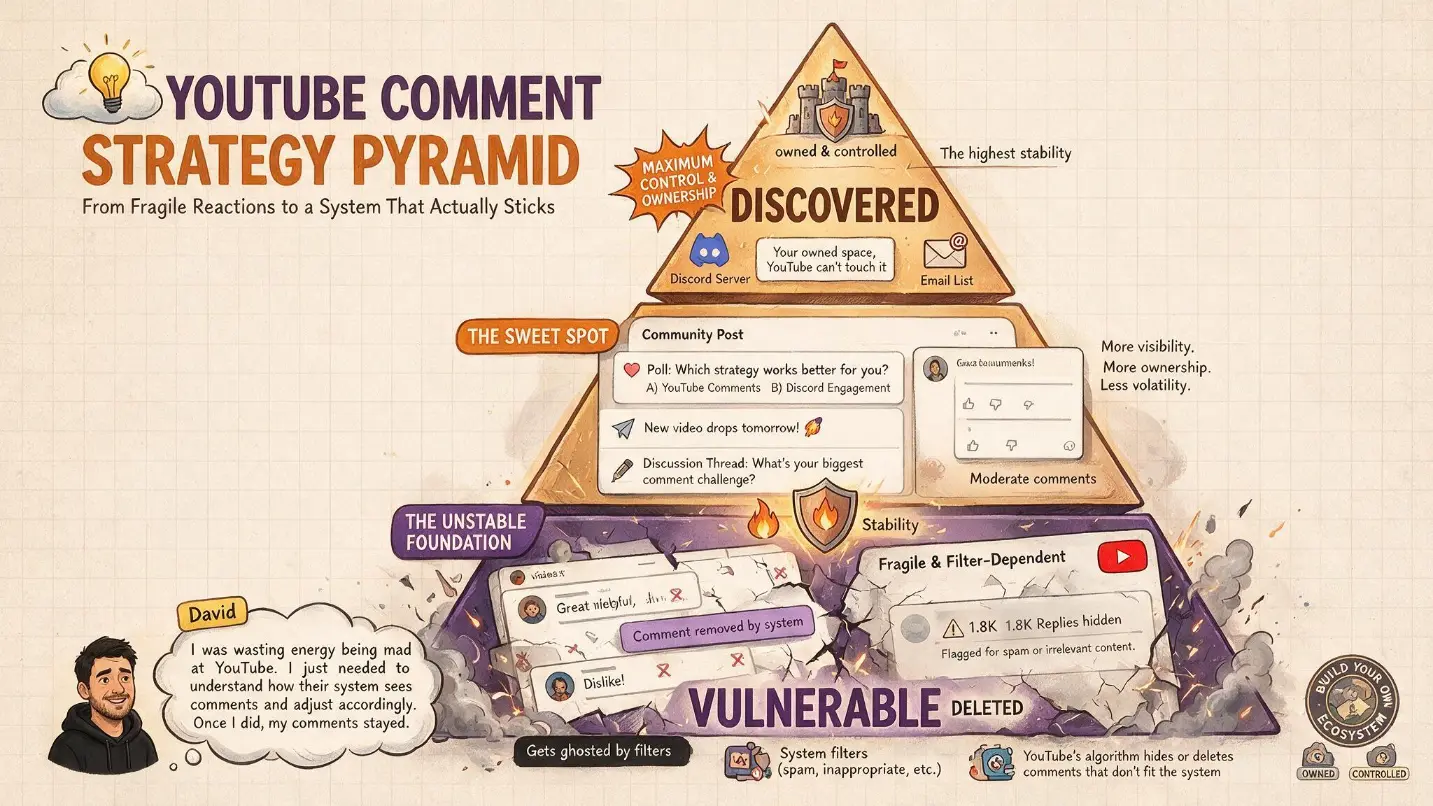
David, who thought YouTube was censoring his comments but it was merely automated spam filters, told me: "I was wasting energy being mad at YouTube. Really, I just needed to understand how their system sees comments and adjust accordingly. Once I did, my comments stayed." That's the honest truth about YouTube comment deletion.
YouTube comment deletion is annoying — and real. But it's usually not personal. It's not political. It's automated. It's triggered by patterns, not individual comments. And it's preventable once you understand how the system works. What works: conversational natural style, comments specific to the video, few or no links, varied format, sensible frequency, established account history. What doesn't work: spammy patterns, links in every comment, identical comments repeated, too many caps and emojis, promotional voice, bot-like behaviour. Stop blaming YouTube for suppressing you. Start learning how their filters actually work. Adjust your strategy. Your comments will stay visible.
▶️ Build the YouTube Presence That Commands Comment Engagement
GTR Socials helps YouTube creators build the views, likes, and subscribers that establish your account's authority — the foundation that makes your YouTube comments count and your community presence credible.