

Priya's sustainable fashion brand went from 8,000–12,000 impressions to 1,500–3,000 overnight. Same content, same posting times, completely different results. She was ready to quit Instagram. Three weeks of targeted fixes later, her reach was back — and the cause was subtle but completely fixable.
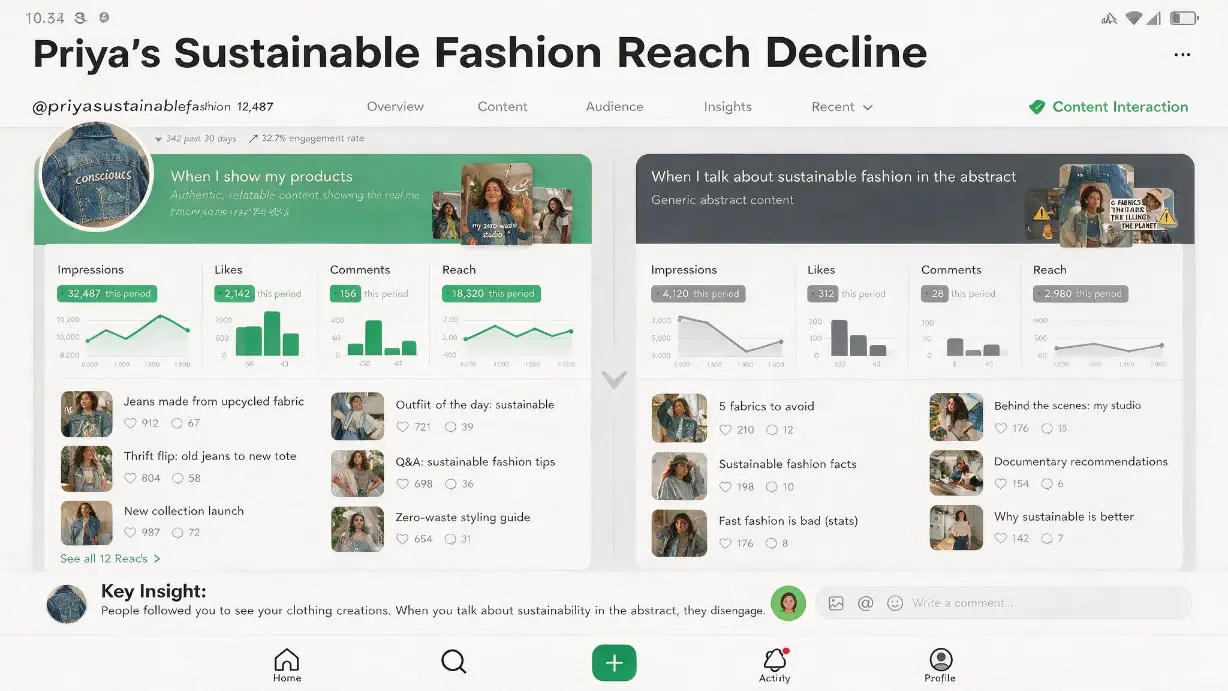
Five weeks ago, I watched live as an Instagram reach implosion happened to a small business owner named Priya.
Her sustainable fashion brand had 12,500 followers — not a huge following, but engaged. She had been posting regularly for two years. Quality content. Genuinely interested audience. People were actually commenting on her posts. Then something changed. Likes declined from 600–900 to 150–300. Comments dropped from 40–60 per post to 8–15. Reach fell from 8,000–12,000 impressions to 1,500–3,000. Same content. Same posting times. Different endings.
"Did I screw up?" she asked me, genuinely concerned. "Did Instagram change the algorithm? Am I being shadowbanned? Is my account dying?" She started looking for answers immediately. Found stories about Instagram "killing small accounts." Found theories about engagement pods being busted. Found people swearing the algorithm was "broken" and unfairly favoring big creators. She was ready to throw in the towel on Instagram.
Drops in Instagram reach are real, but not for the reasons most people think. The algorithm didn't turn on you all of a sudden. Your account wasn't flagged. Instagram is not systematically suppressing small creators. What happened is probably one of a few identifiable, fixable causes — and once you know which one, you can fix it.
We found what was really wrong with her — and it was subtle but fixable. Her reach was back in three weeks of careful tweaks. "I was ready to quit Instagram because I felt like it was against me," she told me later. "But it was simply me not realizing my content strategy had drifted. Once I fixed it, it all came flooding back."
What Is Reach on Instagram — How It Really Works
You can't diagnose problems until you understand what drives reach.
Instagram reach is the number of unique accounts that see your post — not the total number of views. One person seeing your post multiple times still counts as one reach. Reach is different from impressions (where every single view counts). Your Insights shows both metrics, but reach is the more meaningful indicator of actual audience size.
How Instagram Decides Who to Show Your Post To
Initial Distribution
First hour: shown to a small % of followers. Algorithm measures likes, comments, saves, and watch time.
Algorithm Evaluates
If engagement is strong: distribution increases. If engagement is weak: algorithm stops expanding. Usually 2–3 hours.
Secondary Distribution
If test phase passed: shown to non-followers. Potentially Explore page. Suggested for similar accounts. Reach grows substantially.
Content Lifecycle
Peak reach 24–48 hours after posting. Fades slowly over following days. Some posts revive if they keep receiving engagement.
Your reach is almost entirely dependent on whether the initial test audience engages with your post in the first few hours. This is why the first hour of posting is critical — and why content quality matters far more than posting time, hashtags, or any other secondary factor.
What Instagram Values — In Order of Priority
Saves matter most. Shares are very valuable. Comments are useful. Likes still matter but carry the least weight. Especially valuable: likes, comments, and shares from high-engagement accounts.
How far through the video viewers watch, the percentage of the video viewed, replays, and whether viewers drop off early or watch to the end.
Comments that get replied to, genuine back-and-forth exchanges, shares to close friends (a high-trust signal), and content saved to collections.
How consistently you post, engagement patterns on prior posts, account age and activity level, and follower growth trends over time.
Newer posts get a slight preference, but older posts can still reach wide audiences if they continue receiving engagement. Timing matters less than most people believe.
The Real Reasons Your Reach Is Dropping
Before blaming the algorithm, check these actual causes. One of these is almost certainly the real explanation.
Fall in Content Quality — The Most Common Cause
Your latest posts are not performing as well as your older posts — and the algorithm is measuring this directly. What causes it: you changed niche or topic, the content wasn't as refined, your genuine interest in the subject faded, you started copying trends rather than creating authentic content, or captions became less compelling.
What it looks like: old posts still getting 600+ likes while new posts get 150–300. A clear before/after marker where you can identify when the drop started.
Priya's problem: she had moved away from showing products to talking about sustainable fashion in the abstract. Less visual value. Less audience involvement. Lower reach.
The Audience's Tastes Have Changed
Your followers are interested in something different now. Your niche has shifted, your followers' interests have evolved, or you're creating content for an audience that used to exist rather than the one that exists today. The algorithm detects this mismatch and limits distribution.
What it looks like: same quality content, fewer interactions. Some posts get views and others don't. Comments hint at wanting different content. Followers haven't left — they've just drifted.
Posting Frequency Problems
- 5+ posts per day looks like spam
- Algorithm punishes this behaviour
- Followers get overwhelmed
- Engagement gets spread too thin
- Less than weekly → algorithm forgets you
- Profile no longer visible to followers
- Inconsistency loses momentum
- Hard to rebuild after long gaps
Decline in Engagement Quality
People see your posts but don't interact with them. Captions got less interesting, there are no calls to action, content is less conversational, less value and more marketing. The algorithm reads declining engagement rates and reduces distribution accordingly.
Hashtag Strategy Has Changed or Failed
Hashtags don't matter as much as most people think — but they do matter. What hurts: completely irrelevant hashtags, using only dead or low-search hashtags, using banned hashtags (Instagram limits content using these), or abandoning hashtags cold turkey. What doesn't meaningfully hurt: 30 hashtags vs. 15, popular vs. niche hashtags, caption vs. comment placement.
Algorithm Changes — Exaggerated but Real
Instagram does genuinely update its algorithm periodically — modifying post ordering, shifting weight across different signals, and changing what counts as meaningful engagement. Recent changes (2025–2026): more emphasis on saves and shares and less on likes, Reels outperforming static posts, quality of engagement weighed more heavily than quantity, and the first hour after posting becoming even more critical.
Account Limitations or Problems (Rare)
Possible but uncommon: shadowban for breaking rules, a hacked account with suspicious activity, inappropriate content flagged, or spam-like activity detected. How to tell: check if posts show up in hashtag searches, review recent warnings or violations, check for any unusual account activity, and test a single post to see how far reach travels.
Too Many Competitors in Your Niche
Your niche has become more competitive. More creators have entered the space, the algorithm has more accounts to choose from, and your content is no longer differentiated enough to consistently win the distribution slot.
How to Diagnose Your Specific Problem
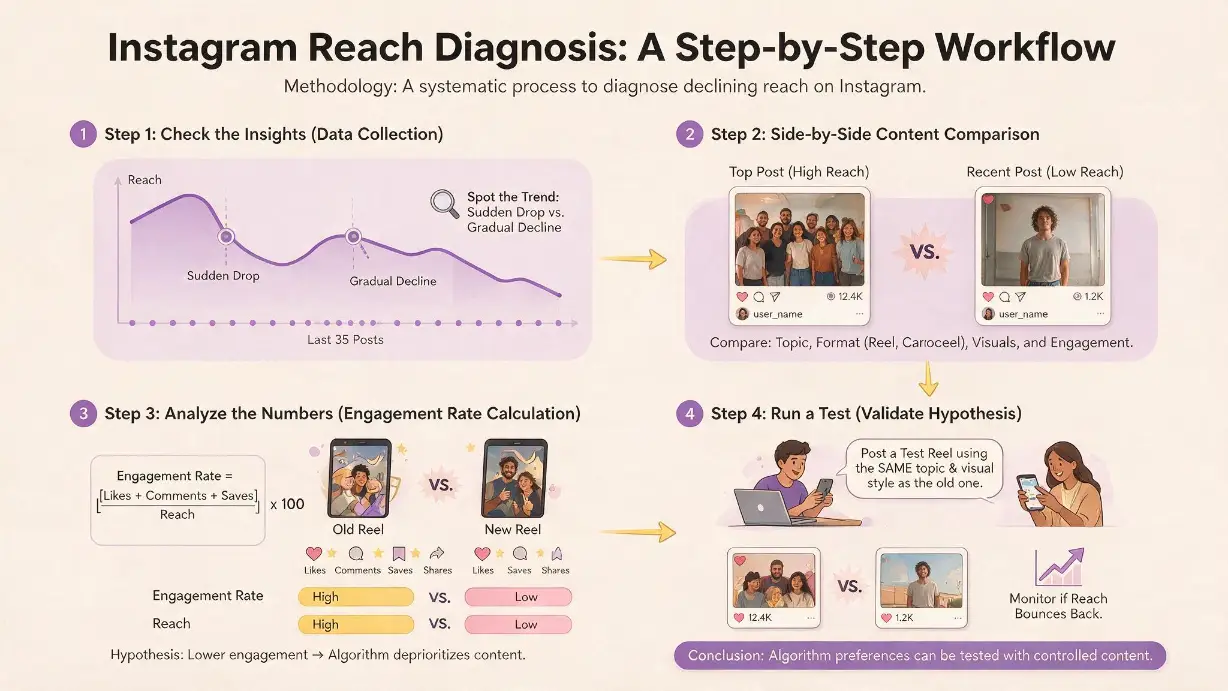
Check Your Analytics — Find When the Drop Started
Open Instagram Insights and look at the last 35 posts. Note average reach per post. Determine whether it happened suddenly on a specific date (something specific happened) or gradually over weeks (content or strategy drifted). Inconsistent performance where some posts do well and others don't usually indicates content quality variation rather than a blanket algorithm issue.
Content Comparison — Old vs. New Side by Side
Pull up three posts from 3–6 months ago when reach was high. Compare them directly to your recent posts with low reach. Look specifically at: topic and niche, image or video quality, caption style and length, how often you were posting, and the type of engagement each generated. Whatever changed between those two sets of posts is most likely your problem.
Check Your Engagement Rate
Engagement rate formula: (Likes + Comments) ÷ Reach. Compare old posts (target: 3–5% engagement rate) to new posts (likely lower). If engagement rate is much lower: content quality issue — your content isn't resonating with viewers. If engagement rate is similar but reach is down: more likely an algorithm change or distribution issue rather than a content problem.
Test Your Fix Hypothesis
If you think it's a content quality problem: post 3 higher-quality posts and measure reach on each. If reach improves, content was the issue. If you think it's an algorithm change: try Reels instead of static photos and track reach. If Reels perform significantly better, that confirms an algorithm shift. If you think the audience has changed: analyse comments on recent posts, create content based on what people are asking for, and see if engagement improves.
Solutions — Fixes for Every Cause
Fix Content Quality
Immediately: objectively evaluate your last 10 posts, identify why older successful posts worked, and return to that equation. Ongoing investment:
- Invest in better photos or video production
- Improve caption value — give people a genuine reason to read the whole thing
- Use real calls to action (not just "follow for more")
- Generate genuine value that makes saving the post feel worthwhile
Fix Audience Alignment
Discover what your current audience actually wants — not what they used to want. Review your top-performing posts for reach and engagement. Read comments carefully for signals about what people are looking for. Ask directly via Stories polls or question boxes. Then double down on what resonates and preserve posting frequency while shifting content direction.
Fix Posting Frequency
If posting too much: reduce to a maximum of 1–2 per day, return to a normal consistent schedule, and remember that quality is more important than volume. If posting too infrequently: build up to 3–5 times per week minimum, aim for one post per day as a baseline, and prioritise consistency over sporadic high-volume periods.
Boost Engagement Quality
Caption improvements:
- Ask genuine questions that spark real desire to respond
- Share personal stories that create authentic human connection
- Offer value that people want to save (tips, insights, actionable information)
- Include clear, specific calls to action — not vague asks
- Respond to every comment, ideally within the first hour after posting
Optimise Your Hashtag Strategy
Research hashtags properly: search each one on Instagram, note post volume, and choose a strategic mix of popular (1M+ posts) and niche (10K–100K posts) tags. Ensure every hashtag is directly relevant to the specific content. Check if any hashtags are currently banned. Test different hashtag combinations across posts and keep what performs best.
Adapt to Algorithm Changes
Adapt your content format to match what the current algorithm rewards:
- Post Reels alongside static images — Instagram is actively pushing video content
- Optimise content specifically to earn saves and shares, not just likes
- Use captions that prompt genuine comments (not one-word replies)
- Be actively present in comments in the first hour after posting — this engagement loop signals quality to the algorithm
What Doesn't Cause Reach Loss — Myths Debunked
Instagram's algorithm doesn't discriminate against small accounts. It ranks posts on a post-by-post basis, not based on account size.
Small accounts get blown up to millions of views regularly. Large accounts lose reach equally often. The algorithm doesn't care about your follower count — it cares about how each individual post performs with its initial test audience.
30 hashtags versus 15 doesn't make a meaningful difference to reach.
Relevance matters far more than quantity. Fifteen irrelevant hashtags performs worse than five perfectly relevant ones. The number is not the variable that matters — the accuracy of your targeting is.
Posting time affects how visible a post is to your existing followers in the first hour but doesn't permanently damage your reach.
Content quality is overwhelmingly the most important factor. Posting time is a secondary variable. Post when you can produce your best content — don't sacrifice quality to hit an "optimal" posting window.
Somewhat true — the algorithm does change. But those changes apply to everyone equally, not to your account specifically.
The current algorithm favours Reels, engagement quality, and saves/shares. These changes apply universally. Adapt to them the same way you'd adapt to any platform evolution — adjust the content, don't blame the platform.
Disappearing and reappearing doesn't reset anything in the algorithm.
Consistency is what keeps the algorithm interested in distributing your content. Posting frequently keeps your account in the algorithm's regular rotation. A break makes you less visible, not more.
GTR Socials Perspective: Declining Reach Is a Signal, Not a Punishment
At GTR Socials, reach loss is the most common problem we work through with frustrated creators. The reach drop is real — the reasons most creators think are causing it usually aren't.
What we know: reach drops are usually fixable. Content quality is the primary driver in the overwhelming majority of cases. The algorithm has grown more complex over time, not more hostile. Small accounts can and do build huge audiences. But you have to adapt as the platform evolves.
Why it happens: creators change direction without realising it. Audience requirements evolve. The algorithm starts favouring different signals over time. Niches become more competitive as more creators enter the space.
Building strategic reach can jumpstart recovery when your content quality is genuinely good but your algorithmic confidence needs rebuilding. Growth services help bring initial visibility that kickstarts the algorithm's test-and-expand cycle. But they're not a replacement for better content — and they won't help if the underlying content quality problem hasn't been fixed first.
Drops in reach are feedback. There's a message in the system. Fix the core problem — content quality, strategy, frequency — and the reach will return. The formula is: diagnose, adjust, test, refine, be consistent. Don't blame the algorithm. Start reviewing your content and strategy with fresh eyes. Drops are feedback, not punishment. Take the feedback seriously and adapt.
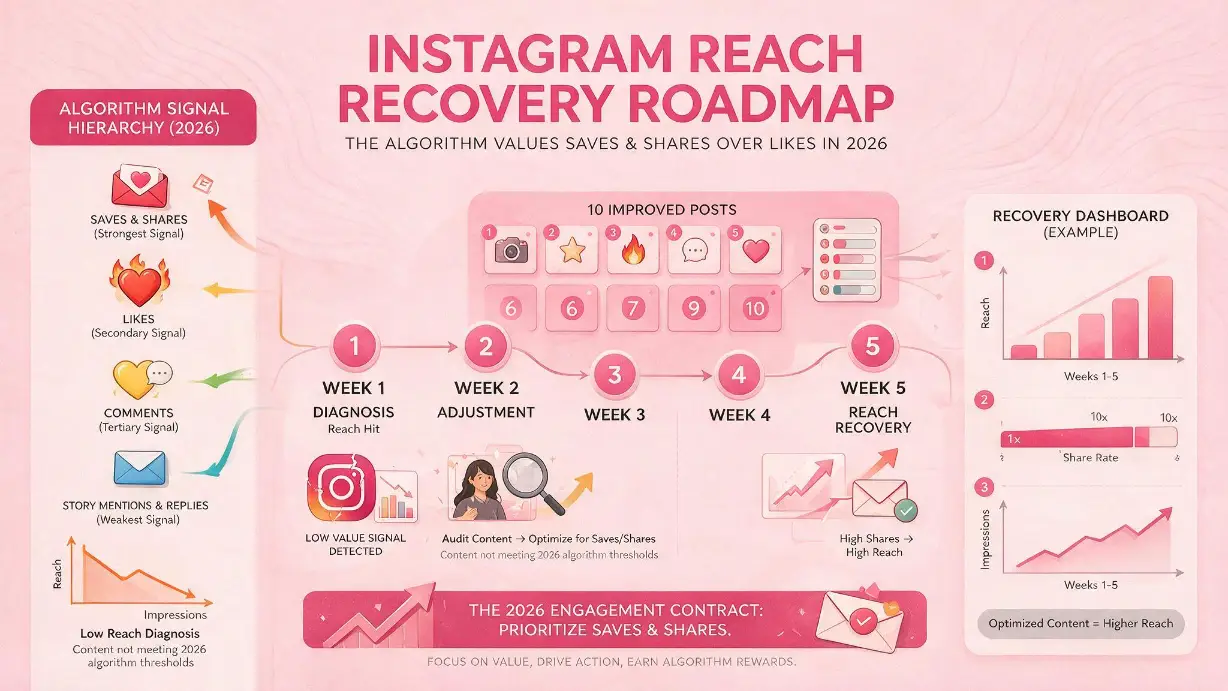
Your Recovery Action Plan — Week by Week
Understand What Actually Caused the Drop
Goal: identify the specific cause before attempting any fix.
- Find the drop start date in your analytics
- Compare old content versus new content side by side
- Review engagement metrics across your last 35 posts
- Determine the probable cause: content quality? frequency? algorithm shift? audience drift?
Apply the Targeted Fix
Goal: address the specific cause identified in Week 1.
- Enhance content quality based on what made your best posts successful
- Return to a regular, consistent posting schedule
- Add genuine CTAs to captions that prompt saves, shares, and comments
- Start posting Reels if you haven't been doing so
- Optimise your hashtag strategy with the research-based approach above
Post 5–10 Improved Posts and Track Results
Goal: validate whether the strategy change is working.
- Post 5–10 posts using the improved strategy
- Track reach and engagement on every post
- Double down on what's showing improvement
- Refine anything that still isn't working
- Maintain posting consistency throughout — don't stop to wait
Consolidate and Continue Improving
Goal: reach should be recovering — now build on the improvement.
- Reach should be starting to recover by now
- Adapt strategy based on what the data is telling you
- Stay consistent — the algorithm rewards sustained quality, not one-off improvements
- Continue testing and learning every week
FAQ: Instagram Reach Is Going Down
Final Thoughts: Reach Loss Is Fixable
Priya, the one who almost quit Instagram when her reach dropped, told me once she identified the real problem: "I learned that reach isn't random. It's feedback. When it dropped, Instagram was telling me something had changed. I listened and fixed it."
That's the real story on reach drops. What actually causes them: content quality changes, shifting audience tastes, posting frequency issues, declining engagement quality, and algorithm tuning (not individual targeting). What doesn't cause them: hashtags, posting time, random account suppression, follower count, or Instagram specifically targeting your account.
Diagnose → Adjust → Test → Refine → Consistency. Don't blame the algorithm. Start reviewing your content and strategy. Drops are feedback, not punishment. Take the feedback seriously, adapt accordingly, and your reach will come back. The algorithm is not your enemy — it's a reflection of how your audience is responding to your content. Improve what you give it to reflect.
Priya's Full Results: What the Three-Week Fix Actually Produced
❌ Before — At the Point of Quitting Instagram
✅ After — Three Weeks of Targeted Fixes
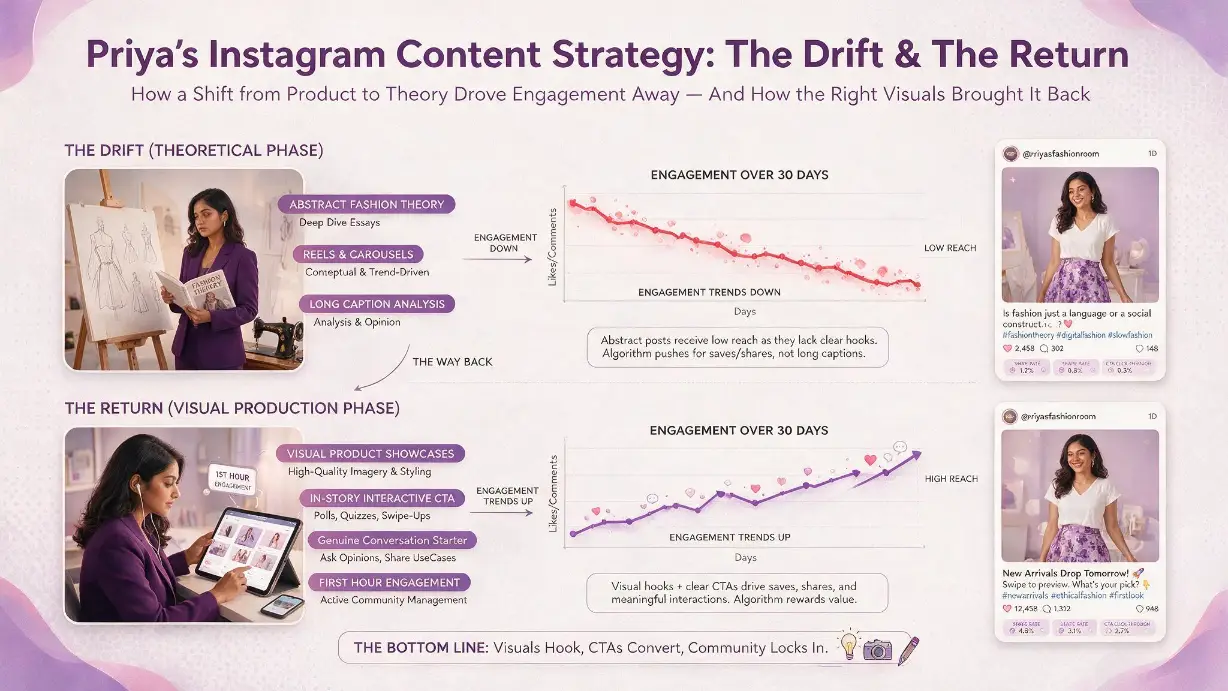
The real lesson from Priya's recovery is the same one that applies to almost every reach drop: the algorithm isn't your enemy. It's a reflection of what your audience is telling it through their behaviour. When reach drops, the system is showing you something changed — either in your content, your audience's preferences, or the competitive landscape. Listen to it. Fix the underlying thing. The reach comes back.
📸 Give Your Instagram Recovery the Momentum It Needs
GTR Socials helps Instagram creators rebuild algorithmic confidence with real followers, likes, saves, and comments — the genuine engagement signals that help quality content pass Instagram's test-and-expand threshold.
Comments (0)