

Somewhere between the fifth "like this post" caption and the twentieth hour of watching your engagement sit at eleven likes, most people on Instagram ask themselves the same question: would it just be easier to buy some? The question deserves an honest answer — not the usual extremes you'll find online.
Somewhere between the fifth "like this post" caption and the twentieth hour of watching your engagement sit at eleven likes, most people on Instagram ask themselves the same question: would it just be easier to buy some?
It's not a shameful thing to wonder. Every brand, creator, and small business account eventually stares at a post that took real effort and got almost no reaction, while a competitor's mediocre content somehow racks up hundreds of likes overnight. So the question deserves an honest answer instead of the usual extremes you'll find online — either "it's a magic growth hack" or "it will get you banned instantly." Neither is quite true. Let's actually get into what's real.
Why Likes Still Matter to the Algorithm in 2026
First, the basics — because you can't answer "does it work" without understanding what a like is actually doing behind the scenes.
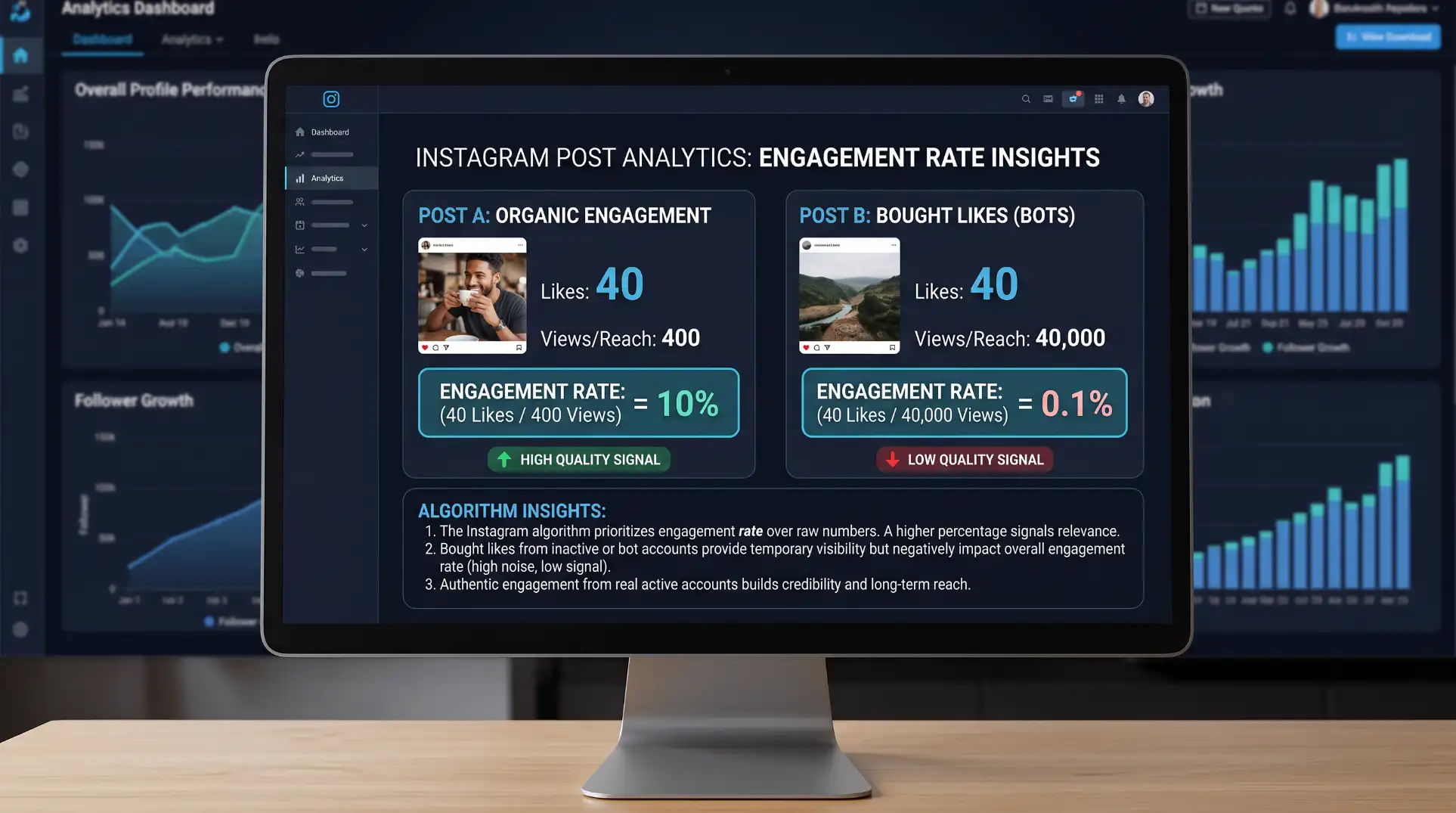
Instagram doesn't run one algorithm anymore. It runs several — separate ranking systems for Feed, Reels, Stories, and Explore, each weighing signals a little differently. But across all of them, engagement rate is treated as a ratio, not a raw number. The system is essentially asking: out of everyone who saw this post, what percentage reacted to it? A post with 40 likes from 400 views is read completely differently than a post with 40 likes from 40,000 views, even though the like count is identical.
Small Test Audience First
New post shown to a limited group — a slice of your existing followers and similar accounts
Algorithm Evaluates Response
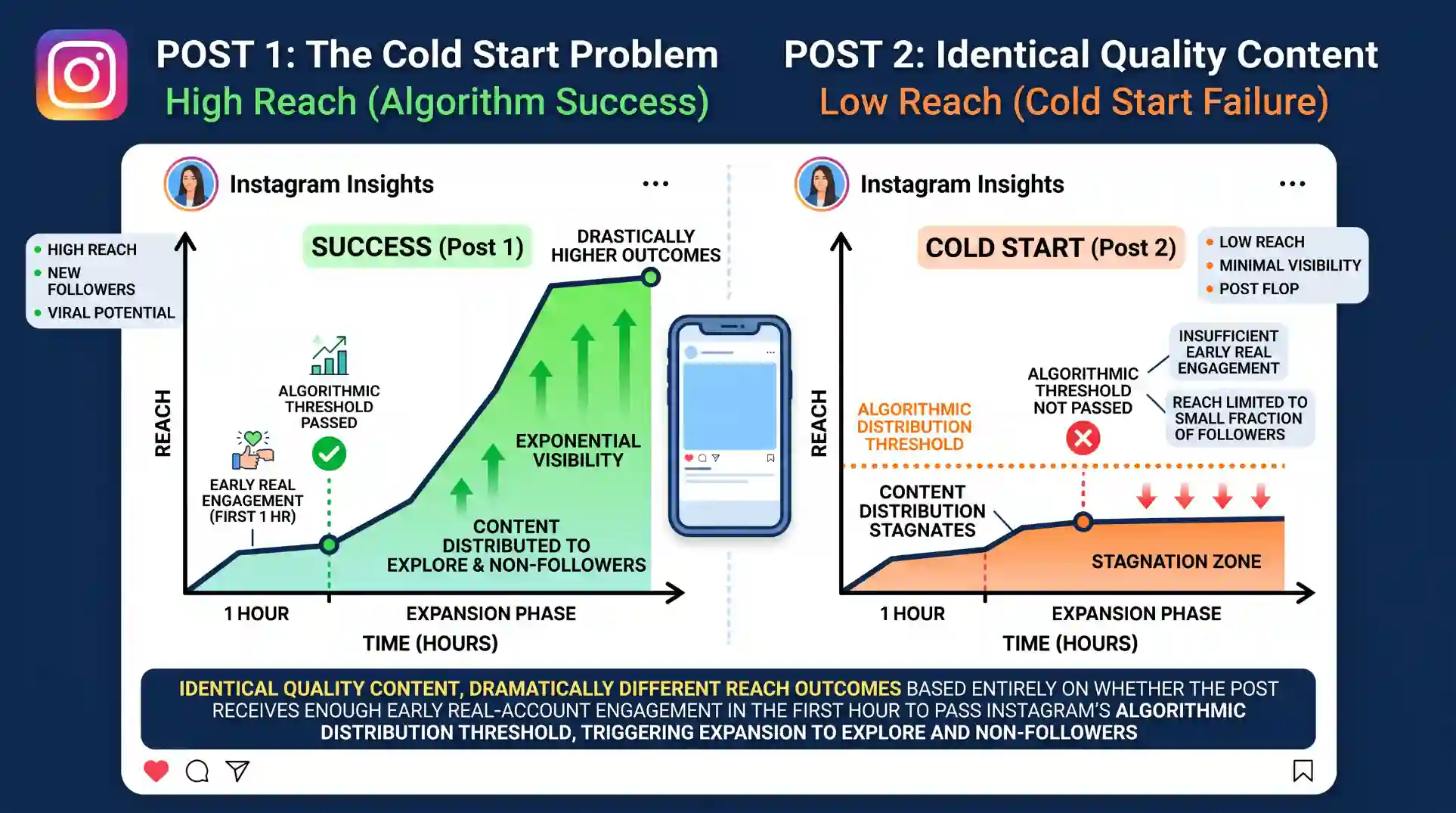
Usually within the first hour or so — how did that group react? Strong early signals expand reach; weak ones bury the post
Wider Distribution — or Not
Pass the gate and the post goes wider — Feed, Explore, Reels. Fail it and the post quietly stops travelling
That's the part people miss when they think about buying likes. It's not really the number itself Instagram cares about — it's what that number implies about how a real audience responded. Early engagement carries outsized weight: strong early signals can meaningfully expand a post's reach; weak ones tend to get it quietly buried. This is exactly why the tactic exists at all — if you can influence what happens in that first hour, you can influence how far the post travels afterward.
So Does It Actually Work?
Here's the honest, unsatisfying-but-true answer: it depends entirely on what you're buying and why.
"It depends entirely on what you're buying and why. The honest answer has nothing to do with the number of likes — it has everything to do with the quality of the accounts behind them."
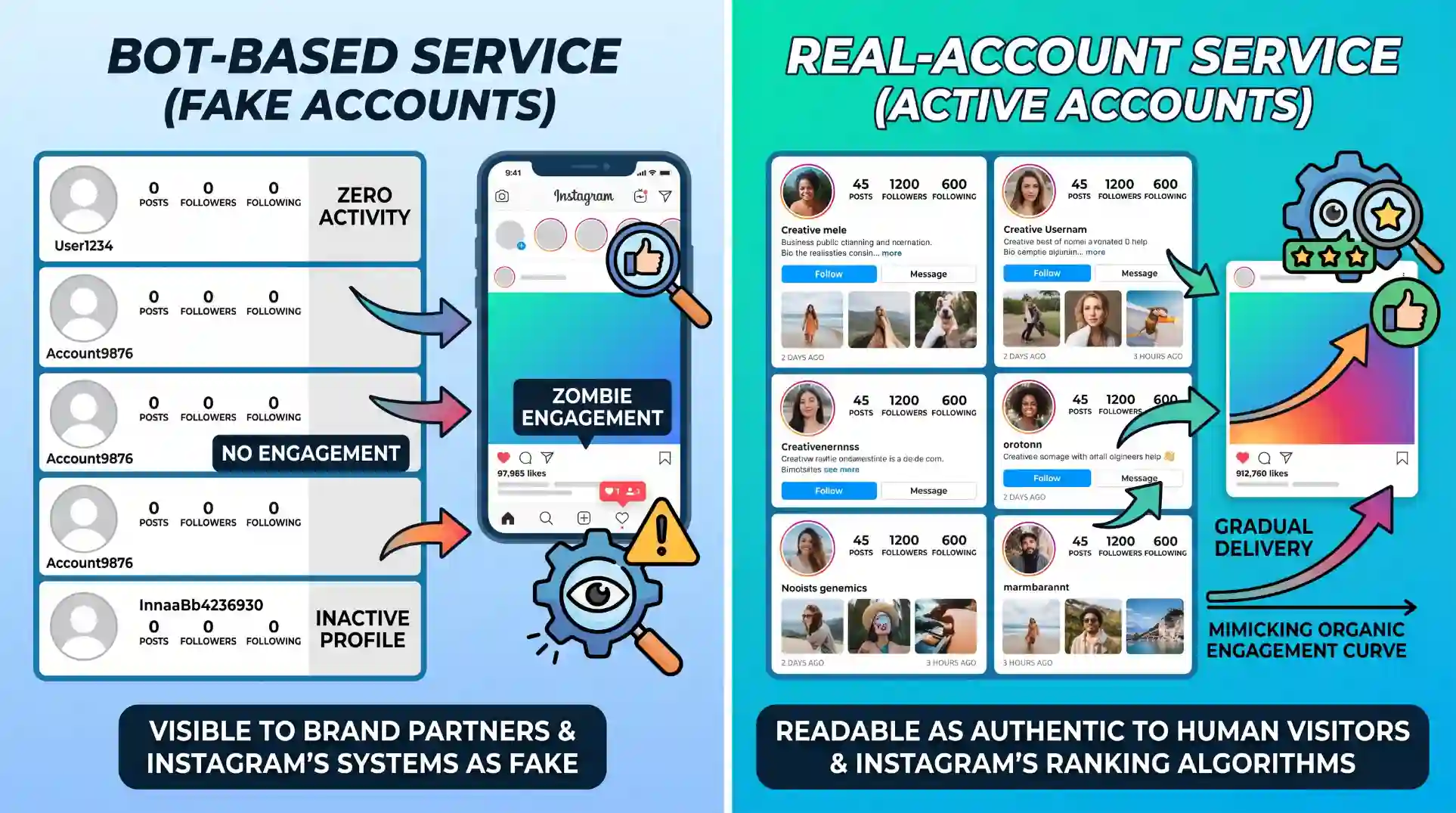
If you're buying a stack of likes from bot accounts — the kind with no profile picture, no posts, no real activity — you're not sending a positive signal to the algorithm. You're adding noise to your engagement ratio without adding anything that looks like genuine interest, since Instagram's systems are specifically built to recognise inactive, templated, or clearly automated accounts. In the worst cases, a flood of obviously fake engagement can actually work against you, dragging down the overall quality signal on your profile rather than lifting it.
If, on the other hand, you're using a service that delivers likes from real, active accounts, paced out gradually rather than dumped all at once, the picture changes. That kind of engagement behaves much more like the early social proof Instagram is designed to reward: a signal that real people found the post worth reacting to, at exactly the moment the algorithm is deciding whether to show it to more people.
It won't manufacture virality out of nothing, and it definitely won't rescue a post with no real substance behind it. But as a way to give a genuinely good post the initial push it needs to get a fair look from the algorithm — rather than dying in obscurity before anyone real ever sees it — it can absolutely do what it's meant to do.
Bots vs Real Accounts — The Only Comparison That Matters
🤖 Bot Likes — The Worst Option
- No profile pictures, no posts, no real activity
- Add noise to engagement ratio without improving it
- Instagram's systems specifically recognise these accounts
- Can drag down overall quality signal on your profile
- Obvious to anyone who looks closely at your likes
- "Zombie engagement" that means nothing to algorithm or humans
- Usually priced at rock-bottom ($0.01-$2 for thousands)
✅ Real Accounts — Legitimate Momentum Tool
- Active accounts with genuine post history and followers
- Contribute a real quality signal to the engagement ratio
- Delivered gradually — natural-looking engagement curve
- Behaves like the early social proof Instagram is built to reward
- Holds up to scrutiny from brand partners and savvy followers
- Gives genuinely good content the early momentum it deserves
- Priced fairly to reflect actual account quality
Rock-bottom "10,000 likes for $2" offers are the fastest way to end up with what the industry bluntly calls zombie engagement: accounts with no posts, no followers, no activity, sitting there doing nothing for your credibility and actively dragging your engagement ratio down. Anyone who looks closely at your likes — a potential brand partner, a savvy follower, or Instagram's own systems — can tell the difference almost instantly.
The Social Proof Effect — The Very Human Side of This
There's also a very human side to this that has nothing to do with algorithms. People judge a post by its social proof before they ever decide to engage with it themselves.
A post sitting at three likes reads as "nobody cared about this," even if it's genuinely good — and most scrollers won't stop to find out. A post with a healthy like count reads as "worth a second look." That perception effect is real, well documented, and it's a big part of why brands launching new products or accounts lean on this so heavily: the goal isn't to fool an algorithm, it's to stop a first-time visitor from scrolling past before they've even seen what you made.
"A post sitting at three likes reads as 'nobody cared about this,' even if it's genuinely good — and most scrollers won't stop to find out."
The social proof effect is a legitimate, well-researched psychological phenomenon — not a trick or a manipulation. People use visible engagement as a proxy for quality when they don't have time to evaluate the content itself. A post with healthy likes earns the extra second of attention that lets the content prove itself. That extra second is what early momentum is actually buying, and it's worth taking seriously on its own terms.
The Real Risk Isn't What Most People Think
The common warning is "you'll get banned." In practice, that's rarely the actual risk for someone buying a reasonable number of likes from a legitimate source. Instagram is far more focused on detecting and penalising large-scale bot networks and coordinated fake-account operations than it is on quietly flagging an individual creator who bought a moderate boost on a post.
Risk 1: Wasted money and a worse-looking profile. Rock-bottom bot likes do nothing useful and make your engagement quality look worse under any real scrutiny. The risk isn't a ban — it's that you've spent money making your profile look hollow.
Risk 2: Treating it as a replacement for content quality. Likes don't fix bad content, an inconsistent posting schedule, or a profile with nothing else going on. They amplify whatever is already there. Buy likes for a strong post from an active, well-maintained account, and you're giving genuinely good work a fair shot at being seen. Buy likes for a weak post on a dormant profile, and you'll get a number that looks slightly better and changes nothing else.
What Actually Matters If You're Going to Try It
If you're weighing this seriously, the difference between it working and it being a waste of money comes down to a few things.
Real, active accounts versus bot farms is the single biggest factor in whether this helps or hurts you. This is worth asking about directly before you buy anything — the quality of accounts behind the likes is more important than any other variable in the decision.
Engagement that trickles in gradually over hours reads far more naturally than a post that jumps from 12 likes to 2,000 in five minutes. Sudden, unnatural spikes are exactly the pattern that draws unwanted attention, whereas a natural-looking curve blends in with how real posts actually perform.
This only works as a kickstart on top of content you'd be proud of regardless. It's not a fix for low-effort posts, and it was never designed to be one. A likes boost on strong content gives it a fair shot at being seen. The same boost on weak content gives it a slightly more visible number — and nothing else.
This tool moves a post from "invisible" to "has a fair shot." It doesn't turn mediocre content into a viral hit, and any provider promising that outcome is telling you what you want to hear rather than what's true. Set expectations accurately and you'll evaluate the results accurately.
The Bigger Picture: This Is a Cold Start Problem
Step back from the likes question specifically and there's a broader pattern worth naming: new and growing Instagram accounts face a genuine chicken-and-egg problem.
The Instagram Cold Start Catch-22
Algorithm Favours Established Engagement
Shows content to more people when an account already demonstrates consistent engagement patterns
But You Can't Build Engagement Without Reach
You can't get the established engagement without the algorithm showing your content to people first
Result Without Early Momentum
Great content sits at a handful of likes for months — not because the content is weak, but because nothing gave it the initial push to escape the cold start
What Early Engagement Solves
A real-account likes boost gives strong content the initial signal it needs to pass the algorithm's early-engagement gate and travel further
Post great content into that gap and you can sit at a handful of likes for months, not because the content is weak, but because nothing has given it the initial push to escape the cold start. That's really the honest case for a service like this — not as a replacement for building a real audience, but as a way to get past the point where good content dies quietly before anyone sees it.
GTR Socials' Instagram likes service is built around exactly that gap: real-account engagement, delivered gradually, intended to give a strong post the early momentum it needs rather than to manufacture numbers that mean nothing. It's a spark for content that already deserves attention — not a substitute for making that content in the first place.
FAQ: Buying Instagram Likes in 2026
The Verdict
Buying Instagram likes in 2026 can work — within a clear and honest definition of "work"
It can help a genuinely good post get past the algorithm's early-engagement gate and past a visitor's first-glance judgment, provided the engagement comes from real accounts and is paired with content worth engaging with.
It cannot manufacture virality, cannot fix a weak post, and cannot replace the slower work of actually building an audience. It moves a post from "invisible" to "has a fair shot" — and that's a meaningful, real thing for creators and brands stuck in the cold start problem.
If you're going to try it, the source matters more than almost anything else — a well-run service using real, gradually-delivered engagement is a legitimate momentum tool. A bottom-dollar bot flood is money spent making your profile look worse under any real scrutiny. Know which one you're buying before you decide it "didn't work."
Before buying, ask: does this service use real active accounts or bot farms? Does it deliver gradually or all at once? Am I applying it to a strong post from an active account? And have I set realistic expectations — momentum tool, not virality guarantee? Answer yes to all four and you're doing it right. Fail any of them and the money goes to waste for a predictable reason.
GTR Socials Instagram Likes — Built for the Cold Start Gap
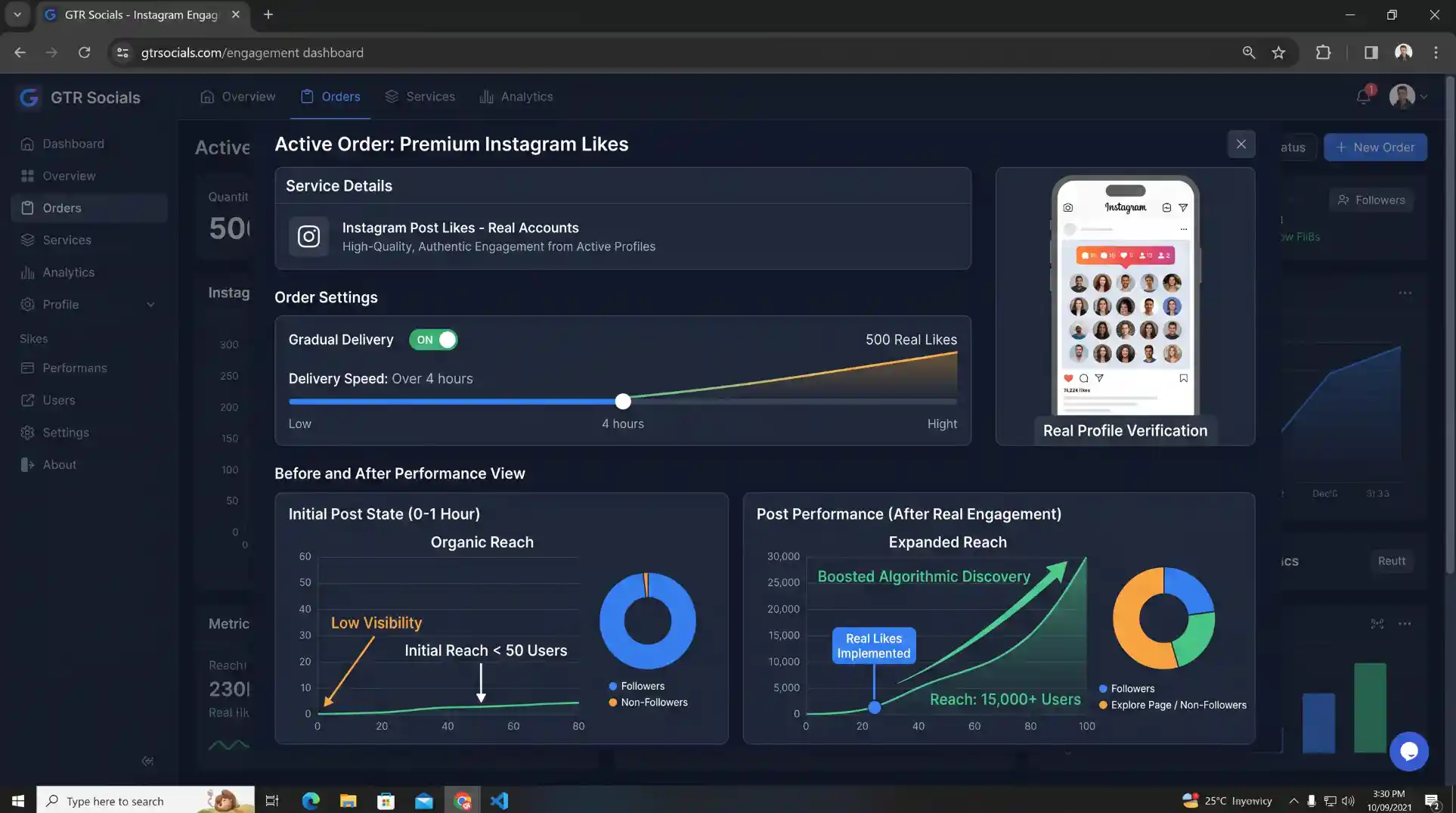
GTR Socials' Instagram likes service is built around the gap described throughout this guide. Real accounts. Gradual delivery. Intended to give a strong post the early momentum it needs to pass Instagram's algorithmic test — not to manufacture numbers that mean nothing, and not to rescue posts that wouldn't hold up on their own.
It's a spark for content that already deserves attention. Whether that's the right tool for where you are right now is a question worth thinking through honestly — but if you've read this far and the answer is yes, you know enough to evaluate any service you try with clear eyes.
❤️ Give Your Best Posts the Fair Shot They Deserve
GTR Socials Instagram likes — real accounts, gradual delivery, built for creators and brands with genuinely good content that needs the initial momentum to get past the algorithm's cold-start gate.
Comments (0)