

Marcus built 8,400 followers over six months, then watched his videos crash from 5K–15K views to 200–400 overnight. He was about to delete his account. His problem wasn't a shadowban at all — it was a content quality issue and algorithm testing. Two weeks later his views were back.
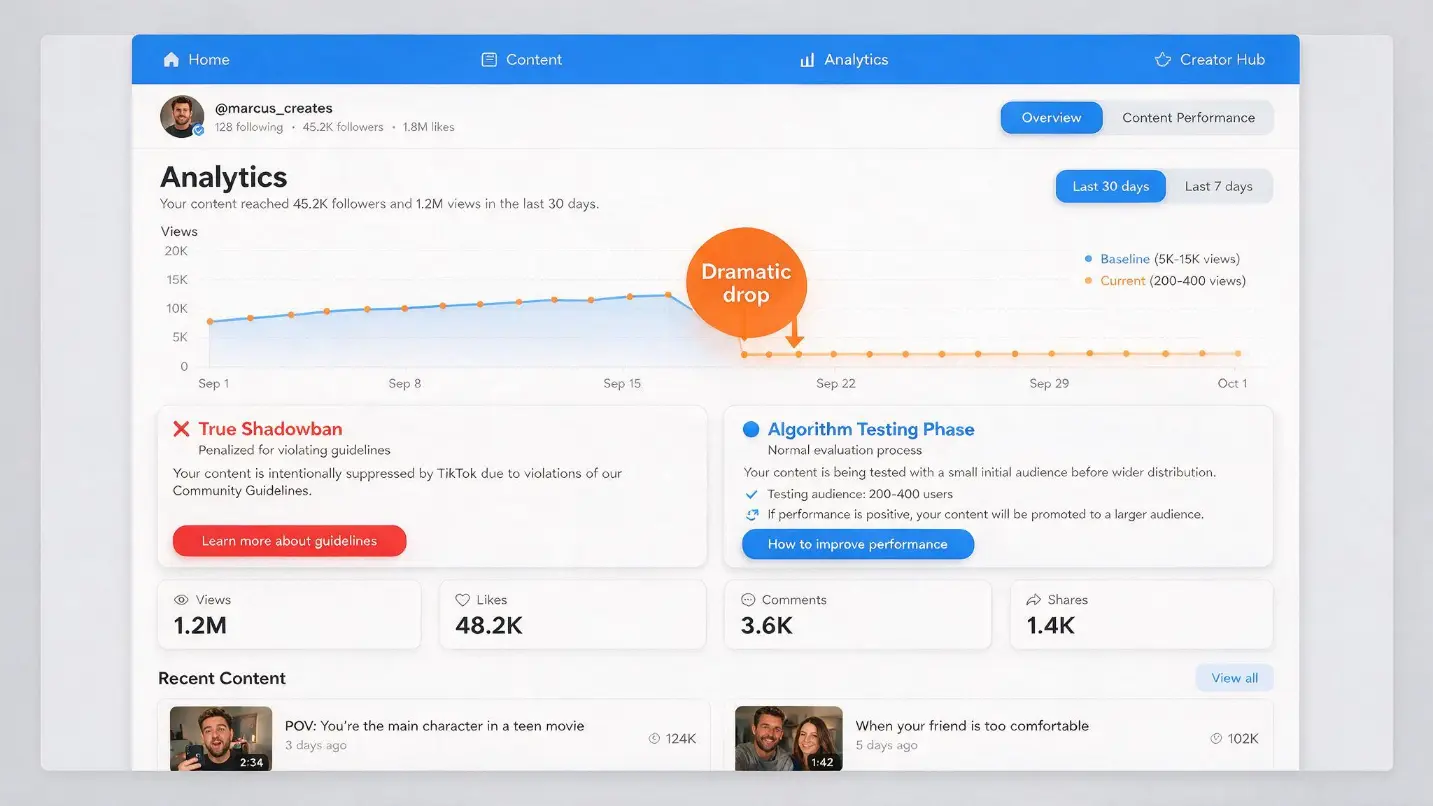
Three months ago, I watched my neighbour Marcus freak out when his TikTok videos stopped getting views.
He'd been posting consistently — three videos a week for six months — and had built up a following of 8,400 subscribers. Engagement was good. Comments were coming in. Videos getting 5K–15K views regularly. And then overnight it all changed. His new videos were getting 200–400 views apiece. Same content. Same posting schedule. Same work. His reach was now almost nil, and he didn't know what was wrong.
"I'm shadowbanned?" he asked me, panicked. "I've heard that's a thing. Is TikTok punishing me for something?" He'd immediately started looking for answers. Saw articles saying he was definitely shadowbanned. Saw suggestions to delete all his videos. Saw he should take a break for "30 days." Saw posts swearing that using certain hashtags caused shadowbans. He was about to delete his account entirely.
TikTok shadowbans are a real thing, but not in the way most people think. And much of the advice online about fixing them is either outdated, exaggerated, or just plain wrong. His real problem was diagnosed — and it wasn't a shadowban at all. It was a content quality issue and algorithm testing phase. He changed his approach, and after two weeks his views bounced back.
"I was about to delete my account because of something that wasn't even the real issue," he told me later. "If I'd known what shadowbans actually were, I could have fixed it right away instead of panicking about the myths."
What Does a TikTok Shadowban Actually Mean?
Before you panic, know what you're actually working with.
🚫 The Accurate Definition
A TikTok shadowban is what happens when TikTok's algorithm purposely limits your video reach despite you posting content that appears to comply with Community Standards.
- Zero or near-zero views (instead of your normal 5K–50K+)
- Followers become less engaged
- New followers cease arriving
- Hashtags you use won't show your videos
- Account still active — you can still post
- Shadowban ≠ account suspension or deletion
- Your account still exists and is accessible
- You're just not being suggested to new viewers
- Usually temporary — not permanent
- Real shadowbans are actually quite rare
How Common Are They Really?
Most creators who think they're shadowbanned are not. Here's what actually happens more often:
🚨 Actual Shadowban (Rare)
- Repeated community standard violations
- Spam-like behaviour detected by algorithm
- Bot-like posting patterns
- Account accessed by someone who violated standards
- Participation in engagement pods detected
⚠️ What Actually Happens (Very Common)
- Algorithm testing phase with small test audience
- Content quality drop detected by algorithm
- Posting too frequently (spam-like behaviour)
- Audience shift — content no longer matches followers
- Normal reach variance (random variation)
- Real guideline violation limiting distribution
Who Actually Gets Shadowbanned?
The legitimate grounds for algorithmic suppression are specific and pattern-based:
- Repeated violations of Community Standards — multiple violations in a short period, a pattern of rule-breaking. Not a first-time offence — TikTok identifies repeat offenders.
- Spam-like behaviour — bot-like mass liking or commenting, repeatedly posting identical content, participating in engagement pods (coordinated fake engagement), bulk follow/unfollow tactics.
- Activity on a hacked account — if your account was accessed and violated standards by someone else, TikTok may restrict distribution until you secure it.
- Bot-like posting behaviour — posting at exactly the same time daily (too predictable), using identical hashtag combinations on every post, signs of automation or generated content.
Shadowbans are usually not imposed for one-time offences. It's pattern behaviour that triggers them. A single mistake or one low-performing video is not a shadowban — it's just normal algorithm variation.
How to Know If You're Actually Shadowbanned
Before assuming shadowban, proper diagnosis is essential. Most creators skip this step and panic unnecessarily.
Check Your Analytics Against Your Baseline
Switch to a TikTok Pro account if you haven't (free, in settings). Check "Video" insights for your last 30 days. The question isn't whether your recent videos are lower — it's how much lower, and over how many consecutive videos.
- Average views consistently down across multiple videos (not a single dip)
- Multiple videos with 50–200 views when your baseline is 5K+
- Big drop in engagement rate across the board
- Pattern repeated across five or more consecutive videos
Compare Against Your Personal Baseline (Not Others)
Look at videos from 2–3 months ago. Note your typical view range (e.g. 8K–15K) and average engagement rate (e.g. 3–5%). A real drop means new videos are getting 10–20% of your usual views, consistently, over more than one week, across multiple videos, with no obvious reason like a change in content quality or topic.
- One video flopped but others are normal → that's just one bad video, not shadowban
- Views lower this week but bounce next week → normal algorithm variance
- New account with low views → you haven't built algorithmic history yet
Test with New Content Before Declaring Shadowban
Post five videos in meaningfully different styles. If some gain traction — the algorithm is still working and your content mix may need adjustment. If all five consistently flop at 50–200 views — algorithmic suppression becomes more likely. Why this matters: a real shadowban applies equally to all your content. If some videos get views and others don't, that's content quality variation, not a shadowban.
Review Community Guidelines Honestly
Read TikTok's Community Guidelines and be honest with yourself: did you post anything that broke these rules, even accidentally, and more than once? The key categories: harassment or bullying, hate speech, sexual content, dangerous behaviour or violence, spam/fraud, copyright violation. If no violations: probably not shadowbanned. If multiple recent violations: algorithmic suppression might be exactly what's happening.
What Really Causes Views to Drop — The Truth
Before blaming a shadowban, check these real causes. In the vast majority of cases, one of these is the actual explanation.
📊 Reason 1: Algorithm Test Phase
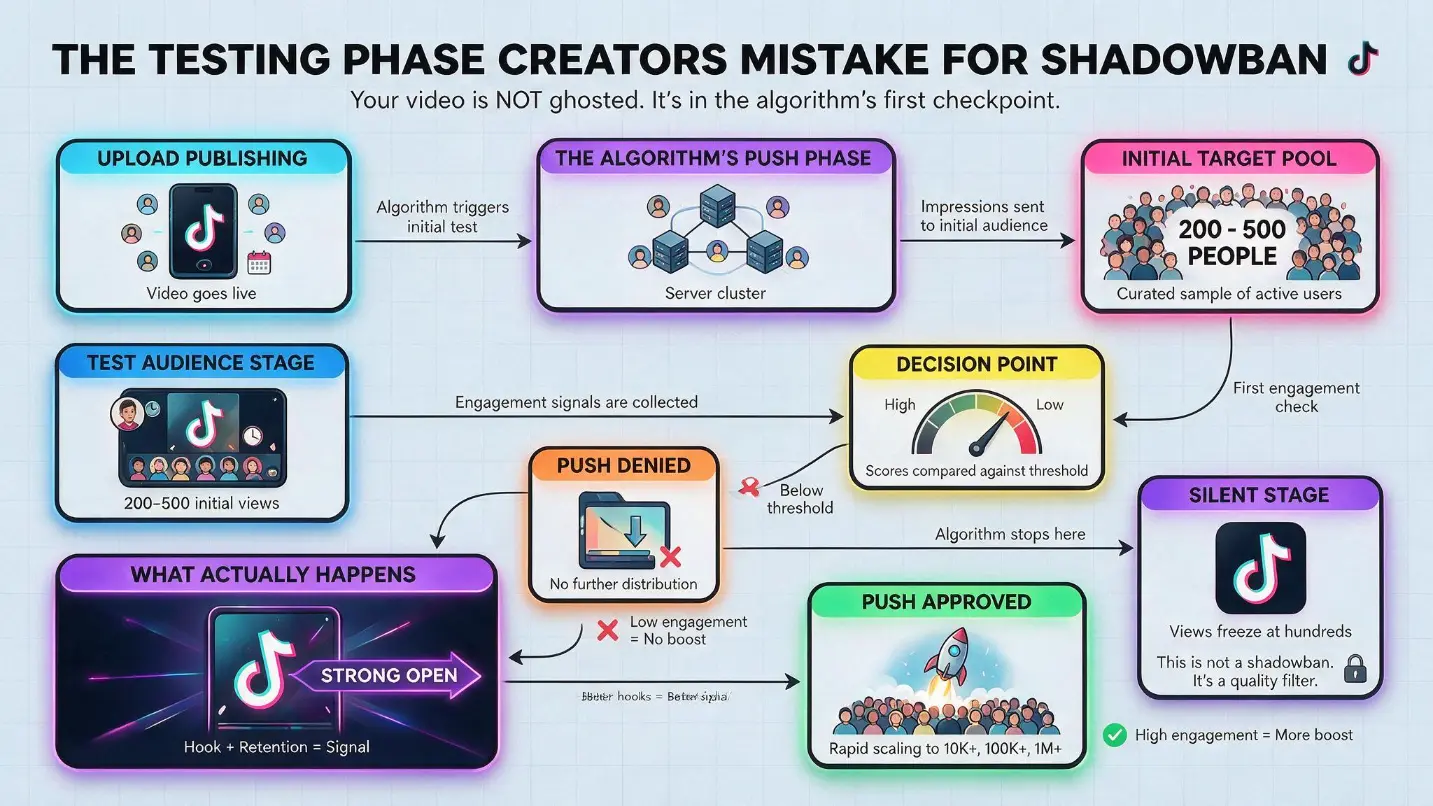
When you upload a video, TikTok tests it with a small audience (200–500 people), measuring completion rate and engagement metrics, and then determines whether to expand distribution. If the test audience doesn't engage, the video doesn't grow and you only see those 200–500 test views. This looks exactly like a shadowban but it's just a failed algorithm test.
Why this happens: your content failed to engage the test audience — weak hook, low retention, insufficient engagement potential.
📝 Reason 2: Change in Content Quality
The algorithm learns what your audience wants and optimises distribution for that content type. When you shift to different content, the algorithm detects an audience mismatch and reduces distribution for testing. Example: you built an audience for fitness content, then started posting politics. Algorithm detects that your existing followers don't want this content and stops distributing it.
🕐 Reason 3: Posting Frequency Problems
Posting too much: 10+ videos a day looks spammy to the algorithm, leading to deprioritisation and temporary reach decrease. Posting too infrequently: the algorithm forgets you, engagement declines, and momentum takes a long time to rebuild. The sweet spot is 1–3 videos per day on a consistent schedule.
👥 Reason 4: Engagement Pod Participation
If you're in a group of creators who like and comment on each other's videos to inflate engagement metrics, TikTok's algorithm is very good at identifying this coordinated inauthentic activity. Once identified, your distribution gets limited — and when you stop, it can take weeks to recover.
#️⃣ Reason 5: Hashtag Abuse (Not What You Think)
This is actually not a cause of shadowban despite being the most common myth. Using trending hashtags doesn't cause shadowban. Using niche hashtags doesn't cause shadowban. What can reduce reach (not shadowban): using blacklisted or flagged hashtags, using hashtags completely unrelated to your content, or going overboard with 30+ hashtags that makes the post look spammy.
🚨 Reason 6: Real Community Standards Violation
If you've genuinely broken Community Standards, TikTok may restrict your distribution. This is algorithmic suppression — not necessarily a permanent shadowban — and ends when you stop the violating behaviour. A single violation might trigger a warning. Repeated violations will trigger suppression.
🤖 Reason 7: Improper Use of Third-Party Tools
Fine to use: analytics applications, TikTok-permitted scheduling apps, tools from authorised creators. What causes problems: bots for auto-liking or auto-commenting, engagement pods, fake follower services, view boosting tactics through manipulation, and any tool that simulates organic behaviour artificially.
How to Fix Low Reach — Whether It's a Shadowban or Not
If You Believe It Is a Shadowban
Do a Content Detox (3–5 Days)
Stop posting temporarily to allow the algorithm to reset. Use the time to improve your content quality rather than trying to manipulate your way out. Don't attempt any engagement tricks during this period.
Check for Community Guideline Compliance
Make sure you comply with all rules. Remove any content that might infringe. Ensure future content won't infringe. Be honest — if you know you posted something borderline, remove it.
Return with Your Best Content
Post one (not multiple) video per day. Focus on exceptional hooks and high engagement. Create the best quality content you've ever produced. Monitor whether distribution improves with each video.
Figure Out What Actually Works
Examine which of your new videos take off and double down on that content style. Don't repeat what consistently failed. Use the analytics to identify the specific elements driving engagement.
Be Patient — Sit Back and Track
Real shadowbans take 2–4 weeks to lift. Algorithm testing issues resolve faster (days). Track views and engagement daily to see the direction of travel. Improvement over two weeks confirms recovery.
If Your Reach Is Low but It's Not a Shadowban
Content quality improvements: better hooks (first second is everything), better retention (keep them watching), more engagement triggers (get people to want to comment), niche clarity (know exactly what your content is for), and consistency (stick to one theme your algorithm has learned).
Technical improvements: publish at peak times when your audience is online, use trending sounds when they genuinely fit your content, ensure good lighting and clear sound, add captions (improves accessibility and retention).
Strategy changes: focus on one content type that's proven to work, interact with comments meaningfully (algorithm recognises this), react to trends within your niche, collaborate with other creators, create content series that build ongoing viewing habits.
Common Shadowban Myths — And Why They're Wrong
The internet is full of shadowban misinformation. Here's the honest breakdown of what's false and why.
Wrong. Hashtags don't cause shadowbans. 30+ hashtags might look spammy but won't shadowban you.
Hashtags help findability. Use relevant ones — 5–10 is ideal. Even using flagged hashtags only reduces reach temporarily, it doesn't trigger a shadowban.
No. There is no magic 30-day reset. If you're shadowbanned, reach returns when you fix what caused it — not because of arbitrary time passing.
A break might help if you were actively breaking rules (it stops the violations). But stopping posting by itself is not the cure — fixing the underlying behaviour is.
Wrong. Deleting all your content is not a solution — it just destroys your content library and harms your account history without addressing the actual cause.
Save good videos. Only remove actual violations of Community Standards. Marcus nearly did this and would have wiped out six months of work for nothing.
No. Posting time does not cause shadowbanning under any circumstances.
Posting time has some effect on reach — when your audience is active matters for initial engagement — but it won't shadowban you regardless of when you post.
False. One offence might get you a warning or a content removal, but not a shadowban.
A pattern of violations results in algorithmic suppression. A single mistake that you fix isn't going to kill your reach.
Wrong. If you are genuinely shadowbanned, it's temporary — typically 2–4 weeks.
Fix the root cause and reach rebounds. Shadowbans end when you stop doing whatever triggered them. No account is permanently shadowbanned — that's just an account suspension.
Partially true in the wrong direction. TikTok doesn't have a formal shadowban appeal process — but you don't need one.
Fix the behaviour that caused it and reach returns naturally. The appeal process is your improved content and clean account activity, not a form you fill out.
The GTR Socials Perspective: Reduced Reach Isn't Always Malicious
At GTR Socials, we work with creators who experience reach drops, and shadowban anxiety is real — but it's usually misdirected.
What we know from working across thousands of accounts: shadowbans exist, but they are genuinely rare. Most reach drops are algorithmic re-evaluations, not punishments. Content quality drives distribution more than any other factor. TikTok's algorithm is very good at detecting manipulation. And most creators are misdiagnosing their actual problem — which means they're applying the wrong fix.
Losing reach suddenly is genuinely scary. It's easy to assume "shadowban" because it's a widely known concept. Shadowban fearmongering is everywhere online because it generates clicks. And shadowban is an easy scapegoat — while the real fixes (better content, better hooks, better retention) require actual work.
Where Growth Services Fit
If you are genuinely shadowbanned and your content quality is good, strategic reach-building can help restart the algorithm. But it won't help if you're breaking Community Guidelines — nothing lifts a justified shadowban except stopping the violation. And if the problem is content quality, more views on bad content won't fix the underlying issue.
Growth services from GTR Socials are most helpful when you're in the normal algorithm testing phase and genuinely good content just needs initial visibility momentum — buy TikTok views to give your content the initial signals it needs to pass the test audience threshold.
Shadowban anxiety is a waste of energy. Focus on content quality. The algorithm will reward it. Create better hooks, retain viewers longer, and give people a genuine reason to engage — and TikTok's algorithm will do exactly what it's designed to do: distribute good content to more people.
Your Shadowban Recovery Action Plan
If you believe you've been shadowbanned, here's the structured day-by-day recovery sequence.
Honestly Assess What's Actually Happening
Goal: confirm whether you have a real issue and what's actually causing it.
- Check analytics — is there a real sustained drop in reach (not just one bad week)?
- Review the last 10 posts for any Community Standards violations
- Honestly assess whether you've been acting bot-like (engagement pods, automation tools)
- Look for alternative explanations before assuming shadowban
Stop and Clean
Goal: remove the behaviour causing the problem, whatever it is.
- Stop posting temporarily — a 3–5 day pause
- Engage genuinely with other creators (meaningful comments, not pod activity)
- Exit any engagement pods or manipulation tactics immediately
- Delete any content that violates guidelines
Come Back with Your Best Work
Goal: give the algorithm quality content to evaluate.
- Return to posting 1–2 videos per day (not bulk posting)
- Create the best hooks you've ever written — first second is everything
- Focus on retention and real engagement, not view counts
- Track daily views and engagement for each video
Assess Recovery Progress
Goal: determine what's actually happening based on data.
- If views improved: you weren't shadowbanned — just algorithm testing
- Views still low: likely a content quality issue, not a shadowban
- Slight improvement week over week: potential shadowban lifting
- Continue improving content quality regardless of outcome
Final Assessment and Forward Plan
Goal: either confirm recovery or shift to content improvement strategy.
- Views back to normal: issue resolved — maintain clean posting habits going forward
- Still low after 4 weeks with no violations: almost certainly a content quality issue, not a shadowban
- Refocus entirely on hook quality, retention, and niche consistency
- Consider GTR Socials growth services to jumpstart algorithmic visibility
FAQ: TikTok Shadowbanning
Final Thoughts: Shadowban Anxiety Is Wasted Energy
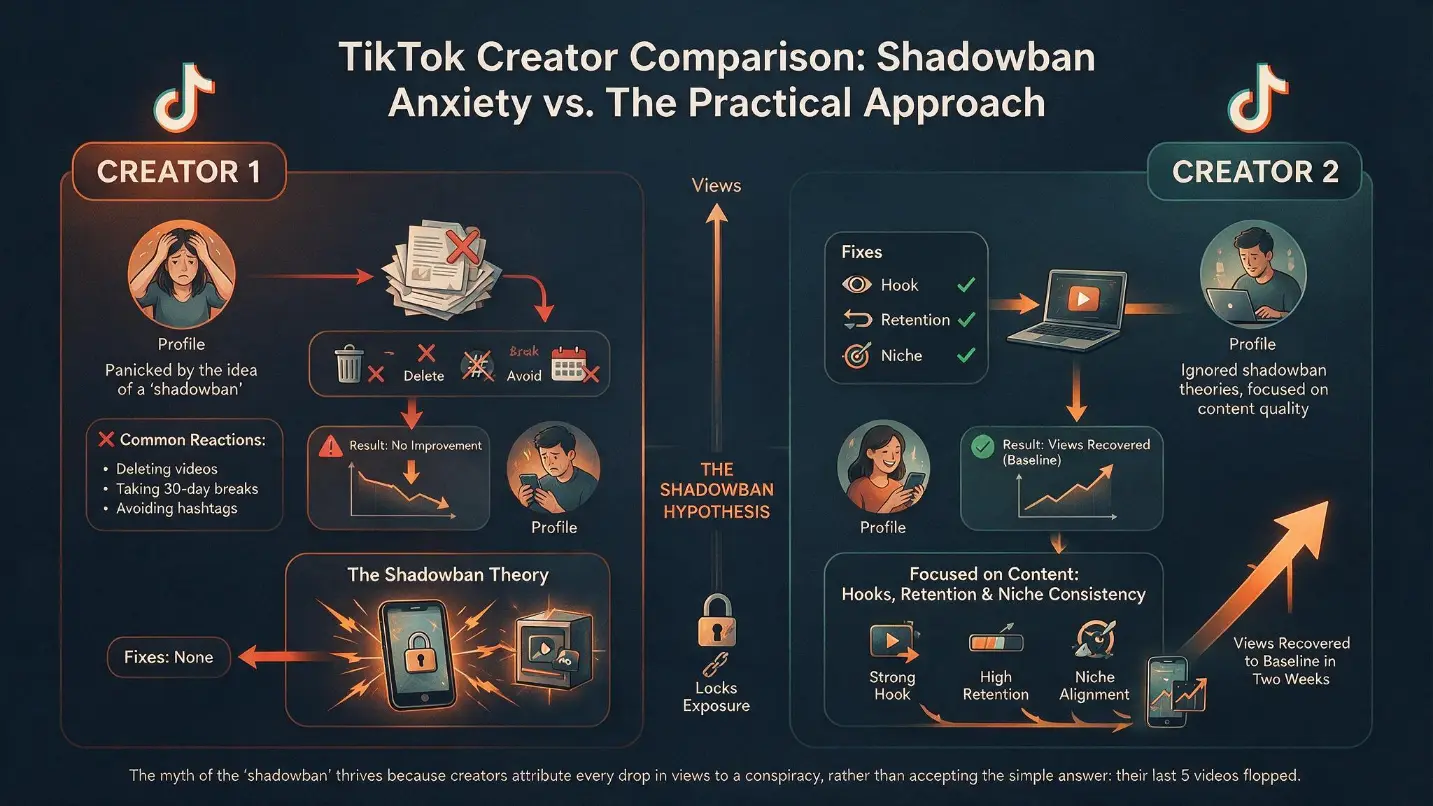
The truth about TikTok shadowbans in 2026: what actually matters is content quality (hooks, retention, engagement), a regular posting schedule, Community Guidelines compliance, and audience alignment — creating content for the right people. What doesn't matter: hashtag anxiety, shadowban panic, myths about 30-day resets, and engagement pod memberships.
Real shadowbans are rare. Content quality is the usual antidote to low reach. Your reach didn't get killed by algorithm punishment. It went away because the algorithm is determining whether your content is worthy of being distributed more widely. More great content. Distribution on request. Stop worrying about shadowbans. Start building hooks that actually stop the scroll.
Marcus's Result: What the Real Fix Actually Looked Like
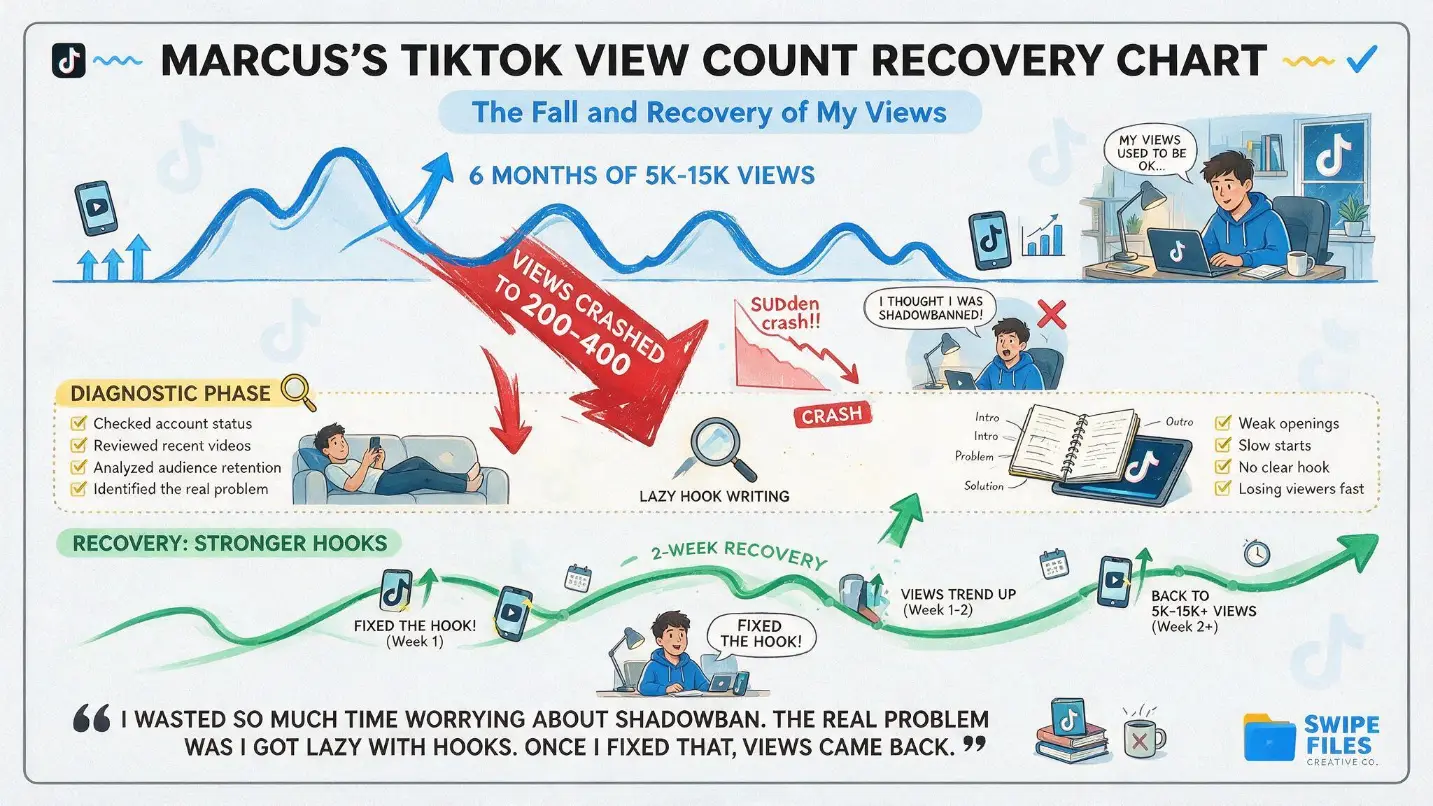
Marcus, who thought he was shadowbanned but had a content quality issue, told me: "I wasted so much time worrying about shadowban. The real problem was I got lazy with hooks. Once I fixed that, views came back. Shadowban was never the problem."
That's the simple, honest truth about shadowbans. The real path forward is simple: quit losing your mind over shadowban myths. Begin enhancing your content — specifically your hooks, your retention, and your niche consistency. Build content that stops the scroll in the first second. The algorithm distributes quality content. Give it quality content to work with.
First: check if you actually have a real sustained reach drop (vs. normal variance). Second: identify the real cause — algorithm testing, content quality, posting frequency, or actual violations. Third: fix the actual cause, not the symptoms. Fourth: create better hooks (first second of every video). Fifth: improve retention (keep them watching). Sixth: be consistent and patient. That sequence recovers reach. Shadowban anxiety doesn't.
🎵 Give Your TikTok Content the Initial Reach It Deserves
GTR Socials helps TikTok creators jumpstart algorithmic visibility with real followers, views, and likes — the initial signals that help your quality content pass TikTok's testing threshold.
Comments (0)