

Marcus posted twice a day for four months and averaged 300 views per video. He wasn't shadowbanned. He wasn't suppressed. He was solving the wrong problems. Six weeks after fixing what actually drives TikTok views, he hit 340,000 views on a single video.
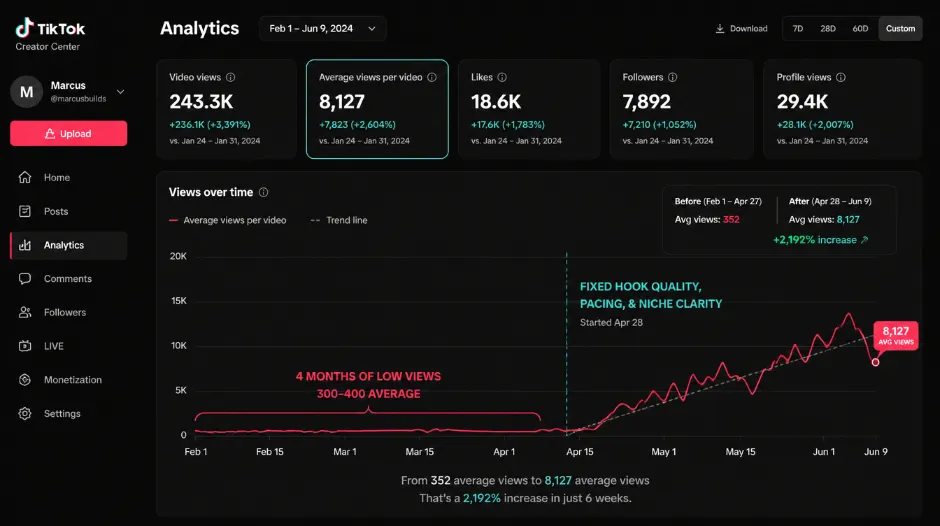
Four months ago, I watched a creator named Marcus give his soul to TikTok for four months and receive almost nothing in return.
He was posting regularly, sometimes twice a day. He was testing out trending sounds. He was doing hashtags. He was "strategically" timing posts. His videos weren't flagged or shadowbanned. TikTok wasn't taking them down. They just weren't getting views.
❌ Four Months of "Doing Everything Right"
✅ Six Weeks After Fixing Real Problems
He was honestly bewildered. "I'm doing everything right," he told me. "I'm consistent, I'm using sounds, I'm posting at good times — why is this not working?" I had to tell him what most TikTok growth guides gloss over: "Because you're solving the wrong problems. You're thinking about TikTok like it rewards consistency and effort. It doesn't. TikTok rewards one specific thing: videos that keep people watching. Everything else is secondary."
Most creators who aren't getting views aren't being "shadowbanned" or "suppressed." They're making content the algorithm doesn't want to push because viewers aren't engaging with it. More consistency or better timing isn't the answer. The answer is to make videos so good that TikTok wants to keep showing them. This guide covers the 7 real reasons TikTok videos get buried, how to diagnose your specific problem, and exact fixes for each one.
Understanding Why TikTok Videos Don't Get Views
Know what is actually going on before you try to fix the problem.
The Real TikTok Algorithm in 2026
Myth: "TikTok first shows my videos to all my followers, then grows the audience if it does well." Reality: TikTok shows your new videos to a test audience of roughly 200–1,000 random people whether you have 1 follower or 100,000. Those people — not your followers — decide whether the algorithm keeps pushing it.
You post a video. TikTok enters it into the test phase.
Test phase: ~500 random people receive your video. They watch, interact, or scroll on.
Algorithm measures: completion rate, rewatches, engagement quality, shares.
If they engage: Video goes to 5,000 viewers → if still engaging → 50,000 → 500,000+ → viral potential.
If they scroll: Video dies at 500–1,000 views. No further distribution. Account not penalised — just this video.
The big idea: it doesn't matter how many followers you have. A 100-follower account can get 1 million views. A 100K-follower account can get 500 views. It all depends on how the test audience reacts to the content in the first few seconds.
What "Engagement" Actually Means to TikTok
Did they watch the whole thing? This is the single most important signal. A video where 50% of viewers watch all the way through gets dramatically more distribution than one with 15% completion.
Did anyone rewatch it? This is a powerful signal that content is worth sharing further. Re-watches tell TikTok the content has value beyond one viewing.
Very important signal — shares tell TikTok the content is valuable enough that viewers want others to see it.
Still matter, but secondary to completion and re-watches. A video with lots of likes but 10% completion won't go far.
These are what most creators obsess over. They matter very little compared to whether the test audience watched to the end.
If TikTok sends your video to 500 people and 250 watch the whole thing (50% completion) — the algorithm rewards it. If only 100 watch the whole thing (20% completion) — algorithm largely ignores it. If only 50 people complete it (10% completion) — the algorithm buries it. Marcus's videos had a ~12% completion rate. That's the entire explanation for why he had 1,450 monthly views despite posting every day. 80% of creators lose their viewers within the first 3 seconds.
7 Real Reasons Your TikTok Isn't Getting Views
These are the actual causes — ranked by how commonly they affect creators who are struggling with low views.
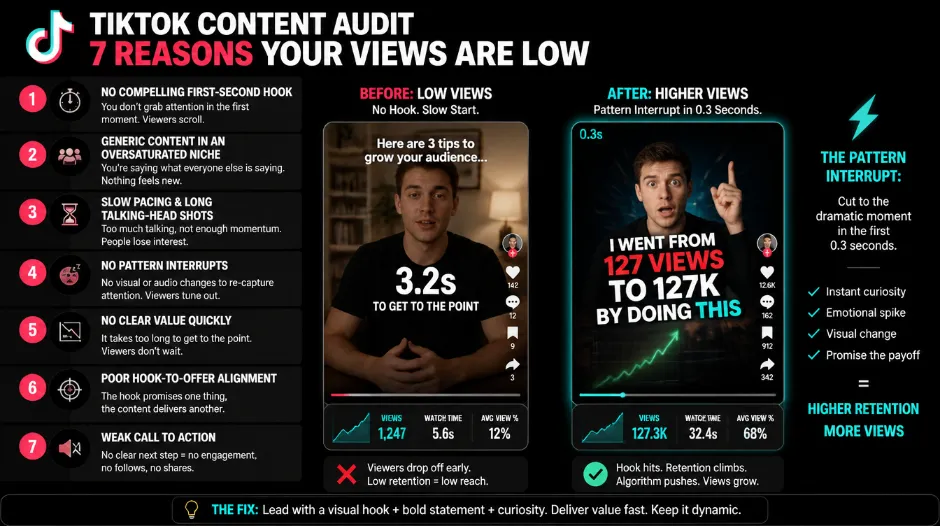
No Hook in the First Second
Your first second doesn't pause the scroll. This is the most common and most damaging cause of low views. 50% of viewers scroll past in the first second. If they're gone, they can't complete your video, low completion means the algorithm fails to distribute, and the video dies before it gets any traction.
- "Hey guys, today we're going to..."
- Intro shot of you facing camera
- Text that says "Watch till the end"
- 5 seconds of setup before content starts
- Slow pans or transitions as opener
- Visual or audio hook immediately
- Text overlay sparking curiosity
- First 0.5 seconds earn the next second
- Jump cut to moment of drama
- Surprising statement or confession
The Niche Is Too Crowded — No Unique Angle
There are thousands of better creators in your niche. TikTok has limited distribution to provide and rewards established creators in saturated niches. Your version competes with hundreds of similar creators daily.
- Generic "how to make money" content
- Standard fitness advice (like 10,000 others)
- Productivity tips without a specific angle
- Copy-paste motivational quotes
- "Productivity for budget ADHD creators"
- "Weight training for tall people"
- "Making $1K/month as a beginner (no experience)"
- Combine two niches in a new way
Content Doesn't Keep Viewers Watching (Bad Pacing)
The video is boring, slow, or loses viewer interest before delivery. TikTok's main metric is "did they keep watching?" — if pacing is slow, people leave. If editing is choppy or confusing, they leave. If it takes too long to find value, they leave.
What this looks like: long talking-head shots, slow transitions, complex setup before any value, unnecessary B-roll, predictable pattern with no interruptions. Marcus's fix was cutting his videos from 6–8 minutes to 45–90 seconds — same value, dramatically more concise editing. Views went up 40x.
Video Is Too Long for TikTok's Algorithm Preference
TikTok's algorithm slightly prefers shorter videos — not because length is penalised, but because it's dramatically easier to maintain a 90% completion rate on a 45-second video than a 10-minute one. The algorithm tests longer videos more rigorously, and gives up faster if they don't perform.
What works best: 45–90 seconds for most content is ideal, up to 2 minutes is fine, 3+ minutes requires phenomenal retention to justify. Under 20 seconds often feels incomplete. If you can deliver your value in 60 seconds as a general rule, do it. Don't pad to fill time. Save long-form for YouTube where it belongs.
Targeting the Wrong Audience
Your content is being shown to people who aren't your target viewer. They watch but don't engage, which generates weak engagement signals and wastes your test audience on the wrong people — the algorithm doesn't distribute further.
What this looks like: broad content that appeals to "everyone," vague or generic communication, no obvious ideal viewer, mixed content that confuses the algorithm about who to send it to. Solution: define your ideal viewer precisely, build exclusively for them, learn their specific language, solve their specific problems.
Technical Quality or Video Issues
Technical issues cause poor viewing experience. This is less important than most creators think — compelling content with bad lighting still beats polished content with no hook — but it still hurts. Heavy watermarks from other platforms, bad audio where viewers can't hear clearly, wrong aspect ratio, and playback lag or stuttering all push people to scroll.
No Personal Brand — Viewers Don't Know Why to Follow
Even if a video gets distributed, viewers aren't following because there's no clear reason to. Without brand retention, each video starts at zero. The algorithm rewards repeat views from the same account — a weak brand means every video is a cold start with no accumulated momentum.
What it looks like: no bio explaining what you do, no obvious content theme, viewers can't tell what you stand for, no reason to follow after watching even a great video.
How to Find YOUR Specific Problem
With seven possible causes, here's how to identify which one is actually holding you back.
Look at Your Analytics
Open TikTok analytics (available once Creator Fund eligible). Check the "Completion Rate %" on your recent videos. Under 30% completion = Reason 1 or 3 (hook or retention problem). 30–50% completion = niche or audience issue but content is watchable. 50%+ completion but not following = personal brand problem (Reason 7).
Objectively Watch Your Own Videos
Would YOU watch this if it appeared on your For You Page? Does the first second make you want to keep watching? Does it hold your full attention? Is there a good reason to follow after watching? Be brutally honest — the truth will reveal your problem faster than any analysis tool.
Benchmark Against Winning Creators in Your Niche
Find creators getting 10K–100K views per video in your niche. Study their first 3 seconds carefully. Observe their pacing, editing, and hook technique. Understand why their videos keep people watching when yours don't.
Test the Content Systematically
Create 5 videos with strong first-second hooks, keeping the same niche and audience. Monitor completion rates on each. If views grow, your problem was Reason 1 (hook). If views are similar, the problem is deeper — investigate further with benchmarking.
Marcus's problem was a weak first-second hook combined with a weak personal brand. This is the most common combination because creators are focused on their content and forget that the hook is how TikTok opens. People decide in 0.5 seconds whether they're watching or scrolling — everything else is secondary to that one decision. Fix: create 10–20 variations of a video hook on the same content and test them. One will perform significantly better.
Fixes for Every Reason — Step by Step
Fix #1: Get the First Second Right
The equation: a visual or audio surprise within 0.3 seconds, plus a text overlay sparking curiosity, plus a clear promise (what are they going to learn), plus immediate value or interest.
- Cut to the dramatic moment first, then explain if necessary
- Text: "This TikTok fix grew views 40x"
- Audio: unexpected sound that causes people to pause their scroll
- Visual: fast cuts or sudden movement that interrupts the scroll pattern
- Personal: a confession or moment of vulnerability
Test method: produce the same video with 3 different hooks. Post all three. See which performs best on day one and use that pattern going forward.
Fix #2: Narrow Your Niche
List 3–5 specific problems your ideal viewer actually experiences. Write content that solves those specific problems. Explain in your bio exactly who you're for. Ensure every video reinforces that defined niche. Example: instead of "marketing tips," become "email marketing for e-commerce founders making $100K–$1M."
Fix #3: Better Retention and Pacing
Change what's on screen every 3–5 seconds. Remove all silence or dead time. Add text overlays throughout to maintain visual interest. Create pattern interrupts to reset attention. Maintain high energy from first second to last. Editing checklist: any pause over 1 second — remove it. Same shot for 5 seconds — add text or cut. Extended transition — replace with a direct cut. If a viewer would think "why am I watching this?" — you've already lost them.
Fix #4: Video Length Optimisation
Best performance: 45–90 seconds. Good: 30–120 seconds. Risky: 3+ minutes (only works with exceptional retention). Too short: under 20 seconds (feels incomplete). If you can deliver your value in 60 seconds, do it in 60 seconds. Never pad to fill time.
Fix #5: Refocus on the Right Audience
Answer three questions before each video: who is this specifically for, what exact problem are you solving for them, why would they care about that right now? Make the answer to question one clear within the first 3 seconds. Test: a random person watches — can they immediately tell if it's for them?
Fix #6: Improve Technical Quality
Film vertically (9:16 aspect ratio), test audio before posting, ensure good lighting (a phone flashlight is fine), steady the phone with a tripod or lean it against something, remove watermarks from other platforms, and ensure there's no lag or stuttering in playback.
Fix #7: Build Personal Brand
Quick wins: bio format "I help [specific person] achieve [specific goal]," a recognisable profile picture, a consistent aesthetic across all content (colours, style, theme), your genuine personality showing in every video, and a clear call to action at the end of each video explaining why to follow.
How to Know When to Persist or Pivot
✅ Keep Going If...
- Completion rates are improving video by video
- Some videos occasionally hit 5K+ views (potential exists)
- Followers are increasing steadily week over week
- You're testing new hooks and angles every week
- You have fewer than 20 videos with the new strategy
🔄 Consider Pivoting If...
- 30+ videos with strong hooks still getting sub-1K views
- Completion rate consistently below 15% despite edits
- No video has ever reached 5K+ views
- Audience feedback suggests you don't understand the niche
- You've tried 5+ distinct angles with no improvement
Pivoting too early after only 5–10 videos, then never giving any single strategy enough time to gather meaningful data. The minimum test for any genuine strategy change is 20 videos with consistent execution. Anything less and you're reacting to noise rather than signal.
The GTR Socials Perspective: When Content Strategy Isn't Enough
At GTR Socials, we work with creators facing exactly this problem. Here is our honest position.
For most creators, low views is a content problem that can be fixed for free. Hook quality, pacing, and niche clarity solve the majority of cases. If done correctly, improvement shows within 10–20 videos with no spend required.
When Content Strategy Hits the Ceiling
Real scenario: you fix everything. Your videos are genuinely good. Completion rate is 40%. Your hook is strong. Your niche is clear. But you're still getting 2–5K views per video instead of 10–20K. Why? The algorithm is fairly testing your content, your videos are getting a genuine test audience — but they're not quite compelling enough to build wider distribution momentum on their own. You need an initial push to get through.
Strategic initial views and engagement can help TikTok's algorithm test content faster, provide social proof that signals popularity, kickstart distribution to a broader audience, and make borderline videos visible rather than invisible. Our TikTok views, followers, and likes services are most effective when the content foundation is already solid.
Growth services don't save bad content. Extra views don't matter if hook quality and retention are broken. You must fix the content foundation first. Services amplify working content — they cannot rescue content that isn't keeping viewers watching. Never use growth services as a substitute for fixing content fundamentals.
The Right Order of Operations
- First (free): Fix content fundamentals — hook, pacing, niche clarity
- Second: Post 20 videos tracking improvement
- Third: If videos still don't perform after fixes — consider growth services
- Fourth: If videos are solid but stuck at a plateau — growth services help break through
- Fifth: Keep optimising while using services — the compounding effect is real
Marcus's combined approach: first 20 videos were free fixes (hook, pacing, niche clarity), resulting in 2–5K average views per video — improved but plateaued. Adding strategic initial push brought averages to 8–15K per video. Borderline videos began winning with growth service support. Total improvement: 40x versus the original approach alone.
Your TikTok Views Strategy — Week by Week
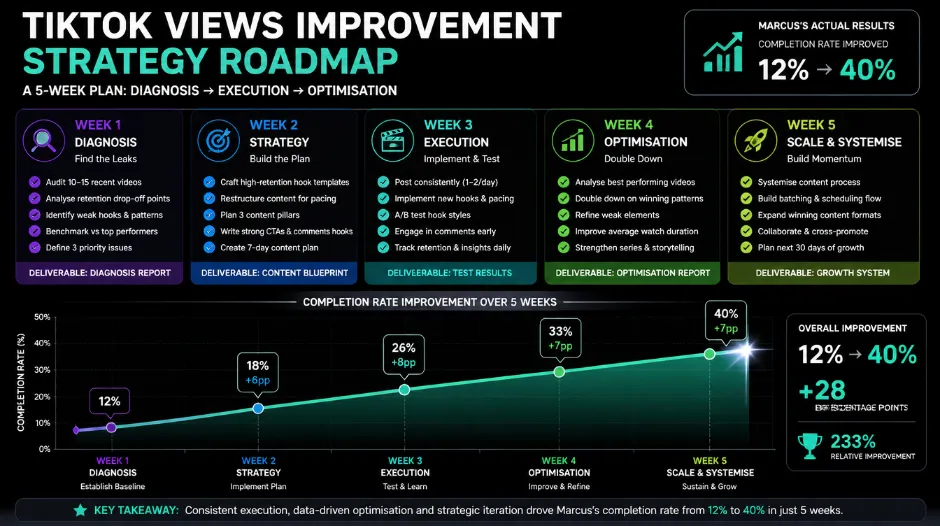
Find Your Actual Problem
Goal: identify which of the 7 reasons applies to your channel.
- Review completion rates on your last 10 videos
- Identify which reason (1–7) most applies
- Watch competitor videos in your exact niche
- Study their hooks, pacing, and editing decisions
Test Hook Variations
Goal: identify your highest-performing hook style.
- Create 5 videos focused entirely on first-second hook quality
- Monitor completion rate on each individually
- Identify which hook style performs best
- Apply those learnings to the next batch
Apply Full Strategy Improvements
Goal: establish consistent improvement in views and completion rates.
- Create 10 videos with improved hooks and faster pacing
- Cut all videos down to 60–90 seconds
- Clarify niche in bio and in every piece of content
- Track views and completion rates weekly
Scale What's Working
Goal: compound growth through strategic optimisation.
- Keep creating with applied improvements
- Track what specific formats are working best
- Double down on winning content formats
- If at a plateau after solid content — consider growth services
FAQ: TikTok Views and the Algorithm
Final Thoughts: Your Views Problem Is Solvable
Marcus, who went from 1,450 monthly views to 120,000+ in six weeks? He hit his first 300K views on a single video and said: "I wasted three months thinking there was something wrong with my account. Really, I just needed to make videos good enough that people wanted to keep watching. Once I did that, the algorithm did its job."
He's right. That's the whole TikTok equation.
There is nothing wrong with your algorithm access. You have a content problem. TikTok's algorithm works perfectly — it distributes videos that people want to watch and deprioritises videos people scroll past. Your job is to make videos people want to watch. The algorithm does the rest automatically.
What Actually Matters vs. What Doesn't
✅ What TikTok Actually Rewards
- Completion rate — did they watch all of it?
- Hook — did they stay after the first second?
- Niche clarity — is this video specifically for them?
- Pacing — does it hold interest throughout?
- Personal brand — why should they follow you?
- Re-watches and shares — powerful distribution signals
❌ What Doesn't Move the Needle
- Number of followers
- Time of day you post
- Hashtag selection
- Using trending sounds
- Posting frequency
- Consistency for its own sake
Stop thinking your account is broken. Stop thinking the algorithm is suppressing you. Stop listening to generic growth advice about posting times and hashtags. Start making videos interesting enough that people want to keep watching. Hook them in the first second. Get clear on exactly who your content is for. Your low TikTok views aren't a mystery — they're feedback that your content needs work. Take that feedback, elevate your content, and watch your views respond.
Marcus's Full Results: What Fixing the Real Problem Actually Produces
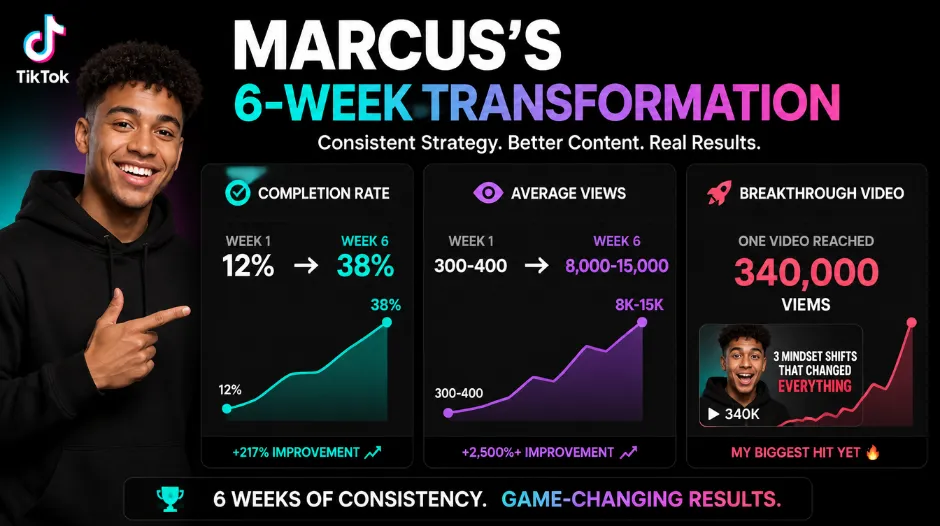
Same creator. Same niche. Same position. A completely different understanding of what TikTok actually rewards. The 7 real reasons for low views: no hook in the first second, a crowded niche with no unique angle, poor pacing and retention, video too long for the algorithm preference, wrong audience targeting, technical quality problems, and weak personal brand. Fix two or three of these and views change dramatically. The right action plan: hook is the first priority, then niche clarity, then pacing, then the personal brand question — in that order. Now go make videos people actually want to watch.
🎵 Fixed Your Content — Now Ready to Break Through the Plateau?
GTR Socials helps TikTok creators build the initial momentum that gets solid content past the algorithm's test phase and into real distribution — views, followers, and shares that compound over time.
Comments (0)