

Most businesses don't have a traffic problem. They have a "what happens after the click" problem. You can spend months building an audience, running ads, and posting every day, and still watch most visitors leave without buying, signing up, or booking a call. That gap is what conversion rate optimization (CRO) is meant to close, and when it's done properly it looks very different from changing a button color and hoping.
The problem with best practices
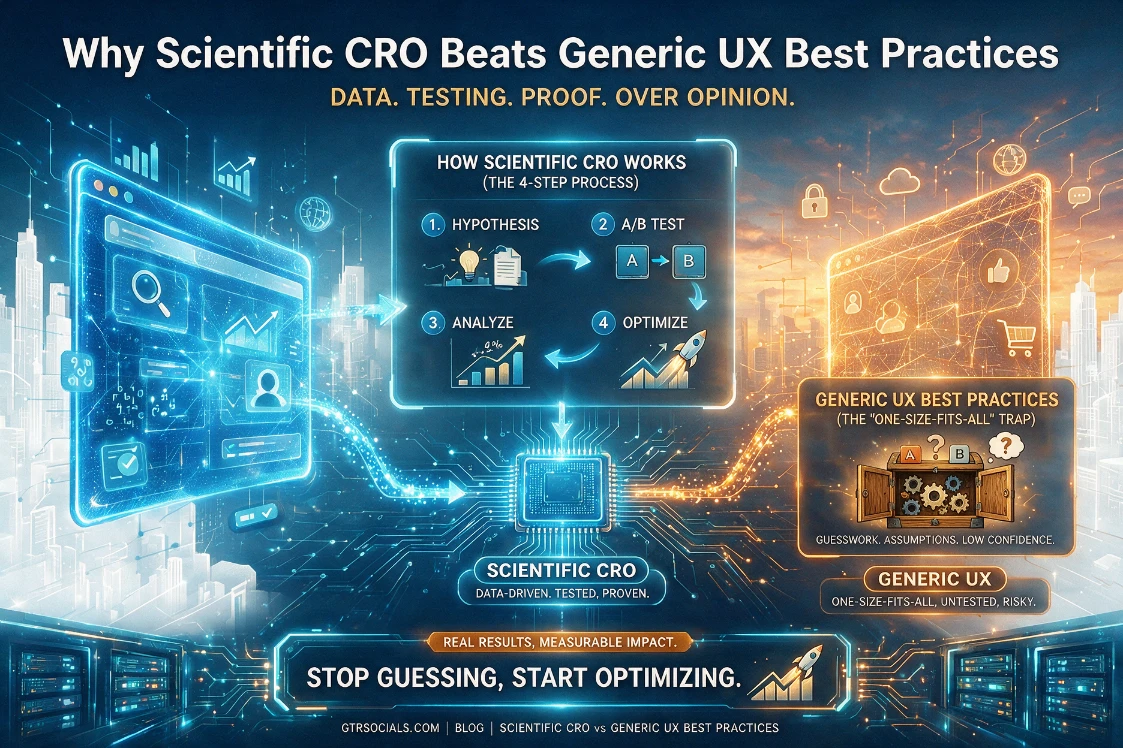
You've probably seen the checklists. Put the call-to-action above the fold. Add trust badges. Shorten your forms. Use urgency. Most of these tips come from somewhere real, and some of them will help.
But here's the catch: a best practice is an average. It describes what worked for other sites, with other audiences, selling other things at other price points. Your visitors might be hesitating for a completely different reason. Maybe they don't trust your shipping times. Maybe your pricing page raises more questions than it answers. Maybe they can't tell how your product differs from the three tabs they have open next to it.
Copying a competitor has the same flaw. You see what they changed, but you can't see the data behind the decision, or whether it even worked for them.
Best practices are a decent starting point for a hypothesis. They're a poor substitute for evidence.
| Approach | What you get | Where it falls short |
|---|---|---|
| Best practices | Averages from other sites | Your visitors may hesitate for a different reason |
| Copying a competitor | You can see the change they made | You can't see the data, or whether it worked |
| Scientific CRO | A hypothesis tested in a controlled experiment | Nobody can know the uplift before the test |
What scientific CRO actually means
A scientific approach to conversion optimization swaps assumptions for a repeatable process. When it's done properly, it looks very different from the "change the button color and see what happens" version most people picture. Teams like Conversion Rate Store, a global CRO agency that operates as a fully outsourced CRO team, treat it as a research discipline. If you work in B2B, their guide to the best cro agencies for B2B lead generation is also a handy way to see how different agencies approach the problem.
In simple terms, it works like this:
- Measure what's really happening. Before anyone redesigns anything, you need clean data on how people move through your site or product.
- Work out why. Numbers tell you where people drop off. Research tells you the reason.
- Form a hypothesis. "We believe changing X will improve Y because of Z," grounded in the research.
- Test it. Run a controlled experiment so you know whether the change caused the result.
- Learn and repeat. Whether a test wins or loses, you end up knowing something real about your customers.
This loop is what separates a CRO program from a one-off redesign. A redesign is a big bet made all at once. Experimentation is a series of smaller, checkable bets that build on each other.
What a complete CRO program includes
Plenty of companies do one or two of these things well. Fewer do all of them together, and the gaps between the pieces are where results tend to leak out. A full program usually covers:
- Data engineering and journey tracking. If your analytics setup is broken or incomplete, every later decision rests on shaky ground. Good CRO starts with making sure events, funnels, and customer journeys are tracked accurately.
- Funnel and behavior analysis. This is where you find the steps with the biggest drop-offs, the segments that behave differently, and the pages that quietly lose people.
- UX research. Behavior data shows what people do. Research shows what they think and feel while they do it: their concerns, motivations, and intent, and how they perceive your brand and offer. Surveys, session reviews, and user feedback all feed into this.
- Hypothesis development. Findings become specific, prioritized ideas, rather than a long wish list of random changes.
- Design and copy. Strong hypotheses still need execution. That means UX/UI design and conversion-focused copywriting that speak to the specific barriers uncovered in research.
- Experiment development and A/B testing. Variants are built, launched, and run properly, so the results can be trusted.
- QA, statistical validation, and post-test analysis. A test that's built badly or called too early can mislead you. Quality checks and proper statistical review protect you from acting on noise, and post-test analysis turns each result into insight for the next round.
Why a team beats a lone consultant
Look at that list again. It spans analytics, engineering, research, strategy, design, copywriting, development, project management, and QA. Very few people are genuinely expert in all of those.
That's why many growing companies lean toward an outsourced CRO team rather than a single consultant or a patchwork of separate freelancers. With a multidisciplinary team, the analyst's findings reach the designer directly, the developer understands the reasoning behind each variant, and QA catches problems before a test goes live. There's less lost in translation, and fewer handoffs to manage on your side.
This is the model Conversion Rate Store describes: an end-to-end CRO function that covers tracking, research, design, experimentation, and validation under one roof. It also works across different business types, including eCommerce and DTC brands, SaaS products, lead generation companies, marketplaces, and subscription businesses, which matters because a checkout problem and a demo-request problem need very different thinking.
What to look for in a conversion optimization agency
If you're evaluating partners, a few questions will tell you a lot:
- How do you decide what to test? Look for answers rooted in your data and customer research, not a standard playbook.
- Do you handle the full process? Ask who owns tracking, research, design, development, and QA. Gaps here become your problem.
- How do you validate results? You want a clear approach to statistical validation, not "the variant looked better."
- Which metrics matter to you? Good partners talk about conversion rate, revenue per user, average order value, funnel performance, and acquisition efficiency, rather than vanity numbers.
- Have you worked in businesses like mine? Relevant experience shortens the learning curve.
- How honest are you about uncertainty? Be wary of anyone who promises a guaranteed uplift. Testing is how you find out what works. Nobody can know in advance, and a trustworthy partner will say so.
Where traffic and conversion meet
Here's something we see often at GTR Socials: brands invest heavily in getting attention, then ignore what happens once it arrives. Growing your reach is one half of the equation. Turning that attention into customers is the other.
If you're still building the top of the funnel, our SEO services and social media growth services can help get more of the right people in front of your brand. Our free online tools are handy for day-to-day content work, and the GTR Socials blog has more guides on turning visibility into results. Pair that attention with a disciplined conversion process, and each visitor becomes worth more.
Whatever route you take, the principle holds: stop guessing why people aren't converting, and start finding out.
FAQ
What is a conversion optimization agency?
It's a team that helps businesses turn more of their existing visitors into customers or leads, using research, design, and controlled experiments to improve funnels and user experience.
How is CRO different from a website redesign?
A redesign changes lots of things at once and is hard to evaluate. CRO changes specific elements based on research and tests them, so you know what actually made a difference.
Is CRO only for eCommerce stores?
No. It applies to SaaS, lead generation, marketplaces, subscription businesses, and other digital products wherever there's a goal you want more users to complete.
Does A/B testing alone count as CRO?
Not really. A/B testing is one part of the process. Without solid tracking, research, and well-formed hypotheses, tests tend to be random rather than strategic.
Can any CRO agency guarantee results?
No. Reputable teams focus on a sound process and validated learning, because outcomes depend on your audience, offer, and market.
Comments (0)