

Diana had 156,000 LinkedIn followers, thousands of comments per post, and genuine career-coaching credibility — and earned $0 directly from LinkedIn. Six months after mapping nine monetization streams: $8,200–$13,800/month.
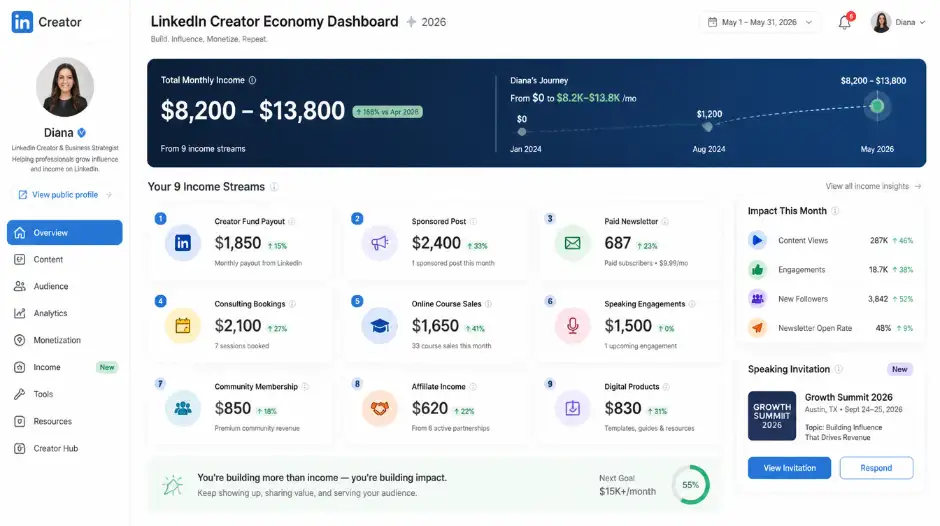
Four months ago I met a career coach called Diana who'd built up a massive LinkedIn presence over the last five years.
She had 156,000 followers, was posting regularly about career transitions and professional growth, and was getting thousands of comments and shares on each post. She had created real credibility and become a trusted voice on career development. But she earned $0 on LinkedIn. She had a consulting business that made $3,000–$5,000 a month from clients she found in her network — but the monetization was entirely off of LinkedIn. The platform was merely a means to build an audience.
"I keep getting told that I should be getting paid directly for LinkedIn," Diana said, exasperated. "LinkedIn is supposed to have a creator economy. But I have no idea how it actually works or what to expect. Is it like TikTok money where you get paid for posts? Like YouTube where ad revenue comes in? Or is it something else entirely?"
What most LinkedIn monetization guides skip over, I had to tell her: "LinkedIn's creator economy is unlike any other platform because LinkedIn users aren't scrolling for entertainment — they're scrolling for professional development. That changes monetization completely. You don't sell attention to ad buyers. You're offering knowledge, insight, and solutions to people who have money to spend."
❌ Five Years, $0 Direct LinkedIn Income
✅ Six Months of Mapped Monetization
What mattered most: she wasn't getting rich quick. She was building a sustainable, diversified income stream from her professional network and expertise. All of the revenue streams fit naturally with her existing positioning as a career guru.
LinkedIn is finally turning into a true creator economy platform, but it's fundamentally different from social platforms. This isn't about going viral and getting attention — it's about professional credibility and helping other professionals solve problems. Money follows expertise, not vanity metrics. This guide covers every monetization method available, with realistic income expectations for each.
How LinkedIn's Creator Economy Is Different
Before getting into methods, it's important to understand LinkedIn's unique positioning compared to every other platform.
LinkedIn Is Not for Fun
📱 Instagram, YouTube, TikTok
Users consume for entertainment and escape. The order is entertainment first (ads, views, followers), then monetization. Large audience equals viral content. Entertainment is the currency of the realm.
Consumption is professional development. Monetization is driven by professional value. Authority plus expertise equals reach. Professional insight is the actual currency that converts to revenue.
What this means: the money you make on LinkedIn isn't really because LinkedIn is paying you for your content. It's driven by the professional opportunities your content creates — clients, sponsors, speaking invitations, and subscribers who trust your expertise.
The LinkedIn Creator Economy Model (2026)
LinkedIn recently introduced official creator features: (1) Creator Fund — newly launched monetization for video creators, similar to TikTok/YouTube but with smaller payouts, requiring 10K+ followers and consistent engagement; (2) Newsletter monetization — subscribe to LinkedIn Newsletters like Substack, readers can subscribe free or paid, with creator revenue on paid tiers offering much higher potential than the Creator Fund; (3) Document monetization — guides and template PDFs that readers can purchase directly; (4) Discovery opportunities — LinkedIn surfacing creators to brands and event organizers actively looking to connect; (5) Creator Fund ad revenue sharing — variable based on participation, but notably lower than YouTube or TikTok equivalents.
Methods 1–4: Core Income Streams
These four methods form the foundation of LinkedIn monetization — from official platform features to direct sponsorship relationships.
The LinkedIn Creator Fund
Official — Passive BonusLinkedIn's official platform monetization. Requirements: 10,000+ followers, account in good standing, consistent engagement, focus on professional content. Revenue is generated by sharing your posts with advertisers, with engagement-driven payments and a monthly payout above a minimum threshold.
10–50K followers: $50–200/month · 50–100K followers: $200–500/month · 100K–500K followers: $500–2,000/month · 500K+ followers: $2,000–5,000+/month. Diana's result at 156K followers with consistent engagement: $200–$400/month.
LinkedIn Sponsored Posts
Top Short-Term RevenueCompanies pay for posts featuring their products or solutions. You write authentically about them, with sponsorship clearly disclosed (required). Find sponsorships by contacting companies in your sector directly, using sponsorship platforms, and building relationships for continued partnerships. What works best: case studies of their tools, platform how-to posts, real reviews and ratings, and problem-solution content.
Early stage (10–50K followers): $300–800/post · Mid-tier (50K–250K followers): $800–2,500/post · Large creator (250K+ followers): $2,500–10,000+/post. 2–4 sustainable monthly posts = $1,600–7,500/month. Diana's formula: 2–3 sponsored posts/month from career development platforms = $1,500–$2,500/month.
Paid Email Newsletter
Predictable Recurring RevenueTurn your free LinkedIn newsletter into a paid subscription. Build a free newsletter, grow your subscriber base, add a paid tier ($10–99/month typically), and LinkedIn takes a cut while you keep the rest. Newsletter types that make good money: industry perspectives, private career coaching, research and analysis, learning and skills content, individual case studies. Pricing strategy: $5–10/month for broad appeal and higher conversion, $15–25/month for mid-tier niche content, $50+/month for premium high-value content.
5,000 free subscribers, 5% conversion = 250 paid at $10 = $2,500/month · 10,000 free, 3% conversion = 300 paid at $15 = $4,500/month · 20,000+ free with tiers = $3,000–$8,000+/month. Diana's numbers: 3,200 free subscribers, 280 paid at $5/month = $1,400/month.
Online Courses and Certifications
Scalable Passive IncomeSelling educational products to your audience. What to sell: online courses ($29–$297+), certifications ($100–500+), masterclasses ($99–$999), video training packages ($49–199). Platforms: Teachable, Kajabi, Skillshare, your own site, or LinkedIn Learning as an alternate format. Sell via posts and newsletter citations, a dedicated landing page, a free sample to build trust, and credibility-driven signups.
Single course, 20–50 students/month: $600–2,000/month · Multiple courses, 50–100+ students: $2,000–5,000/month · Established course library: $3,000–10,000+/month. Diana's formula: career transition course ($97) plus professional development masterclass ($299) = $800–$1,500/month.
Methods 5–9: Additional Revenue Streams
These five methods round out a complete LinkedIn monetization strategy — leveraging consulting expertise, speaking platforms, and personal brand products.
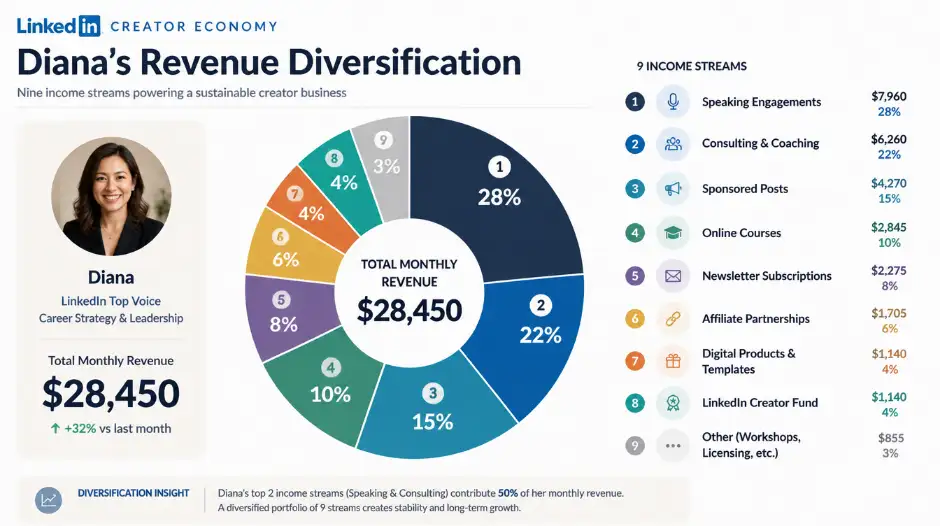
Consulting and Coaching Services
High Hourly RateOne-on-one professional services leveraging LinkedIn credibility. Services: career coaching ($100–$250/hr), business consulting ($150–$500/hr), executive coaching ($200–$500+/hr), specialized knowledge consulting ($100–$300/hr). Offer via LinkedIn headline mentions, a calendar booking link in your profile, free discovery calls, testimonials, and case studies.
Part-time (5–10 clients/month): $1,000–3,000/month · Semi-serious (15–25 clients/month): $2,500–7,500/month · Full-time (30+ clients/month): $5,000–15,000+/month. Diana's result: consulting demand from LinkedIn visibility = $2,000–$3,000/month additional.
Speaking Engagements and Events
Highest Single-Event IncomeMaking money speaking at conferences, webinars, and virtual events. Opportunity types: conference keynotes ($1,000–$5,000+), virtual summit appearances ($500–$2,000), corporate training ($2,000–$10,000), webinar hosting ($1,000–$3,000), panel discussions ($500–$2,000). Build bookings through organizer outreach, speaking bureaus, and growing credentials over time.
Initial intermittent speaking: $1,000–3,000/month (variable) · Established speaker: $3,000–8,000/month · In-demand speaker: $8,000–20,000+/month. Diana's results: speaking invitations from visibility = $2,000–$5,000/month (variable).
PDFs and Documents on LinkedIn
Low Barrier EntrySelling guides, templates, and resources directly to your audience. What to sell: how-to guides ($5–25), resume templates ($10–$49), career change guides ($15–$50), templates and frameworks ($5–$20), industry reports ($20–$100). LinkedIn handles payment and delivery directly, and you keep most of the revenue. Top sellers: reusable templates, problem-solving guides, original research and data, career transition resources.
Single document, 10–30 sales/month: $50–300/month · Multiple documents, 50+ sales: $250–1,000/month · Established library: $500–2,000+/month.
B2B Affiliate Marketing
Passive IncomeCommissions on B2B tools and services recommendations. Best programs: SaaS tools (20–40% commission), online courses (30–50%), consulting platforms (20–30%), learning platforms (15–25%). Recommend in posts and newsletters, disclose affiliate relationships clearly, share what you actually use, and keep recommendations contextual and natural rather than spammy.
Limited presence with sporadic recommendations: $50–200/month · Existing presence with strategic partnerships: $300–800/month · Multiple ongoing partnerships: $800–2,000+/month. Diana's affiliate partnerships: $300–$500/month.
Personal Brand Products and Services
Greatest Long-Term PotentialDirect brand monetization at scale. Options: training and workshops, group coaching programs ($50–$500/month per member), community membership ($5–$25/month), certification classes, annual summits and events. This method has the greatest long-term revenue ceiling but requires significant community management and consistent delivery.
Small group (10–20 members): $500–2,500/month · Established group (100–250 members): $5,000–20,000/month · Large community: $10,000–50,000+/month.
Diana's Income Stack: How Nine Methods Worked Together
No single method made Diana's $8,200–$13,800/month possible. It was nine revenue streams reinforcing each other, all rooted in the same career-coaching credibility.
Diana's Full Monthly Income Breakdown (156K Followers)
All of these revenue streams fit naturally with Diana's existing positioning as a career development expert. Nothing felt bolted on — speaking invitations came because of newsletter content, consulting demand grew from sponsored post credibility, and course sales came from the trust built through consistent, valuable posting.
Fatal Mistakes That Ruin Your LinkedIn Monetization
Too many simultaneous monetization efforts overwhelm both you and your audience, diluting effectiveness across every single method.
Making your profile feel like a sales channel. Your audience gets bored and disengages, undermining the credibility every other method depends on.
Promoting products purely for money rather than because they're genuinely good. LinkedIn's professional audience is quick to notice and quick to lose trust.
Trying to monetize without first building genuine credibility. No trust means no conversion, regardless of which method you attempt.
Building an audience, then disappearing once monetization begins. Inconsistency signals declining commitment and damages the credibility that drove the original opportunities.
Forgetting that LinkedIn is fundamentally a professional platform, not an entertainment one. Content and monetization approaches that work elsewhere often backfire here.
The GTR Socials View: The LinkedIn Creator Economy Is Real, But Different
At GTR Socials, we see LinkedIn as the new creator platform for professionals — and it requires an entirely different mindset than other social platforms.
How monetization on LinkedIn is different: it's a business development platform, not entertainment. It's B2B, not B2C. It's experience-based, not trend-based. Credibility is the actual currency. The income reality reflects this — LinkedIn income tends to be more stable than viral platforms, relies more heavily on expertise, commands higher average transaction values, and operates on naturally longer sales cycles.
Gaming the algorithm doesn't work the way it does on entertainment platforms. Buying followers is pointless and obvious to a professional audience. Spam and hard selling cause audience revolt. Off-brand sponsorships that don't fit your professional positioning lose credibility instantly. Growth services are less relevant here because audience quality is infinitely more important than quantity on a platform built around professional trust.
What we're open about: the key to success on LinkedIn is real expertise and credibility. There's no shortcut to reputation. Our LinkedIn followers and LinkedIn connections services can help establish initial professional presence and discoverability — but credibility itself must be earned through genuine expertise and consistent value.
First: Build real professional authority (6–12 months, foundation work). Second: Create consistent, valuable content as the base. Third: Add the Creator Fund as a passive bonus. Fourth: Grow a newsletter audience for your first true monetization. Fifth: Add a paid newsletter tier for recurring revenue. Sixth: Create digital products for scalable income. Seventh: Establish consulting and services that build on credibility. Eighth: Pursue speaking opportunities for premium positioning. Credibility first, revenue second. The rest follows naturally.
Your LinkedIn Monetization Plan
A structured, multi-year roadmap built around the realistic timeline professional credibility actually requires.
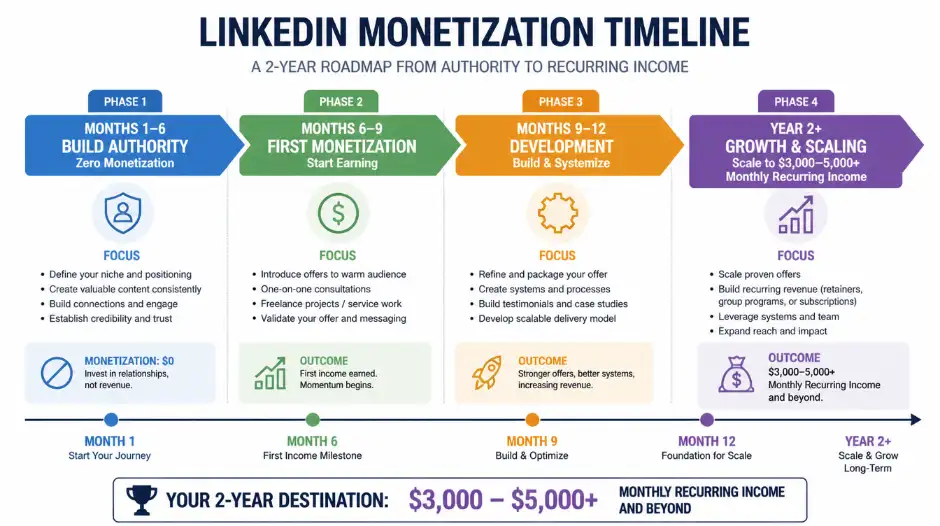
Gaining Professional Authority
Goal: 10K followers and established niche authority. Zero monetization attempts.
- Post consistently, valuable content 3–5x per week
- Interact genuinely with others' posts through comments and conversation
- Become a recognised expert in a specific niche
- Grow toward 10,000+ followers organically
- Make zero monetization attempts during this period
Monetizing the Foundation
Goal: first Creator Fund income of $500–$800/month plus initial sponsorship.
- Join the Creator Fund if eligible
- Start a free LinkedIn newsletter
- Pitch your first sponsored post opportunity
- Begin offering consulting and services
- Grow newsletter subscribers toward 1,000+
Diversify and Scale
Goal: $1,500–$2,500/month diversified income.
- Launch a paid tier for your newsletter
- Create your first digital product
- Build 2–3 sponsor relationships
- Increase your consulting client base
- Explore speaking opportunities actively
Scale Toward Sustainable Income
Goal: $3,000–5,000+/month recurring income.
- Scale the best-performing methods based on real data
- Create additional digital products
- Pursue more speaking gigs as credentials grow
- Expand the consulting business strategically
- Build community or membership tier if it fits naturally
FAQ: How to Make Money on LinkedIn
Conclusion: LinkedIn Values Experience and Time
Diana went from $0 to $8,200–$13,800/month by strategically monetizing LinkedIn. Six months into launching a mix of monetization products, she shared a LinkedIn-ism with me: "LinkedIn monetization is slow. It's not viral. But it is stable. Every dollar is earned through real professional relationships and real expertise. It doesn't feel extractive because I'm actually helping people with their careers and getting paid for it."
The trick was she stopped counting vanity metrics. Followers didn't matter unless they were professionally engaged. Income wasn't measured in how many people she had — it was measured in how she had them.
The creator economy on LinkedIn is real and sustainable because it's based on professional value, not entertainment. Money follows expertise and credibility. The formula: establish professional authority (6–12 months), provide quality content regularly, build genuine community engagement, implement the passive Creator Fund, launch a newsletter as first monetization, add a paid tier for recurring revenue, build scalable digital products, offer high-value consulting and services, pursue speaking for premium positioning, and always remain authentic throughout.
Avoid chasing virality on LinkedIn. Don't make it Instagram-like. Don't wait for fast monetization — it doesn't exist here. Start building real professional credibility. Start regularly providing valuable content. Make better connections with your audience. Your followers aren't paying you directly on LinkedIn — your income is waiting in the credibility, expertise, and professional relationships you build over time. Build your authority. Monetization is coming. Now go become an expert, and the creator economy will follow you.
Diana's Full Results: What Strategic LinkedIn Monetization Actually Produces
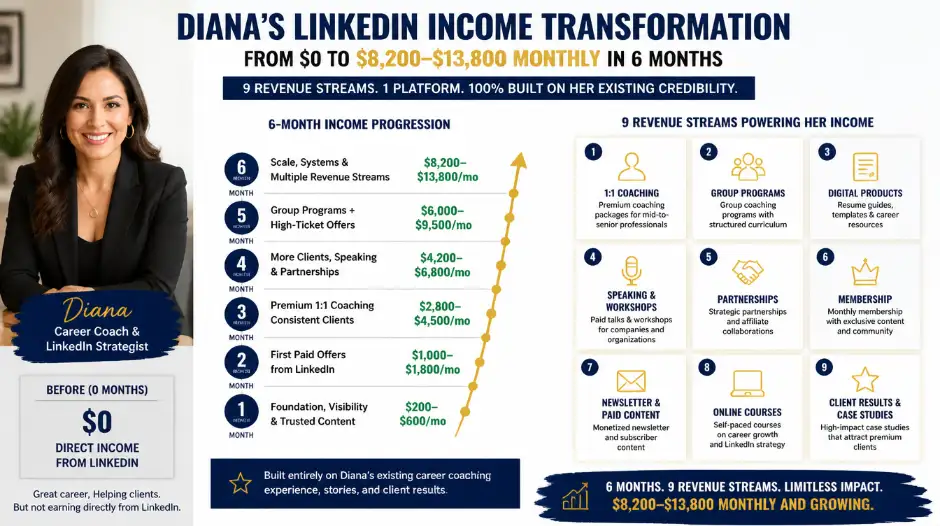
Her current income split: Creator Fund $200–$400, sponsored posts $1,500–$2,500, paid newsletter $1,400, consulting from exposure $2,000–$3,000, courses $800–$1,500, speaking $2,000–$5,000 (negotiable), affiliate partnerships $300–$500. Same expertise. Same network. A completely different understanding of how LinkedIn income actually works. Your LinkedIn monetization formula: establish professional authority, provide consistent quality content, get genuinely involved in your community, implement the Creator Fund passively, launch a newsletter as your first monetization step, add a paid tier for recurring revenue, build scalable digital products, offer consulting and services at premium rates, get out there and speak, and always be yourself. Build your authority. Monetization is coming.
💼 Ready to Build the LinkedIn Authority That Monetization Depends On?
GTR Socials helps professionals build genuine, engaged LinkedIn presence — the foundation of credibility that makes every monetization method in this guide actually work.
Comments (0)