

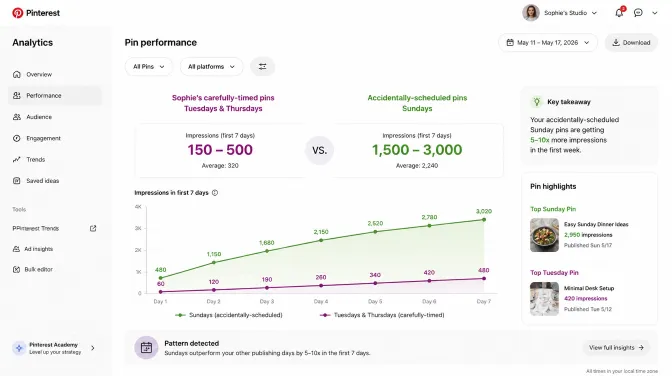
Sophie's "perfectly timed" Tuesday and Thursday pins got 150–500 impressions each. Her accidentally-scheduled Sunday pins got 1,500–3,000 impressions in the first week. Six months after switching to a keyword-first strategy: 8,400 monthly visits, up from 600–800.
Six weeks ago I met home decor blogger Sophie who was frustrated with the Pinterest timing advice she'd read everywhere.
She'd followed the conventional wisdom to the letter — 8 to 11 AM, 2 to 4 PM, and 8 to 10 PM EST on Tuesdays and Thursdays, the times "experts" said were best for maximum reach. She meticulously worked out all the details, tested this schedule, and waited for results. Her actual performance: morning pins (8 AM) got 150–300 impressions per pin, afternoon pins (2 PM) got 200–400 impressions, and evening pins (8 PM) got 300–500 impressions. With 45,000 followers, Pinterest was only sending her 600–800 monthly visitors.
Then, completely by accident, she left a dozen pins queued up on her scheduling tool over the weekend and forgot about them. They auto-posted at 5 AM Sunday morning, 1 PM Sunday afternoon, and 7 PM Sunday evening — times no guide would ever recommend.
❌ "Optimally Timed" Tuesday/Thursday Pins
✅ Accidental Sunday "Wrong-Time" Pins
"I thought I was doing everything right," Sophie said, confused. "But these 'wrong time' pins beat my well-tuned Tuesday posts. What's REALLY happening with Pinterest's algorithm?"
"Pinterest isn't like Instagram or Twitter," I had to tell her — something most Pinterest guides totally ignore. "The algorithm isn't about immediate engagement once you post. It's a search engine first, social platform second. It's not so much about when you post, but about whether people are searching for what you're pinning months or years later that determines how far your pin travels."
Pinterest timing matters far less than on any other social platform. Why? Pinterest is not a timeline feed — it's about searchability and user intent, not when you posted. A well-optimised pin posted at the "wrong" time will beat a mediocre pin posted at the "perfect" time by orders of magnitude. This guide covers how Pinterest's algorithm actually works, what timing research really shows, and the keyword-first strategy that took Sophie from 600–800 to 8,400 monthly visits.
What Research Actually Says About Timing on Pinterest
Here's what the data shows — alongside important context that most timing guides skip entirely.
General Timing Patterns
Morning Window
8–11 AM ESTMorning idea-surfing. People planning their day and browsing for inspiration before activities begin. A small increase in engagement on weekdays, particularly Tuesday through Friday.
Afternoon Window
2–4 PM ESTAfternoon planning mode. People mapping out projects and ideas during a work break. Moderate activity across most niches and days of the week.
Evening & Weekends
7–9 PM EST + Sat/SunEvening inspiration-seeking and weekend project planning. Weekends show surprising strength for niches involving home projects, recipes, and crafts — exactly the segment that surprised Sophie.
Why these patterns exist: they align with when people have mental bandwidth for planning and inspiration. Pinterest isn't scrolled for fun the way Instagram is — it's a place people go to think about future projects.
Four reasons timing advice is less predictive on Pinterest: (1) the algorithm is fundamentally different — not chronological, search-based, with pins valid for months and reach not dependent on followers; (2) user behaviour differs — people actively search rather than passively scroll, and seasonal patterns matter more than daily patterns; (3) content has a vastly longer shelf life — 6–24 months versus 24 hours on Instagram, meaning timing affects velocity, not ceiling; (4) the actual data is inconclusive — some studies show timing helps, others show little change, with enormous individual and niche variation. Instagram and TikTok timing research is genuinely more conclusive than Pinterest timing research. Test your own audience rather than following generic guidelines.
Seasonality and Niche Matter Far More Than Time of Day
🏠 Interior Design / Home Decor
Peak activity in January (New Year renovation) and summer. Secondary peaks in spring (refresh) and autumn. Seasonal content strategy dominates over timing.
👗 Fashion
Peak activity around seasonal changes (March, September) and sales events (Black Friday, holiday sales). Hot items matter more than posting time.
🍳 Food & Recipes
Peak activity during meal-planning times (Sunday evenings, Monday mornings). Seasonal recipes peak weeks before the actual season (pumpkin in fall, eggnog in winter).
🎨 Arts & Crafts
Most active around weekend planning. Seasonal — holiday crafts peak in October. Activity shifts with the school year calendar.
The plan: seasonal optimisation is more important than timing optimisation for your specific niche. Schedule pins for when people are searching for those topics, not when you think they're on Pinterest scrolling.
Why Content Optimisation Is 100x More Important Than Timing
Let's be direct: Pinterest is far more about what you pin than when you pin — much more so than any other platform.
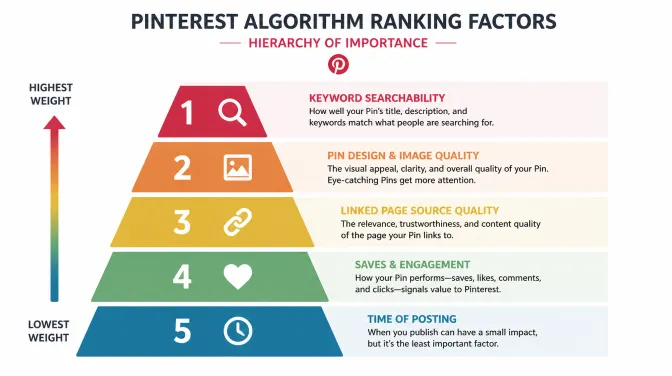
The Order of Searchability
What Pinterest's algorithm prioritises, in descending order:
Title fits search criteria, target keywords included in description, image text is readable, content matches search intent. This is the single most important factor — and the one most guides ignore entirely.
High-resolution vertical images, clear and readable text overlay, professional design, matches niche aesthetic standards. Quality design earns saves, which feeds back into ranking.
Quality of the linked page, page load time, user experience, domain authority. Pinterest cares about what happens after the click — a slow or poor-quality destination hurts your pin's ranking over time.
How many people save the pin, click through to the website, spend time on linked content, or return to the pin. Heavily weighted, but downstream of getting discovered in search in the first place.
Posting time itself carries light weight — a modest boost to visibility in the first 24–48 hours, with little to no effect on long-range reach. Seasonal factors are far more important than the clock.
How Sophie's Sunday pins actually worked: they weren't better-timed — they were different content. She was unintentionally pinning more seasonal, searchable content on weekends and more generic content on weekdays. It was never about timing. It was about content.
Pinterest Content Formats That Win — At Any Time
- High-quality vertical images: 1000×1500px or larger, clean and easy-to-scan layout, readable on-screen text if used, professional appearance throughout.
- Searchable, focused titles: "Modern Farmhouse Kitchen Ideas" beats "Kitchen Inspo." "Easy Chocolate Chip Cookie Recipe" beats "Delicious Dessert." Keywords first, strong value proposition always.
- Keyword-rich, detailed descriptions: 150–300 characters, primary and secondary keywords included naturally, benefits-based language ("Learn how to..."), and a clickable, actionable call to action.
- Evergreen content: Pins relevant all year round, answering questions people consistently ask, not time-sensitive, and compounding in value over months and years.
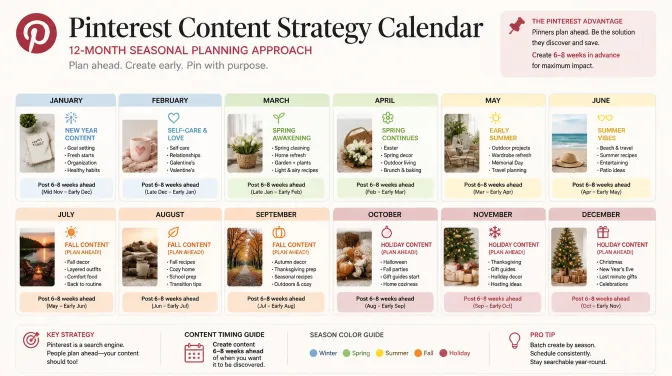
- Seasonal content posted ahead of season: Fall home decorating ideas posted in July (people plan ahead). November recipes posted in September. Pumpkin projects posted in July when search volume is climbing. The timing here is seasonal, not daily.
What consistently underperforms: generic non-searchable titles, low-quality images, vague descriptions with no keywords, content chasing trends that won't matter in two weeks.
Strategies More Important Than Posting Time
These four strategies generate vastly more traffic than any timing optimisation ever could.
Strategy 1: Keyword-First Approach
Don't optimise what you post or when — optimise for search intent. Find out what people are actually searching for in your niche, create content that answers those searches, optimise your pin around those keywords, and post whenever (timing is genuinely secondary). Expect months of compounding traffic as a result. Research tools: Pinterest's own search bar with autocomplete suggestions, Google Trends for search volume patterns, dedicated keyword research tools (Ahrefs, SEMrush), and competitor analysis to see what's already ranking. The difference: create pins optimised for "modern kitchen design" — searched for year-round — instead of "post about kitchen at 9 AM."
Strategy 2: Seasonal Content Planning
Time your pins to when people are searching for topics, not random calendar slots. Seasonal calendar: January (New Year organisation, renovation, fitness), February (Valentine's Day, small spaces), March–April (spring cleaning, garden planning), May–June (summer entertaining ideas), July–September (back to school, fall decorating), October–November (holiday hosting and prep), December (holiday gifts and decorations). Plan and write seasonal topics 30–60 days in advance so pins are indexed before people start searching. Sophie posted summer decorating pins in January — when people were searching — not June, and captured search volume at peak intent.
Strategy 3: Repurpose and Refresh
Create multiple pin designs for the same content, staggered over time. One blog post ("Ideas for Modern Kitchens") becomes 5–7 different pin designs. First design posted Tuesday, second design Friday, third design the following Tuesday, spread over 2–3 weeks. Each design appeals to different audience segments, keeps content visible, and is treated as new by the algorithm each time. Impact: one blog post = 7 pins = 7x visibility potential over weeks and months.
Strategy 4: Target Evergreen Long-Tail Keywords
Build sustainable traffic engines instead of chasing the next viral moment. Long-tail keywords are more specific, less competitive, always relevant, and build authority in a niche over time — with traffic compounding as the library grows. Compare: a viral "You won't believe this kitchen hack!" pin gets 1,000 views and then dies. A long-tail "10 Ways to Organise Small Kitchen Pantries" pin gets 100 views per month for 24 months = 2,400 views and compounding. The long-tail strategy drives dramatically more total traffic than timing optimisation ever will.
When Pinterest Timing Actually Matters
Timing isn't completely irrelevant — there are specific situations where it genuinely affects outcomes.
What Timing DOES Affect (Minimally)
The first 24-hour boost can give 10–20% more initial impressions. First-week visibility is slightly improved. Long-term traffic impact: essentially none. The numbers tell the story: a mediocre pin posted at the "perfect" time might get 500 impressions in the first 24 hours and 1,000 total after a month. An excellent pin posted at a suboptimal time might get only 300 first impressions but reach 15,000 total after a month. Timing impacts velocity (how fast people see it) — not trajectory (how far it ultimately reaches).
The Three Situations Where Timing Genuinely Matters
- Seasonal material: Summer content should publish in April–May (people are already searching for summer ideas). Holiday content needs to start 6–8 weeks ahead. This is about seasonal intent timing, not platform mechanics.
- Following trends: Posting about trending topics during high search volume windows for "trending now" searches. This should be a small part of an overall strategy, not the foundation.
- Coordinated campaigns: Multiple pins promoting a launch on the same day, synchronised with a blog post or other marketing activities, where coordination creates synergy across channels.
Optimising content is a far better use of effort than optimising timing. If you're not dealing with seasonal launches, trending topics, or coordinated campaigns, time spent on timing strategy should be redirected to keyword research and pin design quality — where the real returns live.
Common Timing Mistakes That Cost You Time
Spending hours trying to find the "perfect time" to post when content strategy is 100x more important to overall results.
"I'll post at 9 AM every day" misses the real seasonality patterns that actually drive Pinterest traffic.
Releasing content as you make it, rather than timing it for when people will actually be searching for that topic.
Creating a single pin for a piece of content instead of multiple designs staggered over time, leaving significant visibility potential untapped.
Maximising posting time instead of maximising searchability — optimising the variable that matters least while ignoring the one that matters most.
The GTR Socials View: Timing on Pinterest Is Overrated
At GTR Socials, we work across platforms, and the most misleading advice we encounter anywhere is Pinterest timing advice.
Our position: Pinterest is a search engine, not a social feed. The "optimal posting times" framework that applies to Instagram or TikTok simply does not transfer to Pinterest. Four reasons Pinterest timing guides fall short: (1) the algorithm is search-based, not chronological — timing affects only initial push, total searchable reach matters far more; (2) content has a lifespan of months, not hours — Instagram dies in 24 hours, Pinterest pins last 6–24 months, so timing affects velocity, not trajectory; (3) user behaviour differs fundamentally — people search actively rather than scroll passively, and seasonal patterns dominate daily patterns; (4) the actual evidence is mixed and inconclusive, with enormous individual and niche variation.
What doesn't work: buying fake followers (obvious, bannable), artificial engagement (algorithmically detected), and fake saves (doesn't trigger real distribution since Pinterest's ranking is search-driven, not engagement-velocity-driven the way other platforms are). What could potentially help: real saves and engagement from genuine users providing initial signal quality, helping overcome the cold-start barrier — but only if the pins are genuinely search-optimised to begin with.
What we're transparent about: non-searchable content cannot be saved by any growth service. Timing optimisation will not solve content issues. A keyword strategy is the foundation of long-term Pinterest success — growth services are most useful for getting over the initial visibility hurdle, never as a replacement for searchable content. Our Pinterest followers and Pinterest engagement services work best alongside genuinely keyword-optimised pins — never as a substitute for them.
First: Keyword research and targeting (the foundation everything else builds on). Second: Create high-quality, searchable pins (essential). Third: Optimise pin titles and descriptions (important). Fourth: Post consistently — 3–5 pins per week, sustainably. Fifth: Create multiple designs per piece of content to expand reach. Sixth: Plan by seasonality — when people are actually searching. Seventh: Optimise time of posting (lowest priority). What makes Pinterest successful isn't a scheduling strategy — it's a search strategy. Publish content that's searchable and builds traffic over months. Timing is secondary, always.
Your Pinterest Timing Playbook
A structured, month-by-month roadmap for building sustainable Pinterest traffic through search strategy rather than scheduling.
Build Your Keyword and Strategy Foundation
Goal: a 30–60 day content calendar built around real search demand.
- Conduct keyword research related to your niche
- See how pins currently rank for your top target keywords
- Analyse competitor pins — what designs and topics are top performers
- Develop a 30–60 day content calendar tailored to seasonal search trends
Build and Optimise Content
Goal: a library of optimised pins ready for staggered release.
- Create high-quality vertical pins (1000×1500px or larger)
- Optimise titles for target keywords
- Write detailed, keyword-rich descriptions (150–300 characters)
- Create 3–5 design variants of each content piece
- Prepare content for drip-feed release over weeks
Post Consistently and Test
Goal: establish a sustainable posting rhythm while gathering data.
- Pin regularly — 3–5 pins per week
- Stagger multiple designs of the same content over time
- Track which keywords are driving traffic
- Identify which pin designs perform best
- Treat posting time as an optional, secondary experiment
Scale What's Working
Goal: compounding traffic growth through scaled keyword strategy.
- Double down on keywords that are already driving traffic
- Create more content for trending searches in your niche
- Scale successful pin design types and formats
- Plan seasonal content 2–3 months in advance
- Continue researching new keyword opportunities
Pinterest Timing Questions
Final Thoughts: Pinterest Rewards Strategy, Not Scheduling
Sophie, the home decor blogger who learned timing isn't everything the hard way? Six months later she told me something that sums up Pinterest in a sentence: "I thought I was playing a timing game. It turns out I was playing a keyword game. When I optimised for search instead of scheduling, everything changed. My 'wrong-time' posts beat my 'perfectly timed' posts because they were answering questions people were actually searching for."
Her new method: seasonal content planning based on monthly search patterns, keyword research driving what to create, multiple pin designs for the same content, staggered posting over weeks rather than strategic daily timing, an evergreen focus on content people search for year-round, and far less time spent on finding the "best" time to post.
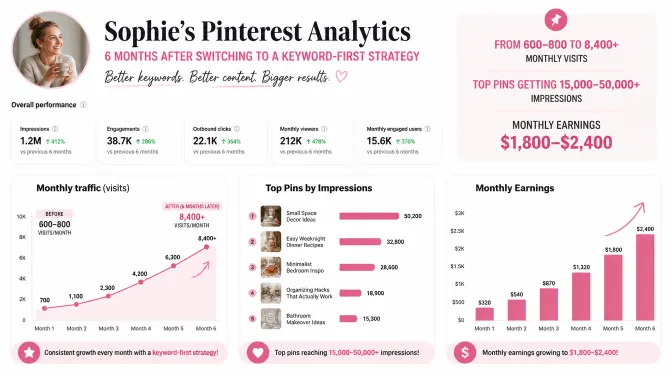
Her scorecard: 8,400+ monthly visits from Pinterest (up from 600–800), compounding growth (month 6 outperforming month 1, month 12 expected to outperform month 6), predictable and sustainable traffic, and less time spent overall — less optimisation, better results.
The platform rewards discoverability, not scheduling. Keyword strategy beats timing strategy by orders of magnitude. Top Pinterest creators focus on keyword research and search strategy, make pins that are high-quality and searchable, build for long-term compounding traffic, plan content based on seasons (when people search, not when you post), create multiple designs for expanded reach, and don't overthink when to post. Build compound traffic over months by getting the fundamentals right — search comes first, scheduling comes last.
Post. Don't wait for the "perfect" time. 9 AM versus 2 PM doesn't matter the way you think it does. Don't think of Pinterest as Instagram. Start researching what people are actually looking for. Start writing keyword-rich, searchable content. Start planning for the season, not the day. Your success on Pinterest has nothing to do with the perfect posting schedule — it's about keyword research, content strategy, and the patience to build compounding traffic over months. Forget the timing. Go build your Pinterest search strategy.
📌 Ready to Build Pinterest Traffic That Compounds Over Time?
GTR Socials helps creators overcome the cold-start barrier on Pinterest — real engagement signals that help genuinely keyword-optimised pins get the initial momentum they need to start ranking in search.
Comments (0)