

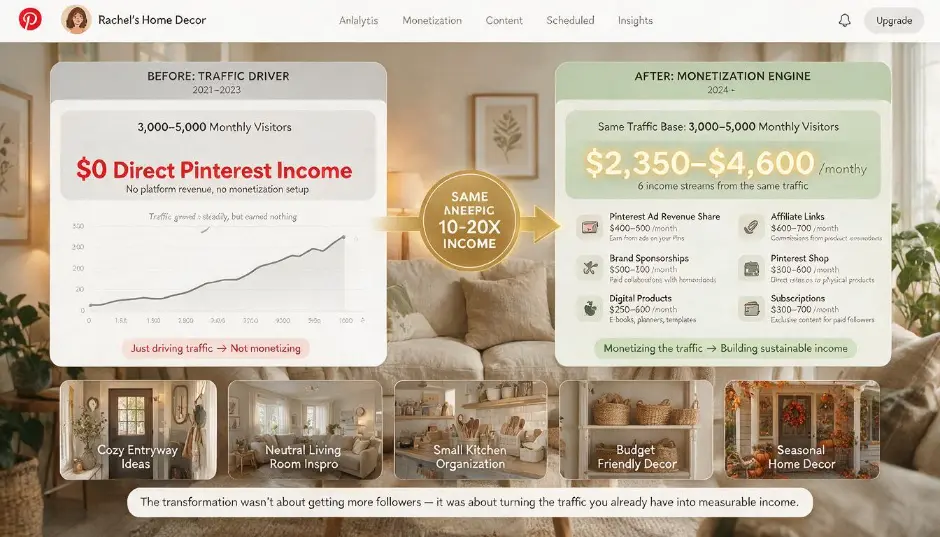
Rachel used Pinterest for two years as a traffic driver and earned $0 directly from it. Six months after restructuring her strategy around actual monetization: $2,350–$4,600/month. Same traffic. Completely different understanding of what Pinterest traffic is worth.
Six months ago, I watched a home decor creator named Rachel discover something that completely changed her understanding of Pinterest income.
She'd been using Pinterest for two years as a traffic driver. She'd pin her blog posts, articles, and design inspiration. It worked beautifully — Pinterest sent her 3,000–5,000 monthly visitors to her blog, where she made affiliate commissions and sold digital products. But she wasn't making any money directly from Pinterest itself.
"Everyone says you can't make money on Pinterest," she told me one day. "I've accepted that. Pinterest is just my traffic driver. The money comes from everywhere else." Then Pinterest launched their creator monetization program — and Rachel had no idea how to use it. "Do I get paid per pin view like TikTok? Per follower like Instagram? Is there a Creator Fund?" she asked, confused.
I had to tell her what most Pinterest creators don't realise: "Pinterest monetization is completely different from every other platform because Pinterest is fundamentally different. You're not getting paid for views or followers. You're getting paid because Pinterest recognises that you help their users find products and solutions. The monetization is built around that value exchange."
❌ Two Years of "Pinterest Is Just a Traffic Driver"
✅ Six Months After Strategy Restructure
Pinterest isn't about direct platform payments like TikTok's Creator Fund. It's about recognising that Pinterest traffic is high-intent, high-value traffic. The people who click your pins are looking for solutions, actively buying products, and ready to engage. The money comes from understanding who these people are and what they want, then monetising that audience through multiple channels simultaneously.
Understanding Pinterest Income — It's Different
Before discussing methods, understand why Pinterest monetization is unique compared to every other platform.
Pinterest Isn't Social Media — It's Search Plus Recommendations
📱 Instagram / TikTok / YouTube
Social platforms primarily showing friends' content. Monetised through platform payments — ads, Creator Fund. Engagement metrics drive income. Follower count directly determines earning potential.
Visual search engine plus recommendation engine. Not primarily social — you don't follow people the way you do on Instagram. Monetised through traffic value and conversions. User intent matters far more than engagement. Follower count barely matters for income.
What this means for income: you're not getting paid by Pinterest for views or followers. You're getting paid through Pinterest by driving valuable, converting traffic.
Why Pinterest Traffic Is Gold
Pinterest users are fundamentally different from users on other platforms — and that difference translates directly to income. Pinterest users are actively searching for solutions with high purchase intent. They look for products to buy, and they search repeatedly for the same types of content. The demographic skews toward higher spending power, and the mindset is planning-oriented rather than entertainment-oriented.
The practical difference in numbers: 1,000 Pinterest visitors might convert 50 to affiliate sales. The same 1,000 Instagram or TikTok visitors might convert 2–5. That's why Pinterest traffic is worth more — and why the monetization strategy is built around traffic quality, not traffic quantity.
Pinterest is finally building creator monetisation at scale — the Ads Fund launched recently (similar in concept to YouTube's Partner Program), creator tools are expanding, and more monetisation options are being added. The creator economy here is still developing, which means early movers have an advantage before it becomes as competitive as Instagram or TikTok.
Methods 1–3: Core Income Streams
These three methods form the foundation of Pinterest monetization — from official platform income to the highest-earning active method for most creators.
Pinterest Ads Fund (Official Monetization)
Passive Bonus — Not PrimaryPinterest's answer to the YouTube Partner Program — sharing advertising revenue with creators based on pin performance and engagement. Requirements: 10,000+ followers (historically, may change), 50,000+ outbound clicks in the last month, account in good standing, US-based initially. Monthly payouts.
Starting creators (10–50K followers): $50–200/month · Growing creators (50–250K followers): $200–800/month · Established creators (250K+ followers): $800–3,000+/month. Rachel's result at 156K followers: $150–300/month.
Affiliate Marketing Through Pins
Most Profitable for Most CreatorsPin products with affiliate links. Users click pin, visit the product page, make a purchase, and you earn commission — typically 5–40% depending on the program. Best affiliate programs for Pinterest: Amazon Associates (1–10%), niche brands in home decor/fashion (10–30%), digital products like courses and templates (30–50%), hosting and SaaS tools (20–40%).
- Find products relevant to your niche
- Join affiliate programs
- Create pins featuring products
- Include affiliate link in pin description
- Drive traffic, earn commissions
- Users actively searching for products
- High conversion rates vs. other platforms
- Recurring searches (same user returns)
- Multiple commission opportunities per pin
- Pins work for months and years
Small niche (10K followers): $100–300/month · Medium niche (50–100K followers): $300–1,000/month · Established niche (100K+ followers): $1,000–5,000+/month. Rachel: 100+ affiliate partnerships = $600–1,200/month.
Sponsored Pins and Brand Partnerships
Highest Single-Pin RevenueBrands pay you to feature their products in authentic pins. Find sponsors by reaching out directly to brands in your niche, showing engagement metrics (monthly visitors, outbound clicks), using sponsorship platforms like AspireIQ and Billo, or building enough presence that brands discover you. Transparent disclosure required.
Early stage (10–50K followers): $200–800 per sponsored pin · Established (50–250K followers): $800–2,500 per pin · Major creators (250K+ followers): $2,500–10,000+ per pin. 2–4 sponsored pins monthly = $1,600–$10,000/month. Rachel: 3–4 sponsored pins monthly from home decor brands = $400–800/month.
Methods 4–6: Additional Revenue Streams
These three methods extend Pinterest monetization beyond the pins themselves — building owned assets and income streams that compound over time.
Driving Traffic to Your Own Products
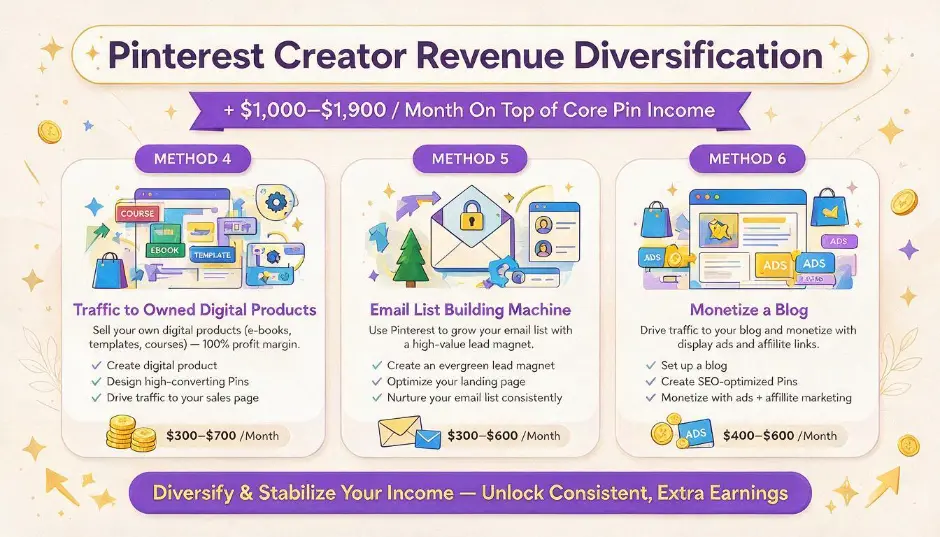
Highest Margin PotentialUsing Pinterest to sell your own products — digital products (templates, guides, courses), physical products, coaching or consulting services, blog content with membership or ads, or email list signups with a lead magnet. Create pins linking to your product sales page. High-intent traffic clicks, lands on the sales page, and converts to purchases at rates far above entertainment platform traffic.
Why this works on Pinterest specifically: users are actively looking for solutions. If you're selling the solution they're searching for, conversion rates are dramatically higher than from Instagram or TikTok traffic.
Single product launch: $500–2,000 · Multiple products: $1,000–5,000/month · Mature product line: $5,000–20,000+/month. 100% profit margin (no commission split), scalable — create once and sell indefinitely.
Email List Building (The Underrated Method)
Most Overlooked — Highest Long-Term ValueUsing Pinterest traffic to build an owned audience that isn't algorithm-dependent. Create pins linking to a lead magnet (free guide, free email course, free template). Users click the pin, join your email list, and become a direct marketing relationship outside of Pinterest's algorithm. Monetise the email list through products, affiliate offers, and sponsored emails.
Why Pinterest is particularly effective for this: the traffic is ongoing (Pinterest users return repeatedly), it's high-intent (actively searching for the problem your lead magnet solves), and the same lead magnet gets exposure to multiple new people daily through search. Rachel built 2,400 email subscribers from Pinterest = $300–600/month in email monetisation.
1,000 email subscribers: $100–300/month potential · 5,000 email subscribers: $500–1,500/month · 10,000+ subscribers: $1,500–5,000+/month.
Blog Monetization Using Pinterest as Traffic Source
Passive Compound GrowthDrive Pinterest traffic to blog content and monetise the blog through multiple channels: display ad revenue (Google AdSense, Mediavine), affiliate marketing, sponsored content, premium or membership content, and email capture funnels. Pinterest's evergreen traffic model is ideal for blog monetisation — unlike social media posts that die in hours, a well-optimised pin can drive traffic to the same blog post for years.
1,000 monthly blog visitors: $30–100/month (ad revenue alone) · 5,000 monthly visitors: $100–300/month · 10,000+ monthly visitors: $300–1,000+/month, plus additional affiliate and sponsorship revenue. Rachel: 3,000–5,000 monthly Pinterest visitors = $500–800/month total blog monetisation.
How These Methods Stack Together
Rachel's diversified approach wasn't one method — it was all six working together, with each method feeding and amplifying the others.
Each method feeds the others. Affiliate pins drive blog traffic. Blog content becomes future pins. Email list subscribers buy digital products. Sponsored brands know you drive sales because affiliate conversions prove it. Multiple smaller streams create more stable total income than one big stream — if affiliate revenue dips one month, you still have Ads Fund plus sponsored plus blog income keeping the total consistent.
Common Pinterest Monetization Mistakes
Posting for engagement and likes instead of discoverability. Forgetting that Pinterest is a search engine, not a social feed. Engagement metrics on Pinterest have little to do with income.
Low-quality, unclear pins that users scroll past. No traffic means no monetization, regardless of how good your affiliate products or blog content are.
Pinning everything (recipes, fashion, home decor, business advice). Users and the algorithm get confused about what your account is actually for.
Promoting products purely for commission rates. Pinterest users notice inauthentic recommendations and unfollow or ignore future pins.
Descriptions without keywords mean Pinterest can't recommend your pins to the right people — the high-intent buyers who would actually convert.
Pinning sporadically — a burst of 50 pins then nothing for two weeks. Pinterest's algorithm deprioritises accounts with irregular activity.
Treating Pinterest only as a traffic source to external products and missing the opportunity to build an owned audience that isn't dependent on any algorithm.
The GTR Socials Perspective: Pinterest Is Underrated
At GTR Socials, we see Pinterest as one of the most underrated platforms for creator income — and one that most creators dramatically underestimate.
What we know: Pinterest traffic converts better than Instagram or TikTok for most niches. Multiple income streams are possible simultaneously — more so than on most platforms. Passive income potential is higher because pins last months and years, not hours. Email list building is genuinely easier on Pinterest than anywhere else because of the high-intent, search-driven audience. The creator economy is still developing, which means opportunity still exists before saturation.
Why creators overlook Pinterest: it doesn't feel like "social media" because it's a search engine. There are no viral moments — growth is slower and steadier. Younger creators prefer TikTok and Instagram where growth feels more exciting. Monetization is less obviously visible than YouTube. And results take time — minimum 3–6 months before meaningful income develops.
Pinterest might generate slower follower growth but faster revenue growth than entertainment platforms. But that revenue doesn't appear immediately. Expect 3–6 months of consistent work before meaningful income. Creators who give up at month 2 miss the compound growth that starts happening at month 4–6 when search optimisation starts paying off at scale.
First: Create keyword-optimised pins (searchability is the entire foundation). Second: Build a consistent daily pinning schedule to feed the algorithm. Third: Identify your 2–3 starting monetization methods (don't try all six at once). Fourth: Drive traffic to owned products and email list to build assets. Fifth: Scale affiliate and sponsorship income as traffic grows. The sustainable approach: search optimisation plus consistency plus traffic monetization. Quick follower growth isn't the goal — sustainable income is.
Your Pinterest Income Action Plan
A structured month-by-month roadmap built around the realistic timeline Pinterest monetization actually requires.
Build the Foundation — Before Monetizing
Goal: 5,000–10,000 monthly visitors, 50+ email subscribers, established keyword strategy.
- Audit niche focus — get specific about what you cover
- Create 100 keyword-optimised pins targeting real search queries
- Set up affiliate accounts — Amazon Associates plus 2–3 niche brands
- Build consistent pinning schedule (10+ pins daily)
- Create your first lead magnet (free guide) for email list building
Activate First Monetization Streams
Goal: $300–500/month combined income from first methods.
- Join Pinterest Ads Fund if you've hit eligibility requirements
- Implement affiliate links across your best-performing pin categories
- Create your first digital product (template, guide, or mini-course)
- Reach out to 5–10 potential sponsor brands in your niche
- Build email list to 500+ subscribers
Scale Across Multiple Revenue Streams
Goal: $1,000–2,000/month from diversified sources.
- Scale sponsored pin partnerships to 2–3 monthly
- Build product line with multiple offerings at different price points
- Grow email list to 1,000+ subscribers
- Start or scale blog if not already monetising
- Leverage email list for additional direct revenue
Scale Sustainable Income
Goal: $2,000–5,000+/month sustainable income from Pinterest ecosystem.
- Scale the best-performing income streams based on real data
- Build email list to 5,000+ subscribers
- Increase sponsored partnership frequency and rates
- Create additional products as the audience needs evolve
- Explore new sub-niches or complementary content areas
FAQ: Making Money on Pinterest
Pinterest's Quiet Income Potential
Rachel, who went from "you can't make money on Pinterest" to $2,000–$4,600/month? She told me something that perfectly captures Pinterest's advantage: "I spent two years just driving traffic. I didn't realise the traffic itself was the product. Once I understood that high-intent Pinterest traffic was valuable and monetisable, everything changed. Now Pinterest is my most profitable channel, and most people don't even know it exists as an income opportunity."
She's right. That's Pinterest's entire advantage.
Pinterest isn't flashy. It doesn't have viral moments. You won't become famous overnight. But it has something better: a stream of high-intent users actively looking to buy, learn, and solve problems. That's gold for creators. The formula that works: keyword research → quality pins → consistent schedule → multiple monetisation methods → scaling what works. Stop thinking Pinterest is just a traffic driver. Start recognising high-intent traffic as a monetisable asset. Your Pinterest income isn't waiting in your follower count — it's waiting in understanding that search-intent traffic converts better than entertainment traffic.
Stop treating Pinterest like Instagram. Start treating it like a search engine. Now go optimise your pins for search — and monetise that traffic.
Rachel's Full Results: What the Pinterest Monetization Strategy Actually Produces
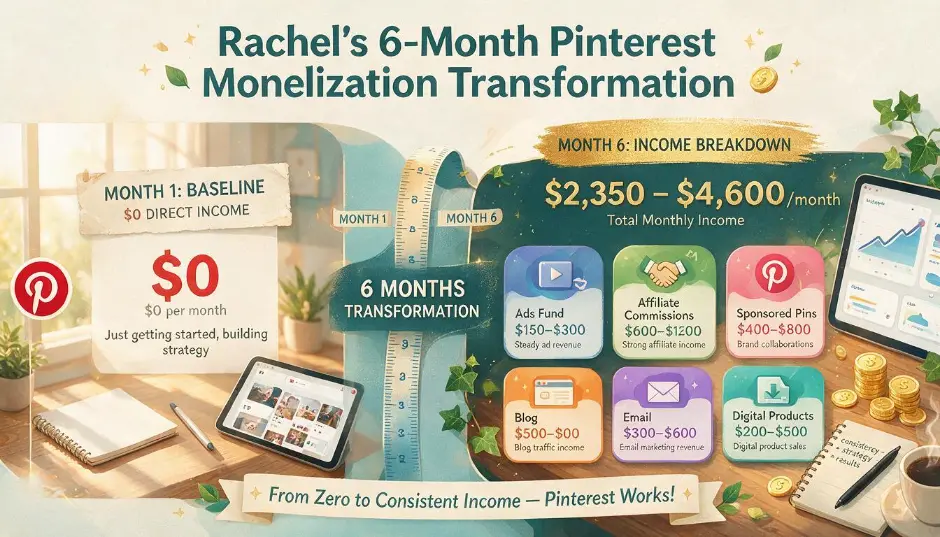
Same traffic. Completely different monetisation strategy. The six income streams work together in a compounding system where each amplifies the others — affiliate pins prove conversion ability to sponsors, sponsored pins drive email signups, email subscribers buy digital products, digital product buyers become blog readers, blog readers discover more affiliate pins.
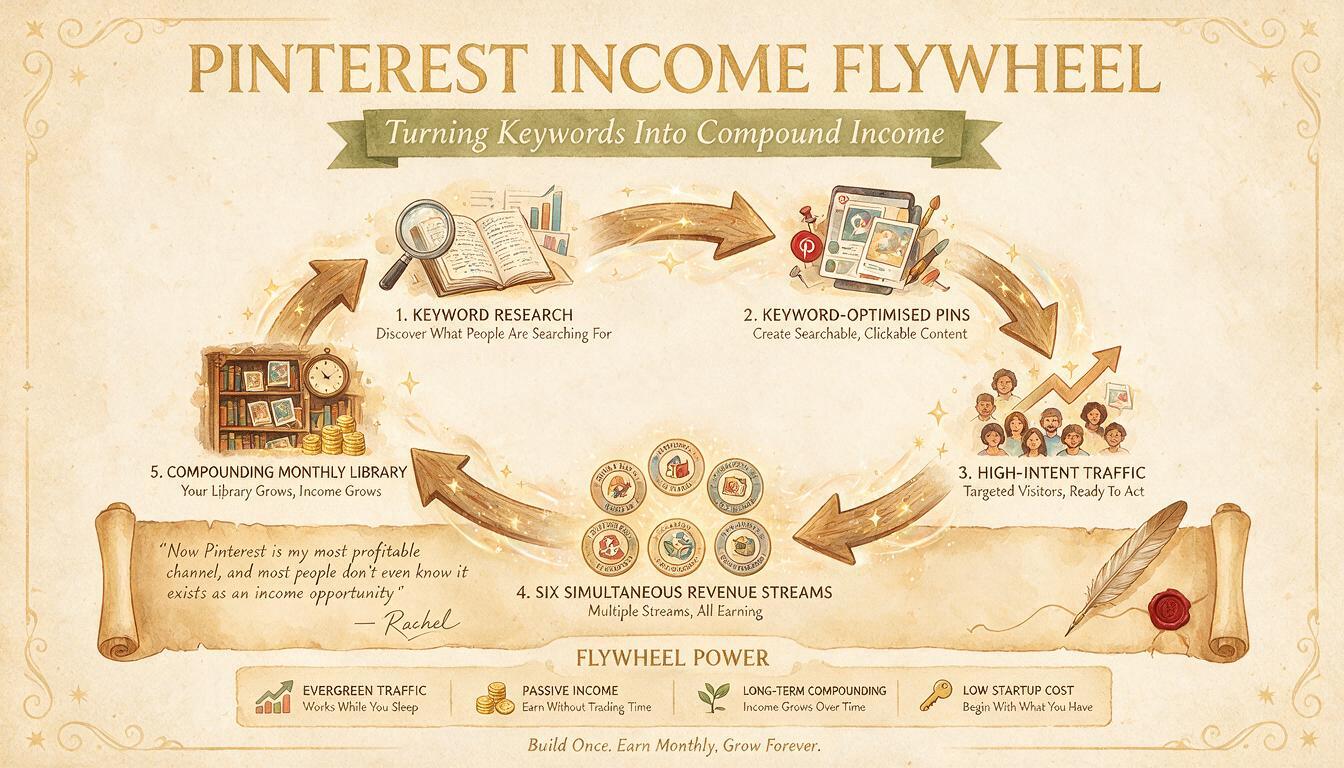
The key principle Rachel discovered: Pinterest success is not about follower count, engagement rates, or viral moments. It's about building a growing library of keyword-optimised pins that continuously deliver high-intent traffic to multiple monetisation points — and understanding that 1,000 Pinterest visitors are worth dramatically more than 1,000 visitors from entertainment-focused platforms, because they're actively looking to buy, not passively consuming.
📌 Ready to Build the Pinterest Presence That Monetizes?
GTR Socials helps Pinterest creators build the follower base and engagement signals that unlock the Ads Fund, attract brand sponsors, and give your keyword-optimised pins the initial visibility boost they need.
Comments (0)