

Casey's perfectly-timed posts averaged 400–800 impressions for two years. Their accidental 2:47 AM tweet got 23,000 impressions, 450 new followers, and 120 real conversations. X's algorithm doesn't reward timing. Here's what it actually rewards.
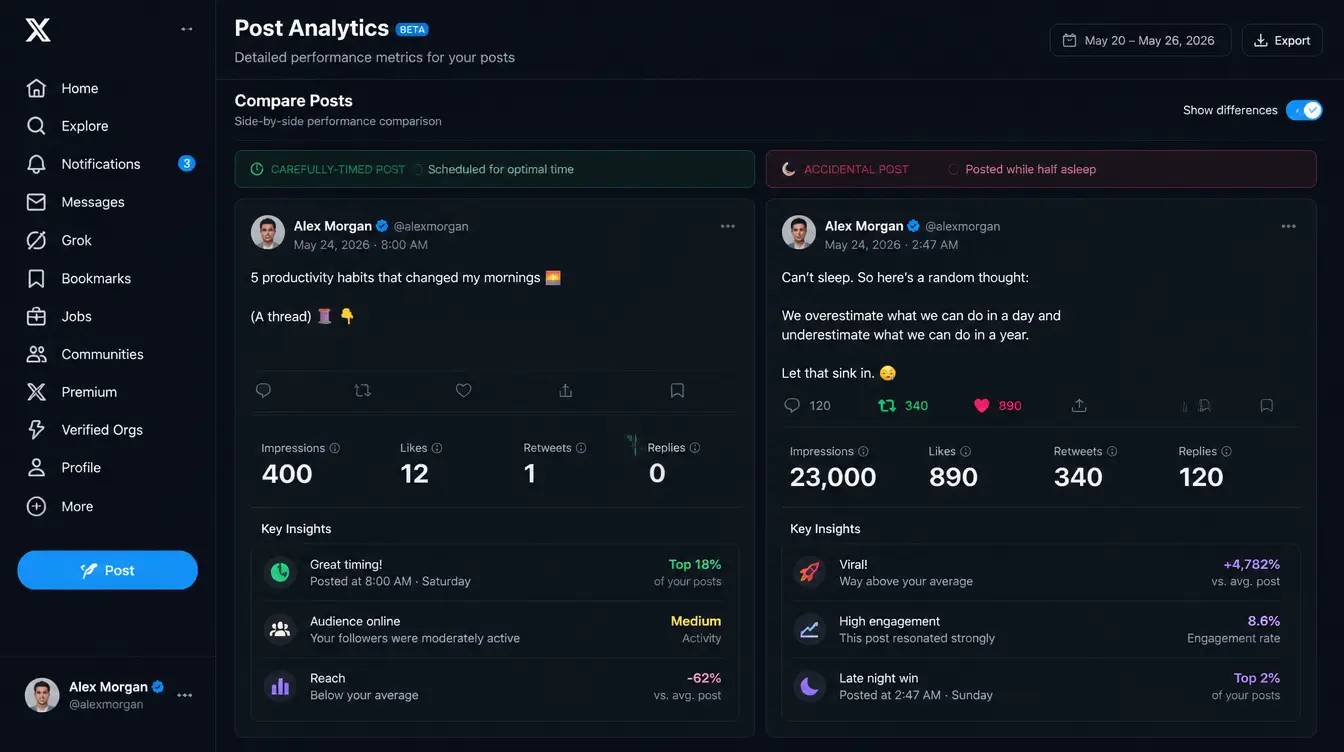
Three weeks ago I watched a fintech educator named Casey do an experiment that completely changed how they thought about timing on Twitter/X.
For two years, Casey had been doing everything by the book: posting at 8–10 AM EST (working professionals checking email), noon (lunch break), and 5–7 PM (end-of-workday wind-down). All the expert guides said the same thing. Their results with "optimal" timing: morning posts got 200–400 impressions and 5–15 likes. Lunch posts got 300–600 impressions and 8–20 likes. Evening posts got 400–800 impressions and 12–25 likes. Average engagement rate: 0.5–1%.
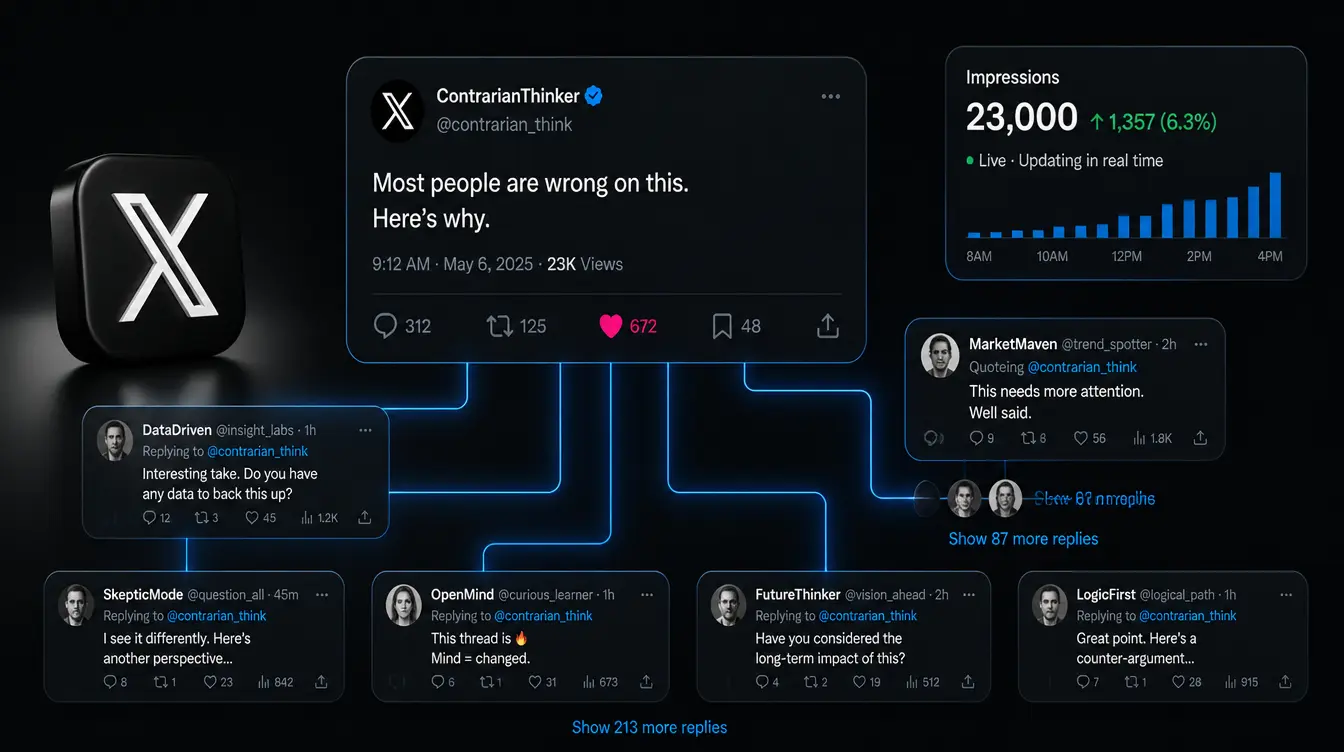
Then one Tuesday at 2:47 AM — total accident, Casey had insomnia and decided to tweet instead of sleep — they wrote: "Honest question: Why do fintech founders act shocked when regulations catch up? We all knew this was coming. The surprise isn't the regulation. It's the arrogance that built it."
❌ Two Years of "Optimally Timed" Posts
✅ One Accidental 2:47 AM Post
"Why did I get 50x more engagement on my 2:47 AM accident post than my intentionally timed posts?" Casey asked me, genuinely confused.
I had to explain what most Twitter/X timing guides ignore: "Because X's algorithm doesn't care about timing like Instagram or TikTok does. Your midnight post worked because it started real conversation and debate — which the algorithm cares about way more than when you posted it. Most 'best time' advice is based on old Twitter assumptions that don't apply to X in 2026."
Timing matters — but less than most guides would have you believe. What matters infinitely more is creating content that sparks conversation, debate, and sharing. A great post at 3 AM is better than a mediocre post at 9 AM by orders of magnitude. This guide covers the real algorithm, what timing research actually shows (with honest caveats), and what Casey discovered about what X actually rewards.
How X's Algorithm Really Works in 2026
Before any timing discussion, you need to understand what changed from Twitter to X — because most timing guides are still using pre-2023 assumptions.
🐦 Old Twitter (Before 2023)
Chronological feed with algorithmic boost. Timing really mattered — content had a short window. Retweets and favourites heavily weighted. Large follower count was a strong indicator of reach. Best times mattered significantly.
𝕏 X in 2026
Chronological and algorithmic hybrid. "For You" tab highly algorithmic (like TikTok). "Following" tab mostly chronological. Engagement quality more important than raw metrics. Follower count is a much weaker reach indicator.
What this means for timing: X is less time-dependent than old Twitter, but more time-dependent than Instagram's purely algorithmic feed. Timing is a factor, but not the dominant one. Casey's 2:47 AM post demonstrates this perfectly.
Core Algorithm Principles
1. Engagement and conversation quality (first priority). X focuses on replies (especially back-and-forth conversations), retweets with added commentary, quote posts, reading and interaction time, and links that generate real engagement. It deprioritises basic likes, quick scrolls without interaction, retweets without commentary, and followers who don't engage. Casey's post worked because it sparked serious discussion — people replied, quote-posted, and engaged substantively. That's what the algorithm amplifies.
2. Recency counts but not as much as you might think. X's algorithmic "For You" feed shows a mix of new and old posts. Content that gains sustained traction can continue distributing for days. The first hour is most important for initial distribution, but the algorithm keeps testing quality content for 24+ hours and beyond. A good post can still go viral weeks later. Timing affects starting velocity, not ceiling.
3. Authenticity and originality signals. X's algorithm rewards original thoughts over engagement-bait hot takes, real expertise and genuine sharing, and nuanced perspectives over rage-bait. It doesn't prioritise "RT if you agree" engagement bait, obvious viral content reposts, low-effort opinions, or bot-like behaviour patterns. An original thought at 3 AM consistently outperforms a derivative post at 9 AM.
On Instagram, a post dies within hours. On TikTok, timing affects which audience sees your content during a narrow window. X gives your content much more time to find its audience — quality content keeps getting tested and redistributed. Timing affects how quickly your post starts, not how far it ultimately goes.
What Research Really Tells Us About X Timing
Here's what the data shows — alongside the honest caveats that most guides skip entirely.
General Timing Patterns (2026 Data)
Morning Window
6–9 AM ESTMorning scroll and coffee hour. Working professionals checking feeds before starting the day. Best for finance, B2B, and professional content. Particularly strong Tuesday–Thursday.
Lunch Window
12–1 PM ESTLunch break browsing. Short but focused attention. Good across most niches. Debate and opinion posts work particularly well here when people want mental stimulation during a break.
Evening Windows
5–7 PM & 9–11 PM ESTPost-work wind-down and evening relaxation. Strong for discussion-heavy content. The 9–11 PM window is surprisingly active for genuine long-form engagement — people have headspace for real conversations.
Best days generally: Tuesday–Thursday see highest average engagement. Sunday is good (people catching up). Monday is mixed. Friday engagement drops (more people offline). Saturday is very niche-dependent. Worst times: 2–5 AM for most niches, Saturday daytime, and holidays.
Timing advice for X should be treated with more scepticism than Instagram or TikTok timing advice for four reasons: (1) X has a smaller, less-studied user base than mature platforms — less data means less predictable patterns and more variance; (2) the algorithm so heavily prioritises conversation quality that a great post at a bad time reliably outperforms a mediocre post at an optimal time; (3) X has a more globally diverse, discussion-driven user base with less scroll-based passive usage; (4) the algorithm has changed multiple times under new ownership — what worked in 2024 may not apply in 2026.
Your Niche Matters More Than General Data
Crypto and finance audiences are most active during market hours (9 AM–5 PM EST) with reduced weekend activity. Tech and developer audiences peak during business hours but have strong evening activity for side projects — late night is surprisingly engaged. Entertainment and culture audiences peak in evenings (7–10 PM) and weekends, and immediately after major events. News and politics audiences peak in the morning (catching up) with evening discussion peaks on weekdays. Test your specific audience rather than following generic advice.
Why Content Quality Is More Important Than Timing on X
Let's be direct: on X more than any other major platform, what you say matters far more than when you say it.
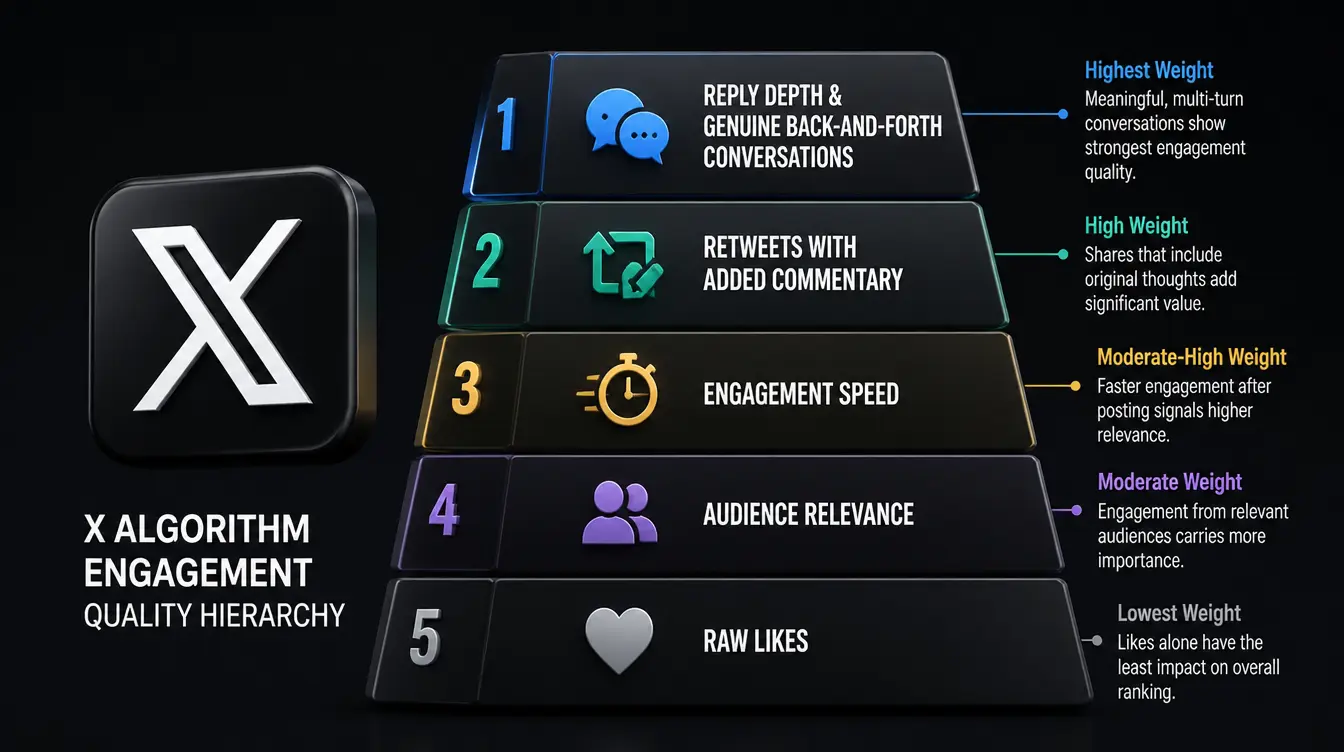
The Engagement Quality Hierarchy
What X's algorithm cares about, in descending order:
Repeated exchanges in replies, meaningful multi-message threads, long conversations over hours, communities building around ideas. This is what made Casey's post go from 800 to 23,000 impressions.
Quote posts that advance discourse, sharing ideas with original thought, retweets that add perspective. These signal that your content is worth building on.
How fast posts get engagement after posting, early engagement as quality signal, followers with high engagement rates. Relevant audience beats large audience every time.
Likes are engagement but low signal algorithmically. Retweets without commentary aren't worth as much. Follower count barely matters. These are the vanity metrics most guides optimise for.
Content Types That Consistently Work (Regardless of Timing)
- Unique perspectives and contrarian takes: "Everyone says X but it's actually Y." Nuanced positions on hot topics. Original analysis no one else has shared. Casey's fintech regulation post was pure contrarian perspective — and it sparked 120+ replies.
- Questions that spark discussion: "What's the biggest misconception about your business?" "Hot take: [opinion] — thoughts?" Open-ended prompts asking for a genuine reply.
- Authentic vulnerability: Lessons and personal struggles, behind-the-scenes realities, honest reflections on failures. The algorithm can't distinguish "authentic" from "manufactured" directly, but audiences can — and authentic content earns real replies.
- Original research and data: Charts and insights, original analysis, data visualisations. "I looked at X and found Y" framing consistently outperforms opinion posts on X's algorithm.
- Real-time commentary on current topics: Immediate comments on breaking news, alternative perspective on live debates, relevant participation in cultural dialogue.
What consistently underperforms regardless of timing: self-promotion without value, engagement bait, content regurgitation, low-effort takes, and bot-like posting patterns.
Strategies That Matter More Than Timing
These four approaches generate more reach than any timing optimisation — and they work at any hour.
Strategy 1: Engagement-First Approach
Before posting your own content, spend 15–20 minutes replying to tweets in your niche — thoughtful, substantive responses that add value and perspective, not just "great post!" Then post your content. The algorithm has seen you as an active, engaged member. People who saw your replies are now more likely to notice and engage with your own post. Your account is "warm" — not dormant — and the initial engagement on your post benefits from the activity you've already generated in the community.
Strategy 2: The Threading Strategy
Multi-tweet threads consistently outperform single posts. Hook with an engaging opening, number your thread (1/8, 2/8, etc.), build argument or story incrementally, ensure each tweet adds standalone value, and end with a strong conclusion and CTA. Threads work because they keep users engaged for longer (time spent), encourage replies at multiple points throughout the thread, demonstrate expertise and depth, and are highly shareable as complete thought packages. Evening hours may perform slightly better for threads since people need time to read — but quality matters far more than timing.
Strategy 3: Real-Time Participation
This is the one area where timing genuinely matters on X: breaking news commentary (post quickly), trending topic participation (short-term relevance window), live event real-time reactions (authenticity signals), and immediate responses to major announcements. Why timing is important here: not algorithmic preference, but relevance value. An old take on yesterday's news is intrinsically worth less. However, a thoughtful take posted the day after often outperforms a rushed hot take posted immediately. Speed matters for news; quality still wins for analysis.
Strategy 4: Test Your Specific Audience Patterns
The only timing advice that reliably works for your account comes from your own data. Weeks 1–2: post at different times (morning, noon, evening, late night), track impressions and engagement for each, note time, subject, and post type. Track time posted, impressions at 1 hour, 6 hours, and 24 hours, engagement rate, reply quality (substantive vs. "great post!"), and retweets with commentary. Weeks 3–4: identify your top 2–3 performing time windows, test whether performance was driven by timing or content quality, and confirm patterns before committing to them.
Common Timing Mistakes on X
Missing opportunities by waiting for the ideal posting window. Bad content at a good time still performs poorly. Good content at a "bad" time performs well. The algorithm prefers content quality over timing every time.
"I'll post at 9 AM daily to hit optimal time." Same time slot means the same subset of people see it every day. Algorithm can suppress repetitive posting patterns. Different audience segments are active at different times.
Optimising exclusively for your own time zone while ignoring a global audience. 9 AM EST equals 2 PM UTC, 6 PM in parts of Asia, and early morning in Australia. There's no single "best time" for everyone on a global platform.
"I'll post 5 times at peak hours every day." Follower fatigue, potential algorithm suppression for high volume, spam appearance, and engagement distributed thinly across too many posts.
Spending hours finding the perfect time while creating mediocre content. Timing cannot save bad content. The algorithm prioritises conversation quality regardless of when the post was made.
Post and then disappear — not responding to comments. Algorithm rewards conversational depth. Unanswered replies are missed opportunities to extend your engagement window and deepen the algorithmic boost.
The GTR Socials View: X Timing Matters Less Than You Think
At GTR Socials, we work across platforms, and X is uniquely different in how timing functions compared to every other major platform.
X's algorithm in 2026 is much more forgiving of timing than Instagram or TikTok. On those platforms, timing is critical for the initial distribution push — miss the window and the post barely reaches anyone. But X keeps testing and resharing quality content for hours and days after posting. Worrying excessively about the best time to post on X is a genuinely inefficient use of creative energy compared to improving content quality.
What doesn't work: purchased followers (visible and harmful to engagement rates), fake engagement (algorithm-detected), engagement pods (not effective on X's conversation-driven platform), and follower bots (bannable offence). What's important: X's algorithm is better than any other platform at detecting manufactured signals. Content quality is the only foundation that actually matters. Most valuable if anything: real engagement from genuine X users providing initial signals to help overcome the cold-start barrier — but only when the underlying content is genuinely engaging.
For X followers and X likes, our honest position: these can help overcome the cold-start barrier for new accounts with genuinely good content, but they cannot save bad content, and X's algorithm is sophisticated enough that quality must come first.
First: Create content that is genuinely useful or thought-provoking (the foundation). Second: Post consistently (3–5x daily, sustainable quality). Third: Be authentic — engage with others before posting your own content. Fourth: Track your timing patterns (optional, genuinely secondary). Fifth: Focus on quality of conversation rather than quantity of posts. Build something worth clicking on. Engage in conversations authentically. Good content gets better with timing; bad content doesn't improve regardless of when you post it.
Your X Timing Action Plan
A structured, month-by-month approach to understanding your actual timing patterns without letting timing optimisation distract from what actually drives X success.
Establish Your Real Timing Baseline
Observe without optimising — collect real data first.
- Post at varied times: morning, noon, evening, late night
- Track impressions and engagement for every post
- Note time posted, content type, and topic
- No optimising yet — just observing patterns in your data
Identify Real Patterns in Your Data
Separate timing signal from content quality signal.
- Review weeks 1–2 data for performance patterns
- Identify best performing time windows (if any clear ones emerge)
- Critically evaluate: was performance driven by timing or content quality?
- Note surprises — unexpected patterns often reveal niche-specific insights
Test Whether Your Patterns Hold
Confirm patterns before committing to them long-term.
- Post more frequently during identified peak time windows
- Check whether patterns hold with similar content types
- Test different content types at different times
- Refine your hypothesis with real evidence
Secondary Optimisation (Keep It Secondary)
Timing is now informing, not constraining, your posting decisions.
- Use timing data as a guide, not a rigid constraint
- Don't sacrifice authenticity or spontaneity for scheduling
- Focus primary energy on engagement quality — replies, discussions, threads
- Keep testing — X's algorithm evolves and your audience shifts
X Timing FAQs
Final Thoughts: Quality Always Beats Timing
Casey, the fintech educator whose 2:47 AM post changed everything, told me six months later: "I used to think timing was the game. That if I could just hit the magic hour, success would follow. My accident post taught me that the game is actually creating something worth engaging with. The timing barely mattered. The fact that it sparked debate? That's what the algorithm cares about."
They stopped fretting over the right time and focused instead on: producing real original analysis, stimulating genuine discussion and debate, engaging deeply in replies, creating content that demonstrates real expertise, and posting when they had something genuinely worth saying.
Timing is important — but not as important as most guides suggest. The real game is creating content that sparks genuine conversation, then participating in that conversation authentically. X's most successful creators focus on content over schedule, engage in conversations authentically, bring unique perspectives, reply meaningfully to replies, test their own audience patterns rather than following generic advice, and don't get hung up on rigid timetables. Post when you have something of genuine value to add. The algorithm rewards content quality, not the clock.
Don't stress over the best time to post. Don't develop content two weeks in advance just to hit a posting window. Stop assuming timing is the bottleneck. Start creating content that's genuinely worth engaging with. Start participating authentically in conversations. Post when you have something of value to say. Your X success doesn't depend on a well-timed post. It depends on your next truly insightful contribution to the conversation. Post when inspired. The algorithm rewards content, not time.
Casey's Results: What Conversation-First X Strategy Produces
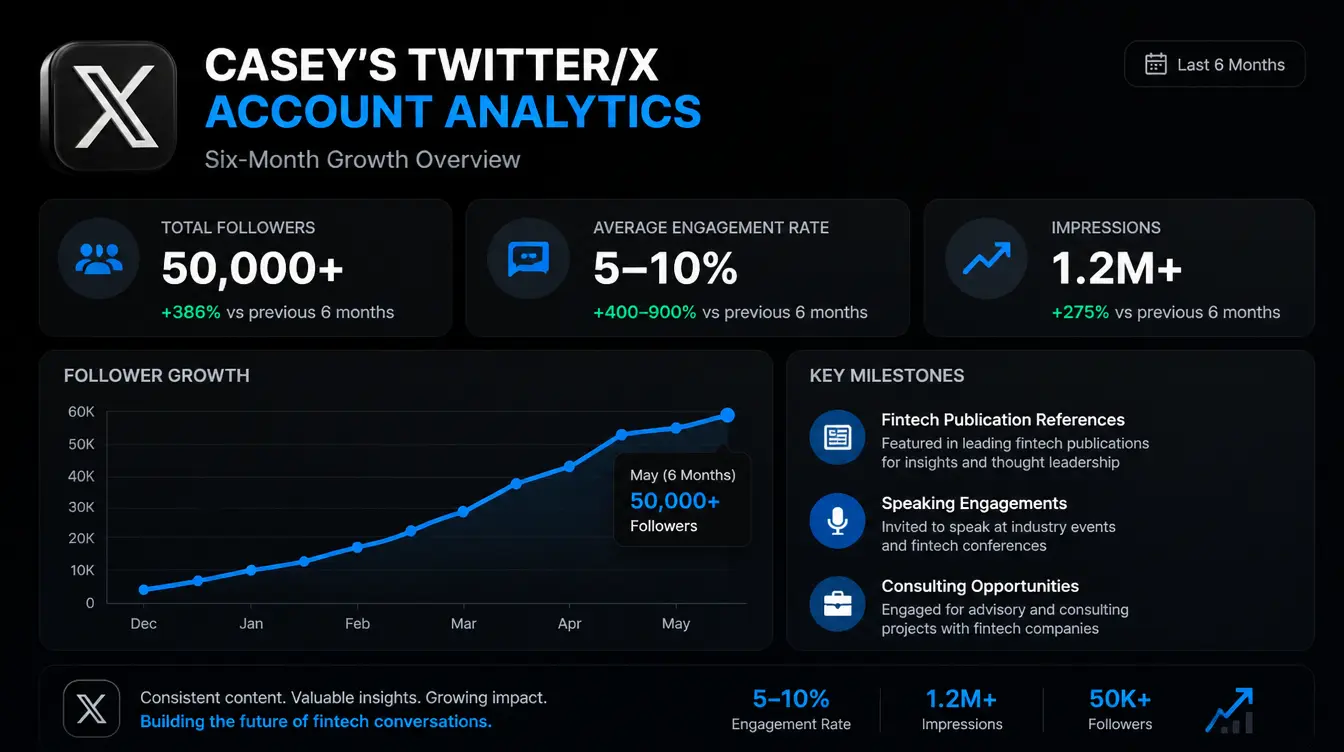
Their results after switching from timing-focused to conversation-focused strategy: followers gained from 450 (that one accident post) to 50,000+ total. Average engagement rate: 5–10% (up from 0.5–1%). Frequently referenced in fintech publications. Speaking engagements, advisory roles, and consulting opportunities from their X presence. Same platform. Same expertise. A completely different understanding of what X actually rewards.
Your X success formula: create quality content (the foundation), post regularly (3–5x daily, sustainably), participate genuinely (respond to others meaningfully), post when inspired (not just scheduled slots), test your audience's timing patterns (optional, truly secondary), focus on conversation quality over metrics, and engage in real-time when relevant to the moment. Go make something worth engaging with — and don't worry so much about when you post it.
𝕏 Ready to Build the X Presence That Gets Real Engagement?
GTR Socials helps creators overcome the cold-start barrier on X — real followers and engagement signals that give genuinely good content the initial momentum it needs to find its audience.
Comments (0)