

Marcus tested the same content at 7 different times. Results ranged from 8,000 to 189,000 views. Then he committed to evening posts — and his average views went down. Here's what he was missing, and what actually drives TikTok timing decisions.
Last month, I saw a fitness creator named Marcus do an experiment that changed the way he thought about when to post on TikTok.
He posted the same kind of content for two weeks in a row: 30-second workout tips with popular sounds. The only thing that changed was the time of day he posted them.
| Day | Time Posted (EST) | Views |
|---|---|---|
| Monday | 3 PM | 47,000 |
| Tuesday | 9 AM | 12,000 |
| Wednesday | 8 PM | 156,000 |
| Thursday | 11 AM | 23,000 |
| Friday | 7 PM | 189,000 |
| Saturday | 2 PM | 31,000 |
| Sunday | 10 PM | 8,000 |
The same quality of content. The same creator. The same trending sounds. Dramatically different results just because of timing. But here's where it gets interesting. When I asked Marcus if he had found the best time to post, he said something that surprised me: "I thought I had. Evening posts did great on the test, so I committed to only posting between 7 and 8 PM for the next month. And you know what? My average views went down."
Why? Because he didn't understand what the data was actually saying.
The algorithm didn't reward his evening posts because of a magical time slot. It was showing his content to people who were actively browsing at those times — and his specific audience (gym-goers interested in fitness) happened to be most active and engaged during those evening hours when they were planning their workouts. His "perfect time" stopped working when his content shifted slightly and his audience demographics changed.
Timing matters — but it depends heavily on your specific audience and your content type. Generic "best time" advice is often wrong for YOUR account. "Post at 7 PM" isn't the answer. The answer is understanding when your audience is most engaged, what type of content you're posting, and testing regularly to find what works for you specifically.
What the Data Really Shows About TikTok Timing
Before getting into specifics, let's look at what research actually reveals — and what its limitations are.
The Broad Research Results
Several studies examining millions of TikToks reveal overarching trends:
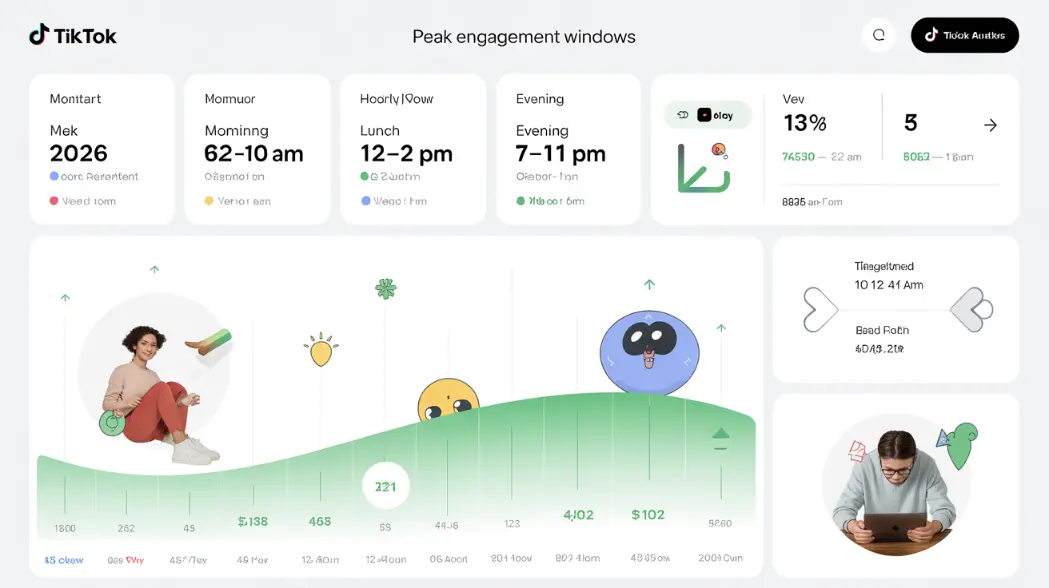
Morning Window
Scrolling while getting ready for work or school. Phone browsing before commuting. High daily phone usage habits. People are intentionally checking their feeds.
Lunch Window
Break from work or school. Mental relief in the middle of the day. High phone usage window. Fast, intentional scrolling sessions with decent attention spans.
Evening Peak
Relaxation after dinner. Getting ready for bed. The longest TikTok sessions of the day. Most often purposeful browsing — not just killing time. Highest overall engagement across most niches.
Best days to post: Tuesday through Thursday show the most engagement on average. Friday performs well especially in the evening. Saturday and Sunday are good for entertainment content. Monday is moderate. The lowest engagement tends to be very late nights and early mornings on any day.
The Critical Warning: Averages Can Be Wrong for Your Account
These times work for millions of accounts. They might not be right for yours at all.
🏋️ Workout Content
Early morning (5–8 AM) when planning morning workouts, or evening (5–8 PM) for post-work gym motivation. Not 7 PM general entertainment time.
🍳 Cooking / Recipes
Meal planning times: 10–11 AM and 4–6 PM. Sunday for meal prep content. Dinner time when people are hungry and thinking about food.
📚 Study Tips
Weekends and evenings when students are actually studying. After school (3–6 PM) and late night (10 PM–12 AM) for student audiences.
📰 News and Commentary
Morning (6–9 AM) when people are catching up on news. Post immediately when news breaks — timeliness beats timing optimisation for current events.
Students are most active after school (3–6 PM) and late night. Working professionals peak at lunch and evenings (7–10 PM). Stay-at-home parents are most active mid-morning (9–11 AM) and afternoon. Night-shift workers have completely inverted schedules. International audiences follow their local time zones, not yours. Optimising for "7 PM EST" might miss the majority of your audience entirely.
Why Timing Is Important (And Why It Isn't)
Most guides don't explore the relationship between timing and views with enough nuance. Here's the real picture.
Why Timing Genuinely Matters
TikTok tests your video with a small initial group of 200–500 people. If engagement is strong, distribution expands significantly. If engagement is weak, distribution stops almost immediately. This first test happens fast — within the first 1–2 hours. Posting when your audience is online increases the chance they're in that initial test group, leading to better early metrics, which leads to broader distribution.
Active vs. passive scrolling matters enormously. During active time, people are genuinely engaged — watching full videos, leaving comments, sharing. During passive time, they scroll quickly, have short attention spans, and aren't really paying attention. When your audience is in their most active engagement mode, they're more likely to watch through, engage deeply, and share. The specific active times vary by audience demographics.
Why Timing Is Less Important Than You Think
Content quality always outranks timing. A great post at 3 AM can still go viral. Mediocre content at the "perfect time" will still flop. TikTok's algorithm evaluates content quality first. Timing amplifies good content — it doesn't rescue bad content. That was Marcus's most important lesson: his evening posts didn't perform because of timing alone; they performed because his content resonated, and timing amplified that resonance.
TikTok's algorithm isn't as time-sensitive as Instagram's. The For You Page doesn't show content in chronological order. Videos can go viral days or weeks after posting. The algorithm continues testing content over time. A video uploaded at 3 AM might not see significant views until 7 PM when more people are active. Poor timing delays viral potential; it doesn't kill it.
Think of timing as an optimiser, not a foundation: 70% of success comes from content quality. 20% comes from audience understanding. 10% comes from posting time. Timing can speed up how quickly good content reaches its audience, improve initial engagement metrics, and help content reach its peak faster. Timing cannot make bad content work, replace deep audience understanding, or fix inconsistent content strategy.
How to Figure Out the Best Time for You to Post
Generic advice gets you to a starting point. Your own data gets you to the best point. Here's a systematic process.
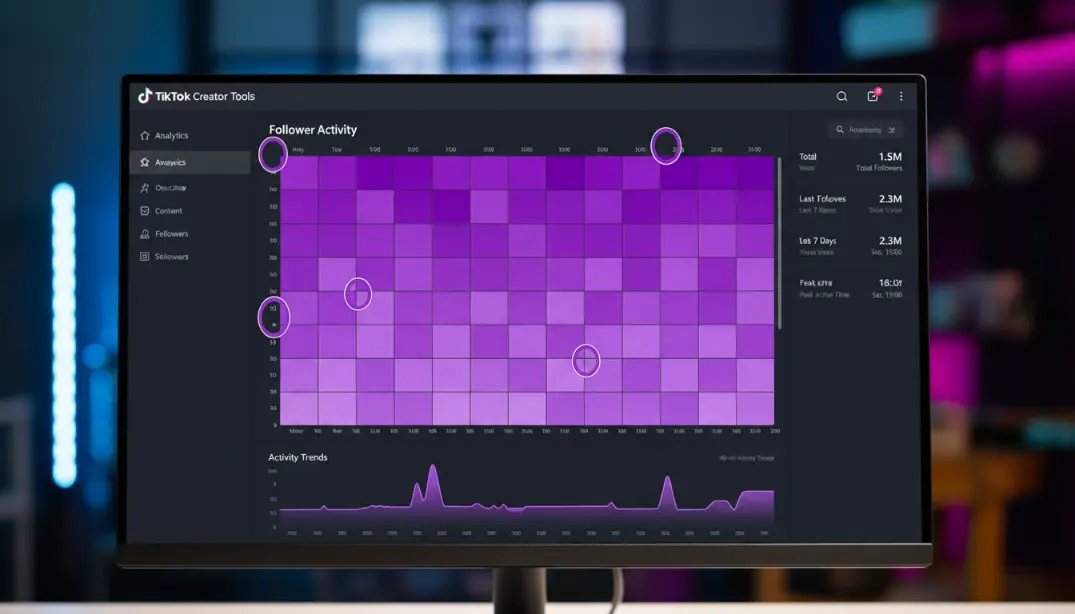
Access TikTok Analytics (100+ Followers Required)
Profile → Menu (☰) → Creator Tools → Analytics → "Followers" tab → scroll to "Follower activity." You'll see a day-by-day breakdown and an hour-by-hour heatmap. Darker shades indicate higher activity. Look for patterns that repeat consistently, not one-off spikes. Note your 3–5 highest activity windows. Post 1–2 hours before the busiest times so your video is indexed and ready when your audience arrives at peak activity.
Run Systematic Timing Tests (Weeks 1–2)
Post at different times across a full week: Monday 8 AM, Tuesday noon, Wednesday 3 PM, Thursday 7 PM, Friday 9 PM, Saturday 11 AM, Sunday 8 PM. Critical rules for valid tests: same content quality, same content type, same trending sound, same video length. The ONLY variable that changes is posting time. Track views at 1 hour, 24 hours, and 7 days, plus engagement rate and watch percentage.
Narrow Down and Confirm (Weeks 3–4)
Identify your top 2–3 time windows from the first two weeks. Post multiple videos in each of those windows. Check if the performance pattern holds across multiple posts. Before drawing any conclusions, watch at least 5–10 videos per time slot — one or two data points aren't enough to see through normal algorithmic variance.
Match Timing to Content Type
Educational and tutorial content: when people are trying to learn — Sunday evenings, mid-morning. Comedy and entertainment: evening free time (7–11 PM), weekend afternoons. Fitness: early morning (5–8 AM) or post-work evening (5–8 PM). Fashion and beauty: getting-ready times (6–9 AM) or weekend browsing. News and commentary: morning catch-up or immediately when news breaks.
Factor in Your Real Schedule
This is what Marcus finally figured out. His 7–8 PM window worked during testing but wasn't sustainable with his work schedule. He shifted to 6 PM — slightly earlier than "optimal" but consistently doable. His average views stayed high because consistency beats hitting the perfect hour occasionally. A time you can maintain for months is always better than a perfect time you'll miss regularly.
Timing and Content Strategy That Works Together
Timing is one part of the puzzle. The content strategy underneath it is what determines whether timing helps or not.
The Hook Is More Important Than the Time
The first 1–3 seconds decide everything. Strong hooks begin with movement or action, ask a question or present a problem, show the result before the process, use a pattern interrupt, or promise immediate value. Weak hooks have a slow start, text that takes a while to read, vague or too-subtle openings, or nothing that stops the scroll.
Why this matters for timing: people scroll quickly even at "perfect" posting times. You have 1–2 seconds to stop them regardless of when you posted. A strong hook combined with good timing creates maximum impact. A weak hook at a perfect time still fails.
Video Length and Watch Time
TikTok heavily weights watch time percentage. Optimal lengths: 7–15 seconds (very high completion rates), 15–30 seconds (good performance if content is engaging), 30–60 seconds (good for stories or tutorials), 60+ seconds (only if the content absolutely justifies the length). The connection to timing: when people are in active engagement mode, they'll watch longer videos. During passive scrolling, shorter videos perform better. Evening (7–10 PM) is safer for longer content. Morning commute (7–8 AM) favours shorter videos.
Trending Sounds and Timing
Trending sounds have a life cycle that interacts with timing differently at each stage. During the first 3 days of a trend: get in as early as possible — being early matters far more than optimising timing. During peak trend days 4–10: timing becomes more important, post during your best windows to stand out. When a trend is declining after day 10: timing optimisation won't rescue overused sounds — move to the next trend instead.
Don't sacrifice catching a trend early in order to wait for the "best" posting time. Being early to a trend is worth more than optimising timing. Post immediately when you spot an early trend, even if it's not your ideal window. The algorithmic advantage of being first outweighs the timing advantage of being optimal.
Timing Mistakes That Hurt TikTok Performance
These are the patterns that cause creators to either miss timing's real benefit or waste energy obsessing over it.
Assuming one time works for all content types and audience changes permanently. Audience behaviour changes seasonally. Weekday and weekend patterns differ. Your audience evolves as you grow.
Following generic advice instead of your own data. Your audience is unique. What works for everyone else might be exactly wrong for your specific niche and follower demographics.
Missing posts because you can't hit the optimal window. The algorithm rewards consistent posting. Irregular posting schedules hurt overall account performance regardless of individual post timing.
Changing content type, sound, time, and style simultaneously. You can't identify what caused a performance change. You end up with invalid data and no actionable insights.
Concluding a time "doesn't work" after a single underperforming post. One video doesn't provide statistically meaningful data. The poor performance could easily be content quality, not timing.
Scheduling posts at optimal times when you'll be asleep or busy. You can't respond to early comments (an engagement signal), monitor performance, or interact with other content to signal to the algorithm that you're active.
Spending hours finding the perfect time and minutes improving content quality. Timing is 10% of the equation. Content quality is 70%. Misallocated effort leads to plateau despite "perfect" timing.
More Advanced Timing Strategies
For creators who have the basics down and want to extract more from their timing decisions.
Posting More Than Once a Day
Research suggests most creators do best with 1–3 posts per day. More than 4–5 risks diminishing returns and can cannibalise your own content. If you're posting multiple times a day, spread posts at least 4–6 hours apart to avoid competing with yourself. A strategic daily spread: morning (7–9 AM) for short tips or motivational content, afternoon (1–3 PM) for lighter, more playful content, evening (7–9 PM) for longer stories or deeper educational content. Using different styles and topics across the three posts reduces internal competition.
Seasonal and Event-Based Timing
For holiday content: post 1–3 days before the actual holiday to allow the video time to gain traction before the peak moment passes. Valentine's Day content posted February 11–13 performs better than February 14. For breaking news: post immediately — timeliness beats timing optimisation for current events. Being 20 minutes earlier matters far more than being at your "ideal" hour. For seasonal content: post at the beginning of the season, not the middle. Summer content posted in May builds traction and views that compound through July and August.
The Off-Peak Benefit Strategy
A contrarian approach: post when fewer creators are publishing. Less competition means your content stands out more in a smaller pool. The algorithm has fewer competing options to show users. This can work particularly well for niche content with a dedicated audience that is active outside peak hours. Test carefully — a smaller active audience may offset the benefit of reduced competition. Works better for some niches than others.
The GTR Socials Perspective: Long-Term Growth Over Short-Term Gains
We work with TikTok creators at all levels at GTR Socials, and we're honest about what really drives sustained success on the platform.
Timing optimisation is valuable, but it's frequently used as an excuse for why content isn't performing when the real issues are content quality and consistency. The hardest part for most TikTok accounts isn't finding the perfect posting time — it's creating content people genuinely want to watch and maintaining that quality consistently enough for the algorithm to learn your content's value.
When you're new or small on TikTok, your videos go to a test audience of 200–500 people. If there isn't strong immediate engagement, distribution stops. At 300 views, even good content can stall. Timing optimisation won't overcome this fundamental challenge alone — which is why some creators consider strategic support to help their best content clear that initial threshold.
Phase 1 — Build Content Quality (Weeks 1–4): Master hooks, storytelling, and editing. Understand your target audience deeply. Post consistently at least once daily. Don't over-focus on timing yet. Phase 2 — Basic Timing Optimisation (Weeks 5–8): Check analytics for follower activity patterns. Post during your 2–3 peak activity windows. Track results in a spreadsheet. Adjust based on actual data. Phase 3 — Advanced Optimisation (Month 3+): Fine-tune timing using accumulated data. Account for seasonal changes. Optimise timing by content type. Maintain consistency while refining.
What we're honest about: our TikTok views and TikTok likes services provide real early engagement signals that can help quality content clear TikTok's initial distribution threshold. This isn't a magic fix — it still requires good content, audience understanding, and consistency. With strategic support, timing becomes less critical in early stages because content gets distributed regardless. Long-term: everyone needs sustainable timing that fits their schedule. Timing optimisation is the 10% that amplifies the 90% you've already built. You can post at the right time every day — but if your content doesn't hook, deliver value, or entertain, views will plateau no matter what time you post.
Your TikTok Timing Plan
A structured, week-by-week system for finding and locking in your optimal posting schedule without wasting months on guesswork.
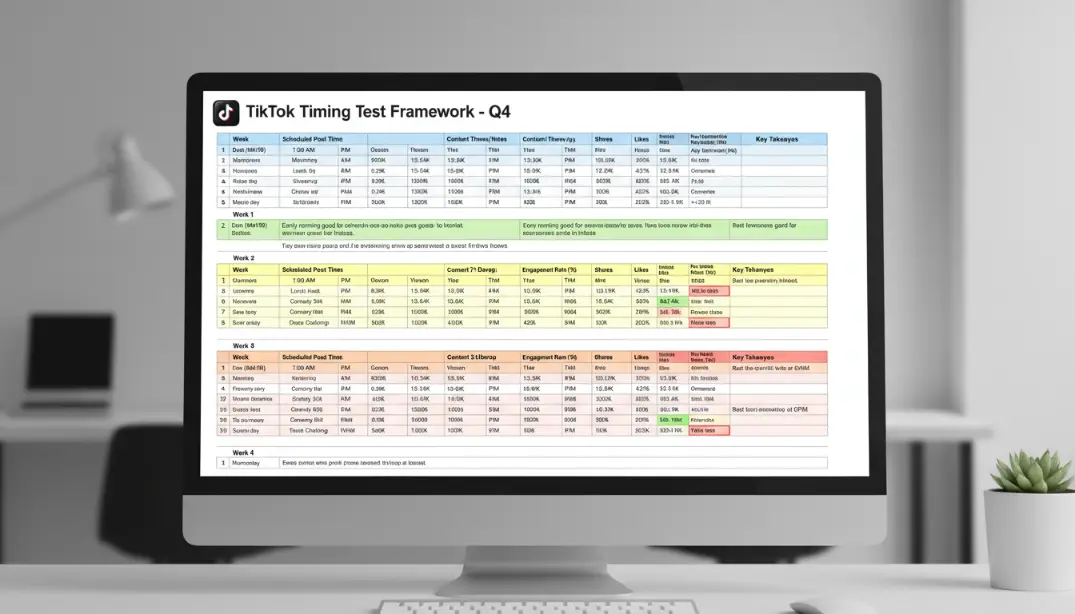
Gather Baseline Data
Build your foundational data set before making any timing commitments.
- Check TikTok Analytics → Follower Activity for current peak windows
- Post at 7 different times across the week (morning, afternoon, evening, weekend)
- Keep content type, quality, sound, and length identical across all test posts
- Track views at 1 hour, 24 hours, and 7 days in a spreadsheet
- Also track engagement rate and watch time percentage for each post
Identify and Confirm Patterns
Turn raw data into actionable timing insights.
- Review data from Weeks 1–2 and identify your top 2–3 performing windows
- Post multiple videos at those times to confirm patterns hold
- Ask: do certain times consistently outperform? Do patterns hold across similar content? Does day of week matter significantly?
- Require at least 5 data points per time slot before drawing conclusions
Commit and Refine
Build a sustainable, data-backed posting rhythm.
- Commit to posting during your confirmed best times
- Be consistent — same times every week builds audience expectations
- Monitor performance and watch for shifts in your patterns
- If needed, use different times for different content types (tutorials vs. entertainment)
- Note weekday vs. weekend performance differences and adjust
Stay Current and Stay Flexible
Timing is a living strategy, not a fixed answer.
- Review monthly to check if your best times are still working
- Watch for seasonal pattern changes (summer vs. school year, holidays)
- Re-test every 3 months as your audience grows and evolves
- Post immediately for early trends — don't wait for "best" time
- If your ideal time becomes unsustainable, find the next best option you can actually maintain
When to Post on TikTok: FAQ
Final Thoughts: Get Good at Content First, Then Get Good at Timing
Marcus, the fitness creator who ran the timing experiment? Three months later, he told me something that perfectly captures the TikTok timing paradox:
"I spent two weeks worrying about when to post before I even knew what my audience wanted. That was backwards. Now I know my content, my audience, and my timing — in that order."
His current approach: consistent posts at 6 PM (works with his schedule), quality he's proud of every time, active community engagement, and average views per video of 80,000–150,000. Not because the timing was perfect. Because he learned the content first and then optimised everything else.
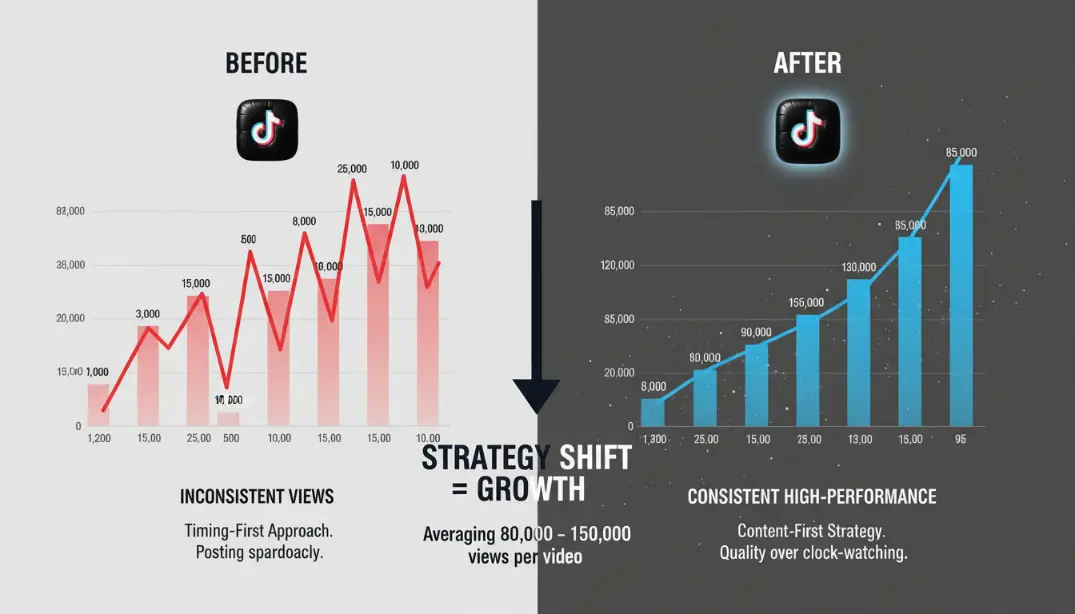
Timing matters. It can accelerate your success, help good content reach its audience faster, and improve your algorithmic performance. But timing is a boost, not a foundation. The TikTok accounts that succeed long-term create genuinely useful or entertaining content, hook people in the first 1–3 seconds, deeply understand their specific audience, post consistently for months — not just weeks, engage authentically with their community, test and adapt based on data, and THEN strategically optimise posting times.
Your action plan: learn content craft (hooks, storytelling, value delivery). Know your audience (who they are and what they genuinely want). Post consistently to build algorithmic trust. Analyse your analytics to find your follower activity peaks. Test systematically — change only the timing variable. Adjust based on your own data, not generic advice. Commit to a schedule that you can actually maintain for months.
Stop searching for the perfect time that will make average content go viral. Start making content people want to watch, understanding who wants to watch it, and posting it consistently when they're most likely to be engaged. Timing optimisation only adds real value after that foundation is in place. The best time to post on TikTok isn't what you think it is. It's in the content you create, the audience you serve, and the consistency you maintain. Learn those fundamentals well. Then let timing optimisation accelerate the success you're already building.
🚀 Ready to Give Your TikTok Content the Early Momentum It Needs?
GTR Socials helps TikTok creators break through the initial distribution threshold — so your quality content gets the early engagement signals that trigger algorithmic reach. Real views, real likes, real results.
Comments (0)