

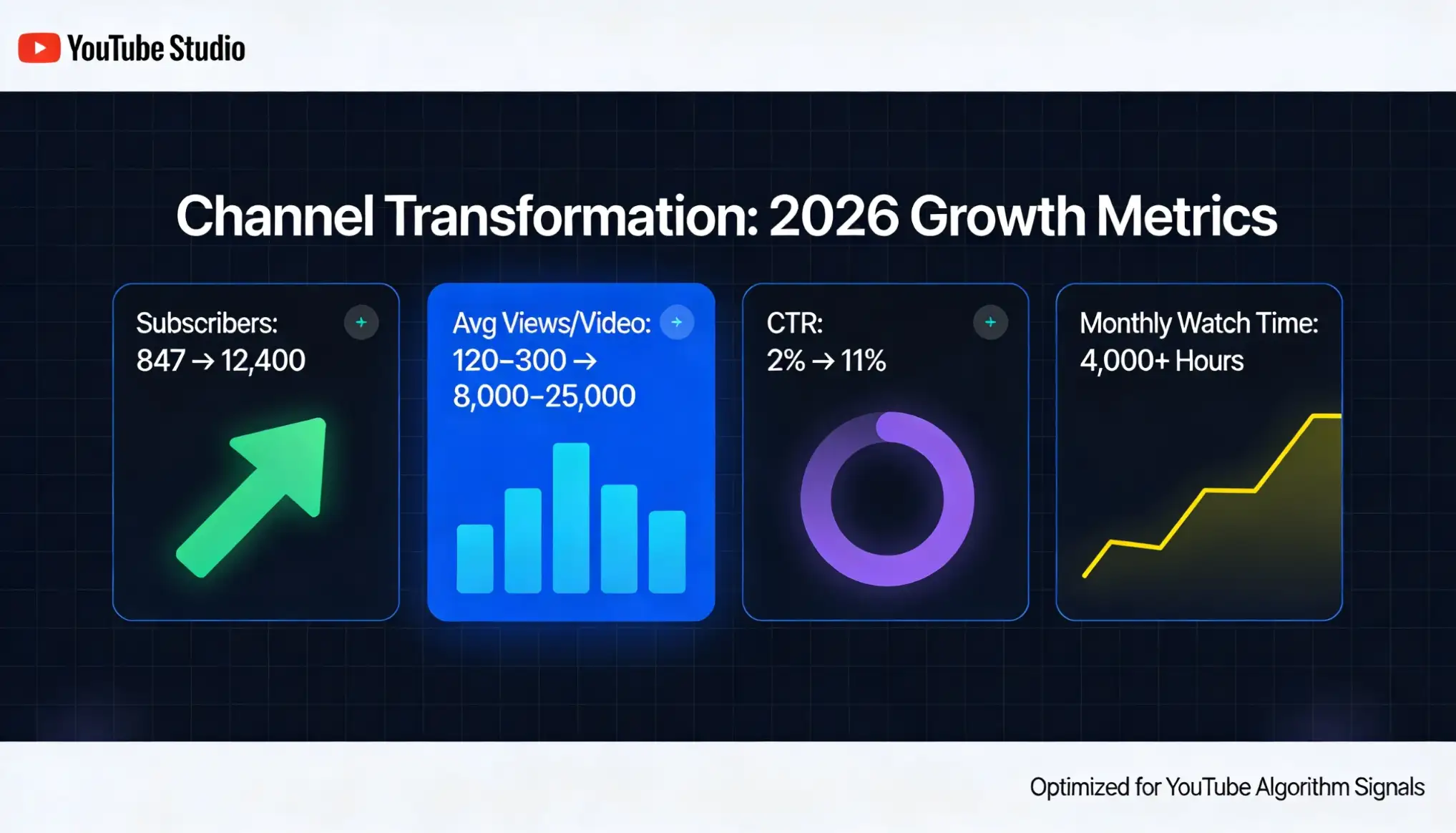
Chris had 847 subscribers after 18 months and 74 videos. Three months after understanding what the algorithm actually rewards: 12,400 subscribers, 8,000–25,000 views per video, and $380 in first-month revenue. Same creator. Same expertise. Same niche. Completely different results.
Four months ago I met a tech educator named Chris who had been consistently uploading to YouTube for 18 months with soul-crushing results.
He created real, practical coding tutorials — deeply researched, clearly explained, professionally edited. Two videos a week, every week. 74 videos.
❌ After 18 Months — 74 Videos
✅ Three Months After Rebuilding
He said to me, tired: "I don't get it. I teach valuable skills. I have better production quality than channels with millions of subscribers. I use keywords in my titles. I've read every 'how to beat the algorithm' article. Why am I invisible?"
Within two minutes of reviewing his channel, the problems were obvious — but not what he'd expected. His titles: "Python Tutorial #37 - Advanced List Comprehensions." His thumbnails: screenshot of code on black background. His video intros: 45 seconds of channel introduction before any content. His video length: 25–40 minutes for topics that could be explained in 8–12. His approach: teaching what he believed people should learn, not what they were actually searching for.
"You're optimising for the wrong algorithm," I said. "YouTube doesn't reward quality content. It rewards content that keeps people on YouTube, watching more videos. Your videos may be educational, but they're not optimised for discovery, clicks, and retention. The algorithm can't promote what viewers don't click on, watch, and want more of."
It's not judging your content quality. It's estimating whether viewers will click on your video, watch it, and watch more YouTube afterwards. Nail that forecast and the algorithm will be your growth engine. Miss it and no amount of production quality, upload consistency, or keyword usage will save you.
How YouTube's Algorithm Really Works
Before tactics, understand the core mechanics — because most creators are optimising for the wrong things entirely.
YouTube Is Not One Algorithm — It's Several
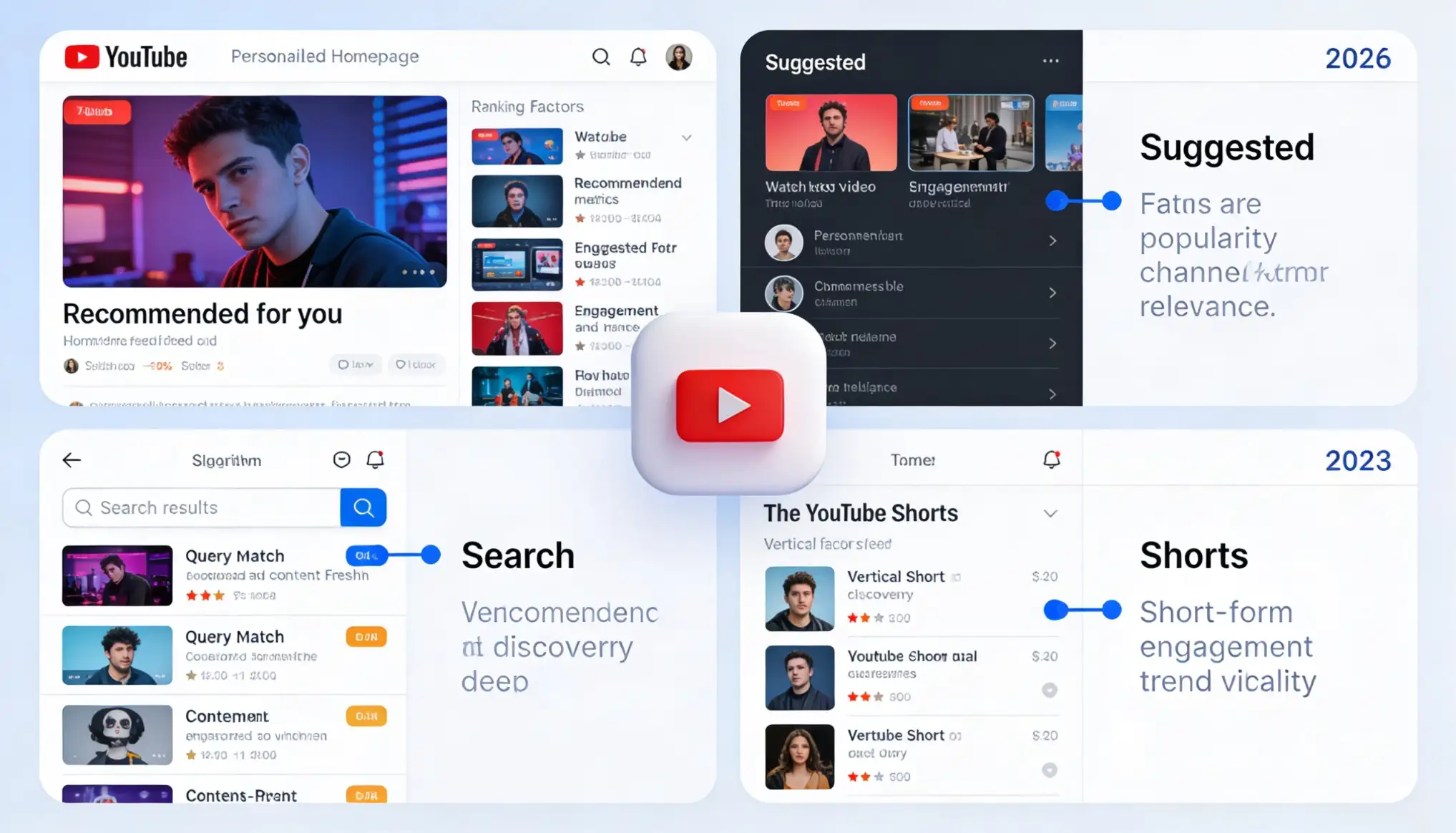
🏠 Homepage (Browse Features)
Opens YouTube with personalised recommendations based on your viewing history. Optimises for watch time — keeping you watching. Must stand out in a crowded personalised feed.
▶️ Suggested Videos
Videos recommended after or during watching. Based on the current video and viewing patterns. Optimises for continuous viewing — the "binge" factor that drives session time.
🔍 Search
Videos shown when users search. Based on search query relevance plus video performance. Optimises for relevance and viewer satisfaction with the search query result.
📱 YouTube Shorts
Separate algorithm, similar to TikTok. Discovery-driven — shows content from channels you don't subscribe to. Different optimisation principles from long-form content.
Session Time: The Core Business Model
YouTube's business model: more watch time = more ad revenue. The goal of YouTube: keep viewers on the platform as long as possible. The algorithm favours videos that get clicked (high CTR), have high retention (keep the viewer watching), and drive more viewing (session time). The algorithm is constantly asking: "Does recommending this video make viewers watch YouTube for longer in a satisfying way?"
How Videos Are Discovered and Promoted
- First impressions pool: New video shown to a small audience of subscribers plus similar viewers. Algorithm monitors performance metrics, usually in the first 24–48 hours.
- Performance assessment: CTR, average view duration, audience retention, and engagement (likes, comments, shares) all evaluated together.
- Expansion or restriction: Good performance = shown to a wider audience. Poor performance = minimal distribution. Strong videos can continue expanding days or weeks after upload.
- Long-term value: Videos can go viral months or years after uploading. YouTube's algorithm continually reevaluates. Evergreen content keeps generating views indefinitely.
YouTube rewards long-term performance, not instant virality. A video that slowly builds momentum over weeks is treated far better than a flash-in-the-pan spike. This changes everything about how you approach content strategy — evergreen content that serves search queries compounds in value for years, not hours.
What Your Rankings Depend On: The Ranking Signals
Here's exactly what YouTube is measuring — and how much weight each signal carries.
Click-Through Rate (CTR)
Very High WeightThe percentage of people who see your thumbnail and click to watch. If people don't click, they don't watch. CTR is the first gate the algorithm uses to decide whether to push a video to a wider audience. Chris's code screenshot thumbnails got 2% CTR. Custom thumbnails highlighting the problem and solution got 9–12% CTR.
Average View Duration & Retention
Highest WeightHow long people watch and what percentage of the video they complete. Average View Duration (AVD) is the total watch time divided by views. Audience retention tracks the % of video watched. The first 30 seconds are most critical. Strong: high initial retention, staying steady throughout, many viewers finishing. Weak: big drop in first 30 seconds.
Session Duration
Very High WeightHow much total YouTube watch time your video generates. YouTube cares more about overall platform engagement than individual video performance. If a viewer watches your video then watches 3 more, your video gets credit for launching that session. Algorithm loves videos that make people binge-watch YouTube.
Engagement
High WeightLikes, comments, shares, subscribes from video, and playlist additions. Engagement indicates content that resonates, builds community, and predicts others will also engage. Comments and shares carry more weight than likes alone. Ask discussion questions, respond to early comments, and take respectful stances that generate genuine conversation.
Production and Video Quality
High WeightResolution (1080p+ is standard), sound quality (critical — bad audio kills retention faster than anything), lighting, editing, accurate information, and value delivery. Production value matters, but content value matters more. Well-produced content of moderate value beats over-produced content of low value every time.
Metadata and SEO
Medium WeightTitle (search keywords, under 60 characters), description (keywords in first 2–3 lines, detailed content description), tags (5–10 relevant, not spam), and closed captions. Metadata helps YouTube understand what the video is about, who to show it to, and when to recommend it. Captions improve both accessibility and searchability.
CTR Benchmarks: Where Do You Stand?
Different Approaches for Different Algorithms
Each YouTube surface has different ranking priorities — and requires different optimisation strategies.
Search Algorithm: Matching Viewer Intent
YouTube Search ranks by relevance of keywords in title and description matching the search query, plus video performance (CTR and watch time specifically for that keyword), user satisfaction (do people watch and not immediately re-search?), and video quality and recency.
Keyword research: Use YouTube Autocomplete (shows actual search queries), check "People also search for" suggestions, and use tools like TubeBuddy, VidIQ, or Google Trends for volume data. Title strategy: Include the exact search phrase near the front of the title. Example — Not optimised: "The Ultimate Keyboard Cleaning Guide You Need to See!" Optimised: "How to Clean Your Keyboard in 5 Minutes (MacBook & PC)"
Homepage Algorithm: Personalised Discovery
Homepage content is custom-made for each viewer based on their viewing history, optimised for what they'll find satisfying next. Ranking factors: CTR (will they click on this?), topic interest (have they watched similar content?), channel relationship (have they watched this creator before?), and performance history (how do comparable viewers react?). Thumbnails must stand out in a personalised feed. Titles must generate genuine curiosity without misleading.
Suggested Videos Algorithm: Session Time Extension
Suggested videos appear next to or after the current video with the goal of keeping the viewer watching more content. Ranking factors: relevance to the current video, what viewers typically watch next, session time potential, and watch time plus CTR. Create multi-part series with natural progression, use end cards linking to related content, and build a content ecosystem where videos reference each other naturally.
YouTube Shorts Algorithm: Explore Feed
Shorts use a separate algorithm similar to TikTok's, featuring a discovery feed that includes content from channels you don't subscribe to. Ranking signals: completion rate (watching all the way through), rewatches (loop viewing), and engagement (likes, shares, comments). Optimise for immediate hook (first 1 second), ideal 15–30 seconds, 9:16 vertical aspect ratio, and subtitles for viewers watching without sound. Use Shorts strategically to convert viewers to long-form subscribers.
Content Strategies That Work With the Algorithm
Understanding signals is one thing. Building a content system that consistently triggers them is the work that actually grows channels.
Strategy 1: The Two-Audience Strategy
The problem: trying to simultaneously keep existing subscribers happy and attract new viewers. The solution is a deliberate content mix. Discovery content (60–70%): topics with wide appeal, high search volume keywords, beginner-friendly, designed to bring in new viewers. Subscriber-centric content (30–40%): deeper dives into niche topics, references to previous videos, community engagement, appeals to your established audience. Discovery content drives growth; subscriber content drives retention. Both are necessary.
Strategy 2: Test Titles and Thumbnails
YouTube allows you to change thumbnails and titles after uploading. Upload with your best guess, track CTR for 48 hours, test a new thumbnail if below 6% CTR, then test a title variation if CTR is still low. Test different thumbnail styles (face vs. text vs. graphic), title structures (curiosity vs. keywords), and text overlay approaches. TubeBuddy has A/B testing features for this. Manual monitoring in YouTube Studio also works.
Strategy 3: Study Your Retention Curves
YouTube Analytics shows detailed retention graphs for every video. Massive drop in the first 10 seconds: weak hook — fix the intro and create immediate curiosity. Steady consistent decline: content lacks engagement — improve pacing, add visual variety, deliver value faster. Designated drop-off spikes: something specific alienated viewers at that timestamp — identify and avoid in future videos. Study every retention curve. Learn the patterns. Build future content around what keeps people watching.
Strategy 4: Upload Timing
Check YouTube Analytics → Audience → When Viewers Are on YouTube. Upload 1–2 hours before your audience's peak activity so the video is indexed and ready when subscribers are active. General patterns (CET): 2–4 PM weekdays (after school/work), 6–9 PM weekday evenings, 9–11 AM weekend mornings. Consistency matters more than the exact hour — same day and time each week builds subscriber anticipation and reliable viewing habits.
Strategy 5: The Playlist Strategy
Playlists trigger autoplay (session time), organise content for discovery, encourage binge-watching, and show up in search results. Create series playlists for multi-part how-tos and course content, topic playlists grouping related videos ("Advanced Excel," "Basic Python"), and order them strategically: best hook video first, coherent progression, closing CTA to subscribe. Playlists are one of the most underused session-time tools on YouTube.
Mistakes That Stifle Your Growth
These are the patterns that keep quality channels invisible — and the specific fixes for each.
"Hey guys, welcome back to my channel! Before we get into it let me tell you about my week..." The viewer came for specific information. Wasting their time causes them to leave, which hurts retention. The algorithm reads poor performance and limits distribution.
Clickbait that never delivers. The result: high CTR but terrible retention. The algorithm sees an attractive thumbnail that generates clicks but then causes people to leave immediately — and interprets this as low-quality content, limiting distribution.
Producing content without knowing what's actually working. Missing patterns in successful content, repeating the same mistakes, no ability to optimise. This is the most fixable mistake on the list.
Three videos one week, nothing for a month, two the week after. Subscribers forget you exist. The algorithm rewards consistent creators. Inconsistency makes it harder to build algorithmic momentum. Audience expectations become unpredictable.
Videos either too long or too short for the value they deliver. Quick tips/hacks deserve 3–5 minutes. Tutorials deserve 8–15 minutes. Deep dives deserve 15–30 minutes. Entertainment can go much longer if retention stays high.
Video ends and the viewer leaves YouTube entirely. Missed session time. Not sending viewers to more of your content. Lost subscription conversions. End screens are the single easiest session-time improvement available.
Following every YouTube trend regardless of niche or audience fit. Doesn't meet subscriber expectations. Confuses the algorithm about your niche. Disappoints current audience and creates churn.
Your YouTube Algorithm Action Plan
A structured, month-by-month framework for building sustainable YouTube channel growth.
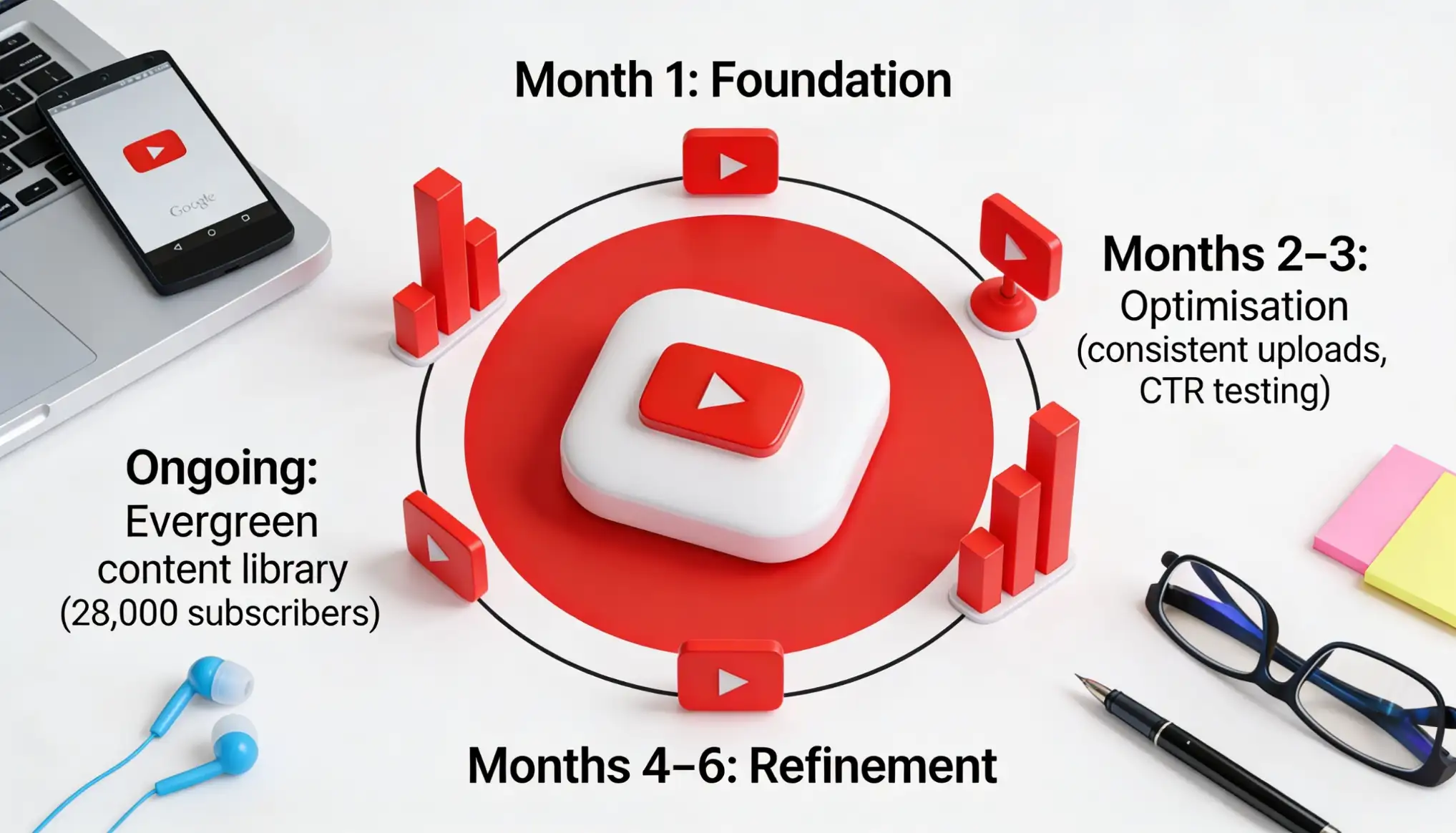
Research and Build the Base
Audit before creating anything new.
- Review existing channel — what's working, what isn't
- Keyword and topic research for your niche
- Study top performers — what are they doing right?
- Plan 10–20 videos with high search potential
- Create thumbnail templates (brand-consistent, eye-catching)
- Create short intro/outro templates (under 5 seconds)
Build Consistent Upload Momentum
Establish the rhythm and start gathering real performance data.
- Upload 1–2 videos per week consistently
- Optimise every title for SEO plus clicks
- Create custom thumbnails and A/B test them
- Hook in first 10 seconds of every video without exception
- Add end screens and cards to all videos
- Reply to every comment in the first 48 hours
Optimise From Real Data
Now you have enough data to make evidence-based decisions.
- Study retention curves — identify patterns of decline and fix them
- Double down on highest-retention content types
- Strengthen weak areas (thumbnail CTR, retention, session time)
- Create binge-watch playlists from existing content
- Test different formats based on analytics insights
Build and Expand
Compound the foundation you've built into sustainable long-term growth.
- Develop an evergreen content library that keeps earning views
- Update top performers regularly (keep them relevant)
- Expand existing successful themes
- Engage community consistently (comments, community posts)
- Watch for algorithm changes and adapt your approach
YouTube Algorithm FAQ
Final Thoughts: The Algorithm Rewards Audience Satisfaction
Chris, the tech educator who went from 120 average views to 8,000+ per video? Six months after our conversation he'd grown to 28,000 subscribers and was making $1,200/month in revenue. Not life-changing money — but a steady income from what had been a deeply frustrating pursuit.
What he told me: "I thought the YouTube algorithm was broken because it wasn't pushing 'quality' content. I learned that 'quality' means 'satisfying the viewer' — not 'took me 20 hours to make.' Once I optimised for viewer satisfaction, the algorithm became my best marketing partner."
It's not a mystery. It's not broken. It is not intentionally suppressing your content. It forecasts which videos will make viewers happy and keep them watching more YouTube. If your videos do that, the algorithm pushes them aggressively. If they don't, the algorithm limits them — no matter how much quality, effort, or production value went into them. Optimise for viewer satisfaction and the algorithm becomes your growth engine.
The creators who win on YouTube: create content that people actually search for or genuinely want to watch, get clicks with great thumbnails and titles, maximise retention with hooks and pacing, build session time through playlists and end screens, upload consistently for months and years, study what works and do more of it, and prioritise viewer satisfaction over creator satisfaction.
Your YouTube algorithm success formula: research what people want (search volume and competitor analysis), create compelling packages (thumbnails and titles that earn clicks), hook immediately (value in the first 10 seconds), maintain retention (cut fluff, deliver value, keep energy high), build sessions (related content, playlists, end screens), upload regularly (weekly minimum, predictable schedule), and analyse and optimise (learn from retention curves and CTR data). Don't try to beat the algorithm. Start making content that genuinely satisfies your audience and keeps them engaged. The algorithm will reward you with discovery, recommendations, and sustainable growth.
Chris's Results: What Algorithm-Aligned Strategy Actually Produces
His current approach: find out what people are actually searching for, create eye-catching thumbnails and titles, hook viewers in the first 5 seconds, deliver value quickly and efficiently, cut ruthlessly (no fluff), keep videos as short as possible while delivering full value, use end screens to increase session time, and upload weekly on a consistent day and time.
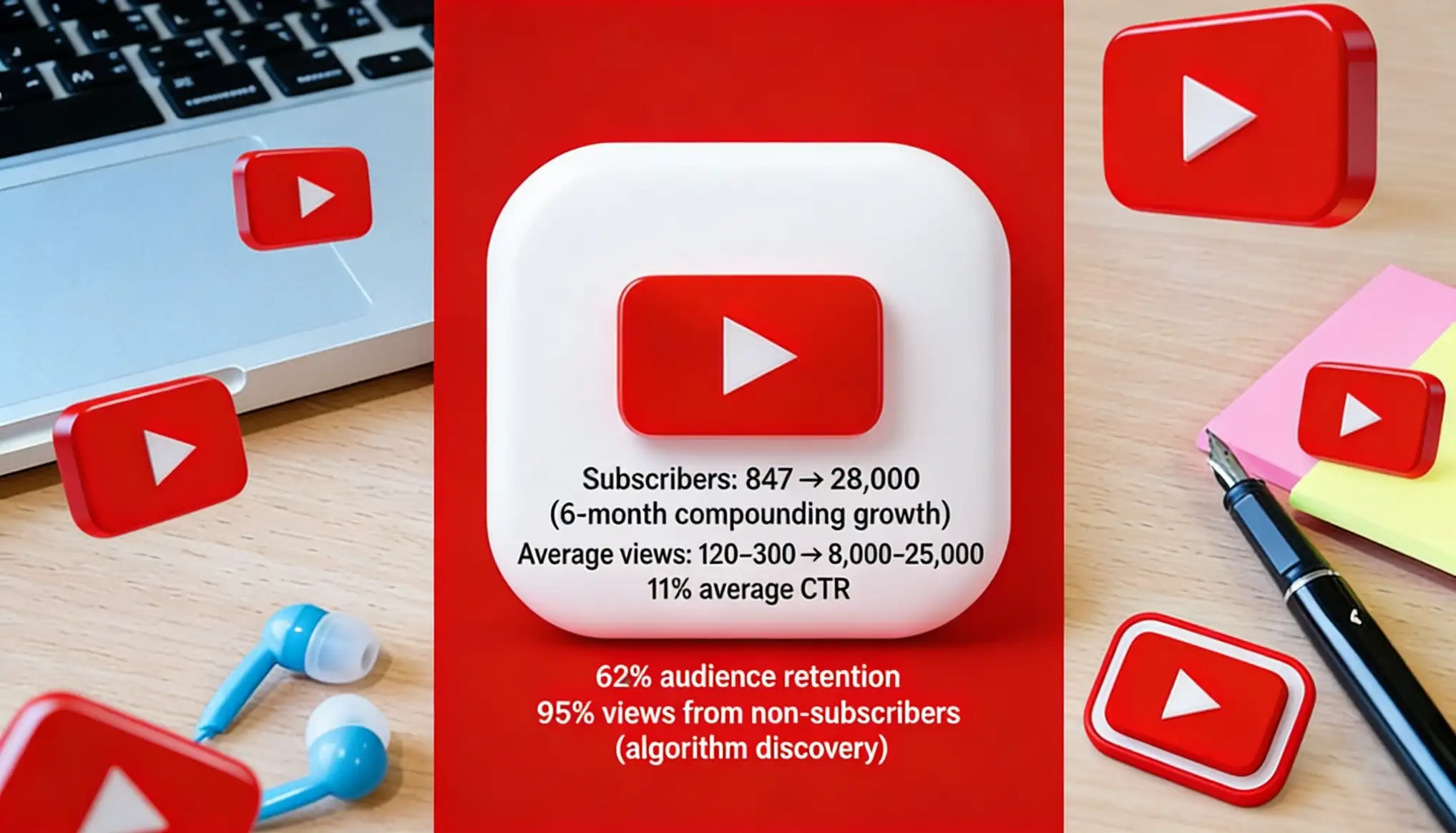
His results: 95% of views from non-subscribers (algorithm doing the discovery work), average 11% CTR (well above average), average retention 62% (excellent for tutorial content), gaining 1,500–2,500 subscribers per month, and compounding sustainable growth that improves month over month.
Same creator. Same expertise. Same niche. A totally different understanding of what YouTube's algorithm actually rewards. Your YouTube success isn't in an algorithm hack or shortcut. It's in your next video that genuinely satisfies viewers — makes them click, watch to the end, and watch more. Create it. The algorithm is ready to push it.
▶️ Ready to Give Your Best YouTube Content the Momentum It Deserves?
GTR Socials helps creators overcome the cold start problem — so your well-optimised content gets the early engagement signals that help YouTube's algorithm recognise its quality. Real views, real subscribers, real initial traction.
Comments (0)