

A YouTuber named Marcus burned three months of vacation time uploading at the "perfect window." His 24-hour views stayed exactly the same. Here's the uncomfortable truth about YouTube timing — and what actually moves the needle.

I saw a YouTuber named Marcus change the way he uploads videos two months ago after reading one piece of advice: "Post on YouTube at 2–4 PM EST on weekdays for maximum views."
He had been posting his tech review videos at 9 AM on Saturdays, which worked with his full-time job and gave him Friday nights to finish editing. In the first 24 hours, his videos got 2,000 to 3,000 views. So he changed. He started taking Wednesdays off work at 3 PM to upload. Made sure that every video went live in that "best window."
Three months later, his view counts for 24 hours were... the same thing. 2,000 to 3,000 views.
He was stressed out, using up his vacation time, rushing edits to meet the "perfect time," and getting nothing out of it. When he asked me what he was doing wrong, I had to tell him something that goes against most YouTube timing advice: "You're not doing anything wrong. You just believed advice that is fundamentally wrong."
The best time to post on YouTube matters a lot less than on almost any other platform. Worrying about it too much can make you miss the whole point of how YouTube works. YouTube is a search engine and a recommendation engine first, and a social feed second.
This guide covers everything: why YouTube timing is different from other platforms, what the data really shows about the best times to post, how to use analytics to find your own best time, the difference between Shorts and long-form timing, what matters more than posting time, when timing is actually strategic, and the honest conversation about consistency vs. optimisation.
Why YouTube Timing Is Different (And Why Most Advice Misses This)
Before you look at specific times, you need to understand why YouTube operates on a fundamentally different model than every other platform.
YouTube vs Instagram and TikTok — A Structural Difference
▶️ YouTube
How the YouTube Algorithm Really Works
YouTube's algorithm gives priority to:
- Click-through rate (CTR): Do people click on your thumbnail when they see it?
- Average view duration: How long do people actually watch?
- Total watch time: The total minutes watched across all viewers
- Engagement: Likes, comments, shares, and subscriptions
- Session time: Do people keep watching YouTube after your video ends?
Notice that "upload timing" is not on that list. The algorithm asks "Is this video good enough to keep people on YouTube?" — not "Was this uploaded at the right time?"
When Timing Does Matter — The Real Reasons
Timing matters for four specific reasons: subscriber notifications (they're more likely to click immediately if they're online), initial velocity signals (strong early performance can speed up distribution), live premieres and community events, and subscriber expectations (breaking a consistent pattern lowers first views). But here's the critical distinction: these factors affect how quickly you succeed, not how high you can go. Timing speeds up good content. It doesn't rescue bad content.
If a video is good enough, it can still get millions of views even if it was uploaded at 3 AM. If a video isn't good, even uploading at the "perfect" time won't save it. Timing is a multiplier, not a magic switch.
What the Data Says: The Best Times to Post in General
Let's see what research actually shows about the best times to post on YouTube — with the important caveats that most guides skip.
| Day | Best Upload Window (EST) | Performance |
|---|---|---|
| Thursday & Friday | 2–4 PM Best Overall | Highest average engagement across all niches |
| Saturday & Sunday | 9–11 AM | Strong — especially for entertainment content |
| Monday–Wednesday | 12–3 PM | Average — reliable for search-driven content |
| Weekdays (any) | 5–8 PM | Good — post-work/school relaxation window |
| Late Sunday Night | Avoid | Lowest engagement — people preparing for Monday |
Why 2–4 PM EST Performs Well
- Catches the afternoon on the East Coast
- It's lunchtime on the West Coast
- Viewers in Europe watching in the evening
- Browsing on mobile at night in Asia
- Video has time to gain engagement before the peak evening viewing window
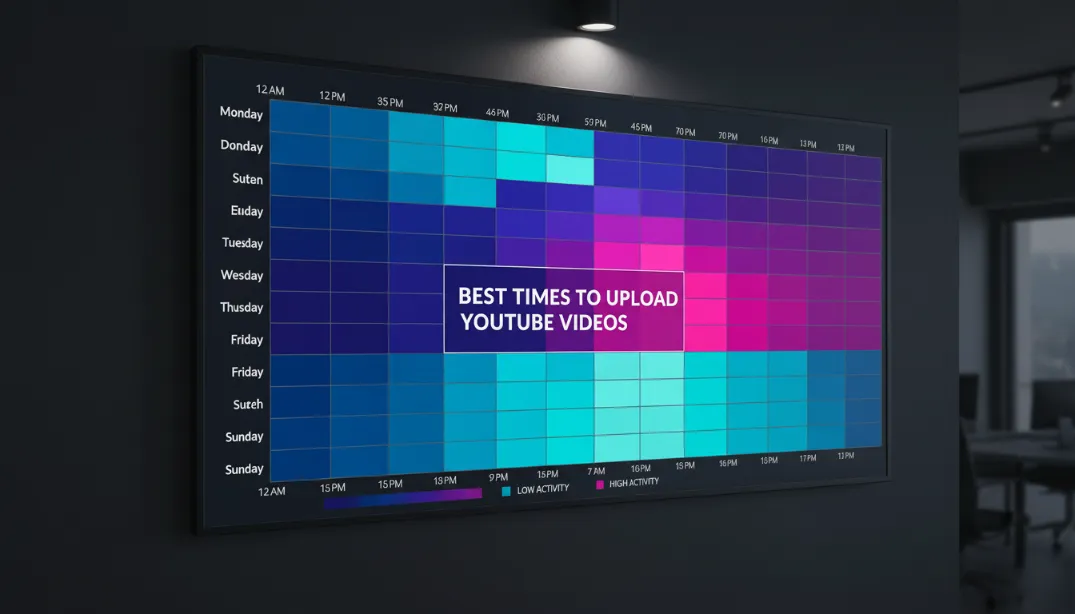
These are averages across millions of channels. They tell you when the most uploads are successful — not when YOUR uploads should go live. Gaming content performs at night. Morning routine videos do better early AM. Kids' content peaks after school. Business content performs Tuesday through Thursday during business hours. Following generic times without knowing your specific audience is like wearing someone else's prescription glasses.
How to Figure Out the Best Time for YOU to Post on YouTube
Generic advice can only take you so far. Here's how to find what actually works for your specific channel and audience.
Look at Your YouTube Studio Analytics
Go to YouTube Studio → Analytics → Audience tab → "When your viewers are on YouTube." This shows a heat map of when your subscribers are actually online — darker colours mean more active viewers. Look for the days and hours with the darkest colours, then upload 1–2 hours before those peaks so your video is indexed and ready when your audience shows up.
Analyse Your Past Upload Performance
In YouTube Studio → Analytics → Reach tab, look at your top 10 best-performing videos and note the publish time of each. Look for patterns — do videos posted at certain times consistently outperform others? Important: factor in content quality. Don't attribute timing success to a video that simply had better content.
Run Controlled Tests
Upload similar content (same format, topic, and quality) at different times over 4–6 weeks each. Compare views at 24 hours, 7 days, and 30 days — along with CTR, average view duration, and subscriber changes. You need enough data to find patterns, not just one or two data points.
Match Timing to Content Type
Search-focused tutorials? Timing matters less — people search when they have a problem. News and reaction content? Upload as fast as possible — timeliness beats optimal time. Entertainment vlogs? Evenings and weekends perform better. Regular series? Consistency matters more than the specific hour.
Be Honest About Sustainability
Can you actually maintain the "best" time for 12+ months? If the ideal window is 2 PM on Tuesday but you work a 9–5, can you keep that up without burning out? Marcus made the mistake of optimising for timing at the expense of sustainability. A consistent Saturday 9 AM schedule that lasts beats a perfect Wednesday 3 PM schedule that you'll miss half the time.
YouTube Shorts vs Long-Form: Different Timing Strategies
Shorts and long-form videos use different algorithms and have very different viewing behaviour patterns. What works for one does not work for the other.
YouTube Shorts — Timing Matters More
Shorts behave much more like TikTok and Instagram Reels. They have a shorter lifespan (hours to days), initial performance matters more, and they're not heavily driven by search. Best windows: 6–10 PM peak mobile scrolling, 12–2 PM lunch breaks, 10 PM–12 AM before-bed browsing, weekends for leisure time. Posting frequency: multiple times per week or even daily is fine. Test timing more aggressively here.
Long-Form — Consistency Matters More
Long-form has lasting potential, is found through search and suggested videos, and performance builds over weeks and months. Initial timing matters less than it does for Shorts. Best approach: upload 1–2 hours before your audience peak, keep a consistent weekly schedule, and give the algorithm time to find an audience over days or weeks. Don't obsess over optimising every individual hour.
For Shorts, think like a TikTok creator — timing, trends, and peak activity windows matter more. For long-form, think like an author — the content quality, searchability, and consistency of publication matter far more than the hour you hit publish.
What Really Matters More Than When You Post
Let's be direct: you're probably overthinking timing while underthinking these things that have ten times more impact.
Factor 1: Thumbnail and Title — The CTR Drivers
Your thumbnail and title decide whether people click, no matter when you posted. A video with a 10% CTR will outperform one with a 2% CTR posted at the "perfect" time in every meaningful metric.
- Thumbnails: Readable text even at small sizes, expressive faces where relevant, high-contrast colours, consistent branding, no clickbait
- Titles: Keywords at the front for search, clear benefit or curiosity gap, under 60 characters, appropriate capitalisation
Time spent improving thumbnails delivers more return than any amount of time spent optimising upload hour.
Factor 2: Watch Time and Retention
YouTube promotes videos that people actually watch, not just click on. A video with 60% retention will beat one with 30% retention at any upload time.
- Hook viewers in the first 30 seconds — deliver on the thumbnail/title promise immediately
- Cut long introductions — get to the value faster
- Target: 50%+ retention for long-form, 60%+ for mid-length, 70%+ for short content
Factor 3: Consistency and Upload Schedule
Consistency trains both your audience and the algorithm. Algorithms learn to test your videos with audiences similar to past viewers. Subscribers know when to expect content. Channels that upload consistently at the same time — even if it's not "optimal" — outperform channels that upload at "perfect" times on an irregular schedule. Long-term consistency beats short-term optimisation every time.
Factor 4: Content Quality and Value
No timing optimisation fixes bad content. Good content solves a real problem, delivers the promise made in the thumbnail and title, is the right length for the topic, and has a genuine personality. The algorithm's job is to find great content and show it to people. If you post great content at 3 AM, the algorithm will eventually find your audience. If you post mediocre content at 3 PM, it doesn't matter.
Factor 5: SEO and Searchability
For search-driven content, optimisation is far more important than timing. A video ranking first for a search term gets views for years, regardless of when it was uploaded. A well-optimised video uploaded at 4 AM will outperform a poorly optimised video uploaded at 2 PM over any reasonable time horizon.
SEO elements: keyword-rich title, detailed description with relevant terms, appropriate tags, subtitles and closed captions, timestamps in description, correct category selection.
When Timing Is Actually Strategic
There are genuine scenarios where timing makes a real difference. Here's where to focus that attention.
Live Premieres
Timing is critical for premieres — they're live events. Use analytics to find your audience's peak activity and schedule there for maximum community presence and real-time engagement.
Time-Sensitive or Trending Content
Responding to breaking news or trending topics? Don't wait for the "best time." Upload immediately. The conversation window is short — upload speed trumps optimal timing here.
Coordinated Launches or Campaigns
Product launches, brand collaborations, or sponsored content with specific goals may have timing dictated by campaign coordination needs rather than your usual upload window.
Starting a New Channel from Scratch
During months 1–6, every view matters more. Post when you can immediately promote and engage — answer comments, share on social, be present for the first 1–2 hours post-upload.
Seasonal or Event-Based Content
Upload seasonal content well in advance so it builds views before the peak search window. Example: Christmas content in early November, not December 20th. The video needs time to rank.
When You Can Be Present to Engage
Upload when you can be there for the first 1–2 hours to respond to early comments, fix issues, and promote on social media. Early engagement signals are amplified when you're actively participating.
Timing Mistakes That Hurt Performance
These are the specific patterns that cause real damage to YouTube channels — often while the creator thinks they're optimising.
Posting at different times every week in an effort to "optimise." Subscribers don't know when to expect content. The algorithm can't find patterns. You can't collect useful data about what works.
Skipping uploads because you can't hit the ideal window. Not uploading at all is far worse than uploading at a suboptimal time. Inconsistent creators lose subscriber interest and algorithmic priority.
Following generic advice instead of your own data. Your audience may have completely different activity patterns from the average. Generic "best times" are averages across millions of very different channels.
Scheduling uploads for the "best time" but being asleep or at work when they go live. You miss early comment engagement, can't fix issues, can't promote in real time, and miss the critical first 1–2 hours.
Using the first 24-hour view count as the definitive success metric. YouTube success compounds over time. Many successful videos start slowly. You may be abandoning good content too early and misreading what the timing is actually doing.
Assuming your first upload time is the best one, forever. Your audience changes as you grow. Seasonal patterns shift. Growth itself changes who your audience is and when they watch.
The GTR Socials View: Focus on the Fundamentals First
We work with YouTubers at different stages of growth at GTR Socials, and we're honest about what actually drives success on the platform.
Timing optimisation on YouTube is important — but it's usually the tenth most important thing, not the first. The most successful YouTube creators master the fundamentals first: genuinely useful or entertaining content, clickable thumbnails and titles, strong viewer retention, consistent upload schedules, real community engagement, improving production quality over time, understanding their target audience, maximising search and recommendations, building sustainable content systems. Then they fine-tune upload timing.
The hardest part for most YouTubers isn't finding the best time to upload — it's getting anyone to watch their videos when they're just starting. YouTube's algorithm needs engagement signals to determine if content is good: click-through rates, watch time and retention, likes and comments, session time. For new or small channels, getting those first signals is brutally difficult. Even great content can die after 100 views in a loop of low distribution and low engagement.
This is where strategic support can help — not by gaming the system, but by providing the initial engagement signals that help good content get the algorithmic distribution it deserves. What we do: start with fundamentals (content, thumbnails, titles, retention), establish sustainable scheduling (times you can maintain for months or years), provide initial momentum support to help videos clear the cold start barrier, and build long-term systems rather than chasing viral moments.
Services like YouTube views, YouTube likes, and YouTube subscribers are tools for getting past zero — not substitutes for the content work that makes growth stick.
The truth about upload timing: posting at 3 PM vs 9 PM might affect your first 24-hour views. But if your content is good, you'll still accumulate thousands of views over the following weeks. Timing is a small gear in a large machine. Make the machine good first.
A Useful Framework for Your YouTube Timing Strategy
Here's a practical four-phase plan for making the most of your upload timing without letting it consume more energy than it deserves.
Set a Baseline — Establish Consistency
Pick an upload time that fits your production schedule. Choose a specific day of the week. Upload at that time consistently for 8 full weeks without changing it.
- Focus on content quality, thumbnails, and titles — not timing
- Don't compare yourself to generic "best times"
- Goal: establish reliability and collect baseline performance data
Analyse Your Data
Open YouTube Studio Analytics → Audience tab → "When your viewers are on YouTube." Check how all 8 uploads performed. Look for patterns in views, CTR, and retention.
- Does your current upload time align with peak activity?
- Are some videos clearly outperforming others regardless of timing?
- Identify 2–3 candidate windows to test
Test Smartly — Controlled Experiments
Try uploading 1–2 hours before your peak activity window. Test weekend vs weekday if you haven't already. Run each test for 4 weeks minimum before drawing conclusions.
- Compare: 24-hour views, 7-day views, CTR, average view duration
- Use similar content for each test — control for quality
- Don't change multiple variables at once
Commit and Revisit Quarterly
Based on test results, pick the upload time that performs best AND fits your sustainable schedule. Commit for at least 3–6 months. Then retest every quarter — your audience changes as you grow.
- New subscriber demographics shift peak activity times
- Seasonal patterns change throughout the year
- Growth itself changes who your audience is
New channel (0–10 videos): Choose a time that works for you, upload consistently, don't overthink it. Growing channel (10–100 videos): Check analytics, align with peak activity, test alternatives. Established channel (100+ videos): You have enough data to optimise precisely — do so. If timing doesn't appear in your data: Your content is search-driven; focus on SEO instead.
Frequently Asked Questions
Final Thoughts: Stop Worrying, Start Making
Remember Marcus? The tech reviewer who was burning vacation days chasing the perfect upload window? After we talked, he went back to his regular Saturday 9 AM schedule. No more used PTO. No more rushed edits. No more upload-time anxiety.
Six months later, his channel grew from 15,000 to 52,000 subscribers.
Not because of timing. Because he redirected the energy he'd been wasting on timing optimisation into the things that actually matter:
- Better thumbnails — he hired a designer
- Better hooks — scripted the first 30 seconds of every video
- Better retention — cut the fluff, increased the pace
- More consistent uploads — a sustainable schedule meant no missed weeks
- Better SEO — actually researched keywords before uploading
Those changes compounded. The timing change? It contributed nothing measurable.
Posting times matter — just not nearly as much as you think, and definitely not as much as the fundamentals you're probably underinvesting in while you debate whether to upload at 2 PM or 4 PM. The YouTubers who do well make content people want to watch, optimise thumbnails and titles relentlessly, keep viewers watching as long as possible, upload consistently on a schedule they can maintain, use analytics to improve over time, and build real audiences. After all that, they fine-tune their timing. Not the other way around.
Your action plan is simple: check your analytics to find out when people are watching, pick an upload time 1–2 hours before the peak that fits your real schedule, upload at that time consistently, spend 95% of your optimisation energy on content quality, thumbnails, and retention, and revisit timing every three to six months based on data.
Make content so good that people watch it whether you post at 3 AM or 3 PM, on a Tuesday or a Saturday. That's how YouTube actually works. The algorithm doesn't reward perfect timing. It rewards videos that keep people on YouTube. Make those videos.
🚀 Ready to Give Your YouTube Videos the Early Momentum They Deserve?
GTR Socials helps creators break through the cold start problem — so your great content gets the initial engagement signals that trigger algorithmic distribution. Real views, real likes, real growth support.
Comments (0)