

I met two fitness coaches who started their Instagram accounts on the same day, with almost identical content strategies. Six months later, one had 2,400 followers and three paying clients. The other had 18,500 followers and twenty-seven. Neither one was wrong. Here's what that actually tells us.

The Two Coaches — and What Their Results Actually Mean
I met two fitness coaches at a digital marketing conference six months ago. They had both started their Instagram accounts on the same day with almost identical content strategies. The only difference was their approach to growth.
Coach A was a purist: "100% organic or nothing. I'll never pay for followers or engagement. It has to be real." Coach B was practical: "I used a growth service for the first three months to get past zero. Now I'm 60% organic and 40% strategic boost when I need it."
Six months later, here's where they both landed:
Coach A — Pure Organic
Coach B — Strategic Hybrid
Both were happy with their choices. Both built something real. But the paths — and the results — were dramatically different.
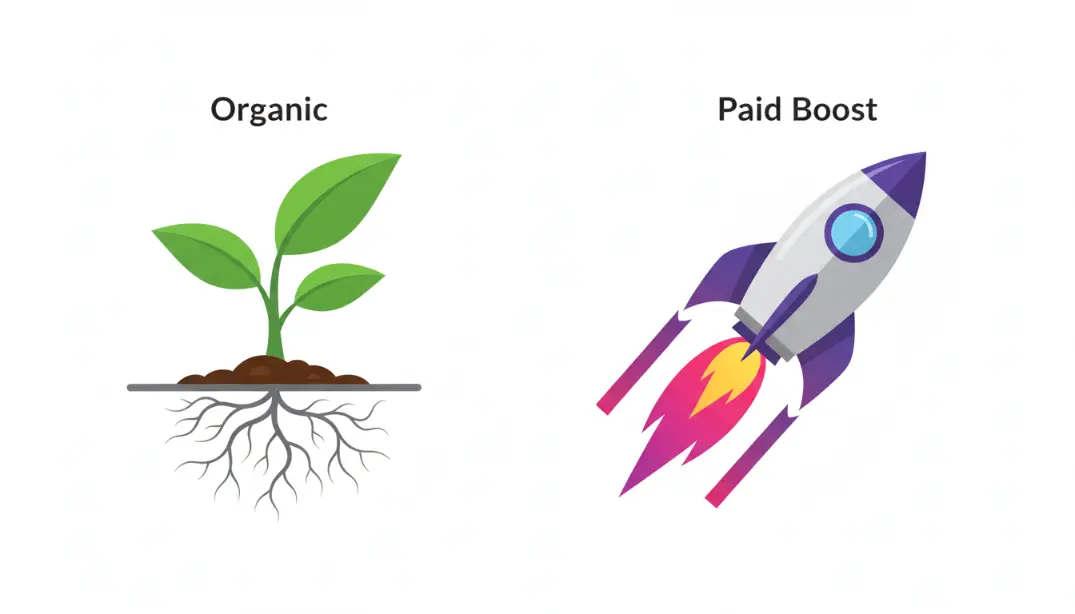
Does organic growth really work better than paid engagement, or is that just the "correct" thing to say? The answer isn't what you think. "Organic vs paid" isn't even the right question. The right question is: what mix of strategies will help YOU reach YOUR goals, given YOUR specific situation?
What We're Really Comparing
Before we decide which is "better," let's make sure we're talking about the same things — because both terms cover a much wider range than most people realise.
Organic Growth — The Traditional Path
Building your social media presence without paid services by creating content, engaging authentically, using platform features, making connections, and letting your audience grow over time through genuine discovery.
✅ What it involves
📊 The real numbers
Paid Engagement — The Strategic Boost
Using paid services to increase followers, likes, comments, votes, or other engagement metrics — to build initial momentum, break through plateaus, or amplify existing content.
The Quality Spectrum — This Changes Everything
Not all paid engagement is the same. There's a massive range between the bottom and top of the market, and confusing them is the #1 reason people walk away with the wrong conclusion about whether "paid" works or doesn't.
Clearly fake profiles, bulk delivery in minutes, zero activity after purchase. Result: useless metrics, serious platform risk.
Real accounts that never engage. Numbers go up, nothing else does. Visible delivery patterns. Result: inflated metrics, no actual value.
Real profiles with some sporadic activity. Better delivery methods. Result: safer metrics with modest secondary value.
Real platform users, slow natural delivery, niche-focused targeting. Result: real metrics plus genuine engagement potential.
The tier you choose matters just as much as whether you choose paid at all. Comparing bottom-tier bots to high-quality organic growth is like comparing a broken car to a functioning bicycle — it proves nothing except that not all options within a category are equal.
The Truth About Organic Growth — The Real Pros and Cons
Let's get honest about organic growth — not the marketing spin, and not the cynical dismissal either. The real picture is more nuanced than either camp admits.
The Real Benefits of Organic Growth
1. Genuine Community and Real Connection
People who find you organically have actively chosen you. They connect with your content, engage meaningfully, become real customers, and stay long-term. Coach A's 6% engagement rate reflects this — every follower made a deliberate decision to follow.
2. Algorithmic Trust Compounds Over Time
When real people consistently engage with your content, your posts reach more people, you show up on more Explore pages, and the platform trusts your account. That trust makes future content perform better automatically.
3. Transferable Skills That Last
Building organically forces you to master content creation, community building, and platform algorithms. These skills outlast any individual platform. No algorithm change can take away what you've learned about creating genuine value.
4. Zero Platform Risk
You're following every rule, with no account suspension risk, no follower loss anxiety, and no ethical grey areas to navigate. That peace of mind is worth something real.
The Real Problems With Organic Growth
Starting from zero in 2026 is like yelling into a void. Algorithms don't distribute content from new accounts. No engagement signals means no sharing. Great content gets 20 views and dies. Coach A nearly quit three times in her first three months because of this wall.
Real organic growth requires 1–3 hours of content creation daily plus 1–2 hours of community engagement — every day, for months or years, with no breaks. Most people, especially business owners, simply don't have this capacity.
You might post for six months and gain 500 followers. You might create genuinely excellent content that nobody sees. You can do everything "right" and still not grow — or make mistakes and accidentally go viral. Time invested does not equal results guaranteed.
While spending 15–20 hours a week on organic growth, you're not serving customers, improving your product, or pursuing time-sensitive business opportunities. For businesses, organic growth can cost more in lost revenue than any paid service would.
Organic growth is genuinely the gold standard for community quality. But it's not a morally superior strategy that always wins — it's a method with real trade-offs that is right for some people in some situations, and wrong for others.
Paid Engagement: The Real Benefits and Drawbacks
The same honest lens applied to paid engagement — no marketing spin, no cynicism. Just the actual picture.
The Real Benefits
1. It Solves the Cold Start Problem Directly
Strategic paid engagement is the most direct solution to the biggest obstacle in organic growth. It gives algorithms initial engagement signals, makes content look share-worthy, breaks the cycle of zero engagement, and gives organic growth a base to build from. Coach B paid for engagement for three months to reach 5,000 followers — after that, organic growth took over because momentum existed.
2. Time Efficiency for Real Businesses
Instead of spending three hours daily on engagement, that time goes into making better content, serving customers, and running the actual business. When paid services cost $500/month and free up 60 hours of your time — hours worth significantly more than $500 — the math genuinely works.
3. Predictable and Scalable
You can hit follower milestones on schedule, scale up for product launches, support specific campaigns, and build business plans around reliable growth data. This matters enormously for anyone with business goals attached to their social presence.
4. Immediate Social Proof
In 2026, people use follower and engagement counts to judge credibility before engaging with content. An account with 10,000 followers gets taken more seriously than one with 500 — fair or not, that's the reality. Social proof draws in real organic followers who wouldn't have considered you at a smaller count.
The Real Problems
⚠️ Platform Risks
💸 Business Risks
If you have 10,000 followers from paid services but only 300 genuinely engaged fans, you'll get 300 likes per post — not 3,000. A 3% engagement rate signals to the algorithm that your content isn't resonating, which actively suppresses your organic reach. This is why tier quality matters so much: low-quality paid engagement can damage your organic performance.
When Each Strategy Makes Sense — Real-World Scenarios
The "better" strategy isn't universal. It entirely depends on your specific situation, resources, and goals.
When Organic Growth Is the Right Choice
You Have Time but Limited Budget
Student creators, side-project builders, people with flexible schedules who can commit hours daily to content and engagement with no pressure for fast results.
You're in a High-Trust Niche
Community-focused content, education, niches where authenticity is the primary currency. Audiences that would actively penalise you if they discovered paid engagement.
Building a Long-Term Personal Brand
No monetisation pressure, purely building reputation and trust over years. Long-term compounding value matters more than speed. Credential-building in your field.
You Have Genuinely Viral-Potential Content
A unique perspective, skill, or format that spreads on its own. Natural discovery mechanisms work well for you already. Content that has already shown organic traction.
When Paid Engagement Makes Most Sense
You Have Budget but Limited Time
Business owners, high-earning professionals who can't commit to daily engagement. Time genuinely worth more than the cost of paid services elsewhere in the business.
Stuck at Zero Despite Good Content
Great content that's dying at 50 views. No initial algorithmic push despite genuine quality. Need momentum to let organic processes activate. A strategic jumpstart, not a permanent solution.
Time-Sensitive Business Goals
Product launch in three months. Partnership talks that require social credibility. Seasonal business that can't wait two years for organic momentum to build.
Specific Contest or Campaign
Entering a voting contest with real stakes, a time-limited promotion with a set end date, a one-time opportunity. Not an ongoing strategy — a targeted goal with a clear finish line.
Late to a Competitive Niche
Competitors have large established audiences. Great product or service but no visibility. Need to level the playing field to even compete for the same opportunities.
Validating Before Committing
Using paid engagement to test niche viability, validate content before scaling it, or gather market intelligence before a major content or business investment.
The Hybrid Approach — Usually the Smartest Strategy
Most successful accounts don't choose one method and stick with it forever. They use a phased approach that extracts the best from both strategies at the right stage of growth.
This is exactly what Coach B did — and why it worked so well.
Paid Boost — Solving the Cold Start
Strategic growth to reach 2,000–5,000 followers. Initial engagement to signal algorithmic value. Just enough to activate organic processes.
- Focus: follower base and initial engagement signals
- Goal: reach the threshold where organic takes over
- Content: establish voice and consistency during this phase
- Spend: invest in quality services, not volume
Mostly Organic with Selective Paid Support
80% organic growth and engagement, 20% paid boost for specific posts or campaigns. Build real community on the momentum base.
- Focus: content quality and real audience relationships
- Paid: only for launches, important posts, or viral opportunities
- Goal: let the organic flywheel start spinning independently
- Monitor: engagement rate should climb as real followers accumulate
Primarily Organic — Paid as a Precision Tool
90–95% organic growth and engagement. Paid becomes a targeted tool for specific events rather than a baseline strategy.
- Focus: sustaining community, deepening value
- Paid: only for major launches, contests, or key campaigns
- Goal: self-sustaining presence that doesn't depend on paid
- Result: the best long-term outcome — organic foundation, strategic flexibility
The goal of paid engagement in a hybrid strategy is to get to the point where you no longer need it. You're using it to activate organic growth — not to replace it. Think of it like push-starting a car: you use external energy to get the engine running, and then the engine sustains itself.
Platform-by-Platform: Where Each Strategy Works Best
Different platforms have different algorithms, different community cultures, and different responses to organic vs. paid strategies. What works brilliantly on one platform can be almost useless on another.
Extremely competitive in 2026. Reach has dropped significantly for most accounts. Reels required for meaningful growth. Cold starting is brutally hard. Paid gets you past zero; organic builds the long-term community that converts.
TikTok
Best: OrganicThe algorithm gives new accounts a genuine fair chance. Viral potential exists regardless of follower count. Content quality matters more than audience size. Cold starting is significantly easier than Instagram.
X / Twitter
Best: OrganicEngagement-based algorithm rewards participation. Conversation-driven growth means you can punch above your follower count. Niche communities are easy to find and join. Strategic content promotion helps specific posts.
YouTube
Best: OrganicAlgorithm rewards watch time, not vanity metrics. Subscriber count is less important than viewer retention. Searchable, long-term content creates lasting compounding value. Paid ads for specific videos can accelerate discovery without risk.
Professional audiences value authenticity above almost everything. Engagement rates are still relatively high for good content. Less creator competition than consumer platforms. Paid engagement feels artificial and can actively damage credibility.
Facebook / Pinterest
Best: Paid AdsOrganic reach for pages is extremely limited. Meta Ads and Pinterest Ads are the legitimate paid option that actually works here. Community growth via Groups remains organic-friendly for the right niches.
Long-Term vs Short-Term: How Your Timeline Changes the Equation
Your time horizon changes which approach makes financial and strategic sense — sometimes dramatically.
If You're Planning 6–12 Months Ahead
Paid engagement can make clear sense. The question to ask is: will the opportunity cost of slow organic growth be higher than the financial cost and risks of paid engagement? If you have a product launch, partnership opportunity, or seasonal window in that timeframe, the answer might genuinely be yes.
If You're Planning 2–5 Years Ahead
Organic growth becomes progressively more appealing. The compounding effects of genuine engagement multiply over years in a way that paid engagement fundamentally can't replicate. Real community members refer others, create user-generated content, and become long-term customers. Paid followers generally don't.
The question becomes: is short-term speed worth long-term vulnerability? Being dependent on paid services two years from now means you've built on sand rather than rock.
The most effective long-term strategy is often: use paid engagement early to overcome specific obstacles → switch to predominantly organic as momentum builds → use paid selectively for key events → build toward a presence that sustains itself indefinitely. This is what successful accounts actually do, as opposed to what they tell their audiences they do.
The Transition Point
The pivotal question for anyone using paid support isn't "should I?" — it's "what's my exit plan?" The goal should always be to use paid to activate organic growth, not to substitute for it indefinitely. If you've been using paid engagement for twelve months and organic hasn't improved, that's a content problem, not a budget problem.
The Real Cost-Benefit Analysis — Actual Numbers
Most people compare these strategies without looking at the actual numbers. Here's what both approaches really cost — time included.
| Cost Category | Organic Growth | Paid Engagement |
|---|---|---|
| Time per week | 12–20 hours (content + engagement + strategy) | 6–12 hours (content only — engagement outsourced) |
| Monthly money cost | $50–$200 (tools, scheduling, stock) | $500–$2,000+ (quality services) |
| Time value (@ $50/hr) | $2,400–$4,000/month in time | $1,200–$2,400/month in time |
| Total monthly investment | $2,450–$4,200 (time + money) | $1,700–$4,400 (time + money) |
| Result predictability | Low — highly variable | High — metrics predictable |
| Community quality | High — genuinely engaged | Mixed — depends on service tier |
| Platform risk | None | Low to moderate (depends on service) |
| Long-term value | Very high — compounds | Moderate — requires ongoing management |
If you pay $1,000/month for a growth service and reclaim 30 hours that you spend serving two additional clients at $1,500 each, you're generating $3,000 from those recovered hours while spending $1,000. The net is +$2,000. That's before accounting for any business benefit from the actual growth. The math only works if your time genuinely has alternative value — but for most business owners, it does.
The GTR Socials View — What We Actually Think
We have a stake in this conversation because we offer paid social media growth services at GTR Socials. That means we have to be more honest about this, not less. Here's what we genuinely believe.
Three Realities We Can't Ignore
Social media platforms in 2026 are algorithmically saturated. Algorithms give priority to accounts that already have engagement. Starting from scratch is ten times harder than it was five years ago. People with genuinely valuable knowledge and services can't get noticed — not because their content isn't good, but because they can't generate the initial signal the algorithm needs to start distributing it.
A 22-year-old content creator can spend four hours a day on Instagram. A 40-year-old business owner with three kids cannot. That doesn't mean the business owner's expertise is less valuable — it means they need different tools to achieve the same visibility.
Some accounts start with existing networks, personal brands from other platforms, professional content creation equipment, and three hours daily for engagement. Others don't have any of these advantages despite having equal or greater value to offer. Paid engagement is one of the tools that helps level that imbalance.
What We're Honest About
Our services — including Instagram followers, Instagram likes, and Instagram poll votes — are designed to get you past initial algorithmic obstacles and build social proof that activates organic growth. They are not a magic solution and they are not a replacement for content.
If you want 100% organic and have the time — go for it. If paid engagement would damage your credibility in your specific industry, don't use it. If you believe services alone will make your account successful without great content, we'll disappoint you. If you're not willing to create genuine value, no growth service will help you long-term.
You have great content that's getting zero traction due to the cold start problem. Time limitations prevent sustained organic effort. You have time-sensitive business goals that organic growth can't meet. You've weighed the actual trade-offs and they make sense for your situation. You want to build something real — just faster.
How to Make Your Decision — A Six-Step Framework
Stop arguing about which approach is abstractly "better." Here's a structured way to work out what's actually right for you.

Clarify Your Goals and Timeline
What do you actually want to achieve — personal brand, business leads, influencer status, contest victory? When do you need it? No urgency at all, or specific milestones in 3–6 months? The answer changes everything that follows.
Assess Your Real Resources
Be brutally honest: how many hours per week can you genuinely sustain for 6–12 months? What's your monthly budget? What's your time actually worth in alternative uses? Organic growth is only "free" if your time has no value.
Evaluate Your Starting Position
Are you starting from zero or do you have an existing base? How competitive is your niche? Do rivals have large established audiences? Is the content you have genuinely ready for amplification?
Consider Your Industry Standards and Values
Would paid engagement damage credibility in your specific field? Are there ethical concerns that genuinely matter to you — not as performance, but as a real personal standard? Be honest rather than performative about this.
Choose Your Path
Use the decision guide below. Pick the option that honestly matches your situation — not the one that sounds best in the abstract.
Commit for 90 Days and Track the Right Metrics
No strategy works in two weeks. Commit for 90 days. Track engagement rate (not just follower count), business results (clients, sales, opportunities), time invested, and genuine satisfaction with the process.
The Decision Guide
🌱 Choose Organic If...
💜 Choose Paid Engagement If...
🔀 Choose Hybrid If...
Frequently Asked Questions
Final Thoughts: It's Not About Better — It's About Right
Remember Coach A and Coach B? When I asked both whether they'd make the same choice again, they both said yes — without hesitation.
Coach A values the integrity of her community. Every follower chose her. Every client came from a genuine connection. It's smaller, it took longer, and it nearly broke her three times — but she's proud of every part of it.
Coach B values her business outcomes. The paid boost helped her past the initial wall, but she built everything that matters herself after that. Without that first push, she wouldn't have those 27 clients. The path wasn't "pure" — but the result is real.
Both are right. Neither is wrong. The "organic vs paid" debate is built on a false premise — that one is inherently superior to the other. The truth is more interesting than that.
Not making a deliberate choice — just drifting. Choosing based on what sounds virtuous rather than what fits your situation. Expecting either method to work without creating genuine value. The approach doesn't matter as much as whether you're honest with yourself about the real trade-offs, committed for long enough to see results, and focused on building something worth following.
If you choose organic, go all in. Commit the time, make exceptional content, engage honestly, and trust the long-term compounding. If you choose paid engagement, use quality services, treat them as a tool not a crutch, and have a plan for building toward organic independence. If you choose hybrid, use paid to overcome specific obstacles, transition toward organic sustainability, and don't confuse the initial push with the destination.
Your audience — organic, paid, or hybrid — is waiting for the value that only you can provide. Whatever path gets you to them, go make something worth following.
🚀 Ready to Get Past Zero and Build Real Momentum?
GTR Socials offers strategic growth services across 20+ platforms — designed to solve the cold start problem so your content gets the audience it deserves. Real accounts, quality service, honest results.
Comments (0)