

Two marketing consultants. Same industry. Similar follower counts. One post got 47 likes and 2,000 impressions. The other got 2,400 likes and 140,000 impressions. The difference wasn't quality — it was understanding what LinkedIn's algorithm actually rewards.
Last month, I watched two marketing consultants post nearly identical content on LinkedIn.
Consultant A shared a thoughtful post about client retention strategies — genuine insights from 15 years of experience, practical tips, well-written and valuable. She got 47 likes, 3 comments, and maybe 2,000 impressions.
Consultant B posted the same week with a controversial hot take: "Stop doing discovery calls. They're a waste of time. Here's why..." His post exploded: 2,400 likes, 187 comments (many arguing with him), 15 shares, and over 140,000 impressions.
Consultant A — Valuable Content
Consultant B — Controversial Take
Same industry. Similar follower counts (around 5,000 each). Completely different results. When I talked to Consultant A afterward, she was frustrated. "I shared real value. He posted rage bait. But the algorithm rewarded him, not me. How is that fair?"
She was asking the wrong question.
The LinkedIn algorithm isn't designed to be "fair" in the sense of rewarding the most valuable content. It's designed to keep people on LinkedIn as long as possible by showing them content they'll engage with. Understanding what should work is different from understanding what actually works — and the algorithm has changed significantly in the past few years.
If you're still using LinkedIn strategies from 2022 or 2023, you're probably confused why your reach has dropped. This guide covers everything: how LinkedIn's algorithm actually works in 2026, the signals that matter most, what content gets amplified, engagement tactics that work, posting strategies for maximum visibility, and how to work with the algorithm instead of against it.
How LinkedIn's Algorithm Has Changed (2023 vs 2026)
Before diving into current tactics, let's understand what's shifted — because the 2026 algorithm operates very differently from what most guides still describe.
LinkedIn now heavily prioritizes how long people spend reading your post and its comments. Short posts that people scroll past instantly = poor signal. Long-form content that keeps people reading = strong signal. Engaging comment sections = extended dwell time = massive algorithmic boost. This fundamentally changed what content performs well — quick tips struggle, long-form storytelling and debate-sparking content dominate.
Comments are now weighted 5–10x more heavily than likes. Old algorithm: 100 likes ≈ 20 comments in value. Current algorithm: 20 meaningful comments dramatically outperform 100 likes. Posts that generate conversations get dramatically more reach than posts that collect silent likes.
Who engages with your content matters as much as how many engage. The algorithm evaluates whether engaging users are active LinkedIn participants or passive accounts. 20 comments from active, engaged LinkedIn users dramatically outperforms 100 comments from passive accounts.
Native LinkedIn video now receives preferential algorithmic treatment. It auto-plays in feed, has naturally higher dwell time, and gets distributed more broadly than text or images — especially for videos under 2 minutes.
The critical engagement window has shortened significantly. Old algorithm: first 6–12 hours mattered most. Current algorithm: first 1–3 hours are make-or-break. If your post doesn't generate engagement quickly, the algorithm assumes it's not interesting and stops showing it.
LinkedIn now differentiates between Creator Mode accounts and standard profiles. Creator Mode adds a "Follow" button, featured topics, and LinkedIn Live access — with allegedly better algorithmic distribution. The tradeoff: harder to build direct connections, more focused on broadcasting.
| Signal | Old Algorithm (2023) | Current Algorithm (2026) |
|---|---|---|
| Likes | Significant boost | Minimal boost |
| Comments | Moderate boost | Massive boost (5–10x likes) |
| Critical window | First 6–12 hours | First 1–3 hours |
| Video | Slight preference | Strong preferential treatment |
| Dwell time | Minor signal | Top-tier signal |
| Network quality | Not evaluated | Heavily weighted |
The Signals That Matter Most in 2026
LinkedIn's algorithm evaluates content based on specific signals. Here's what actually matters, ranked by impact — so you know where to focus your energy.
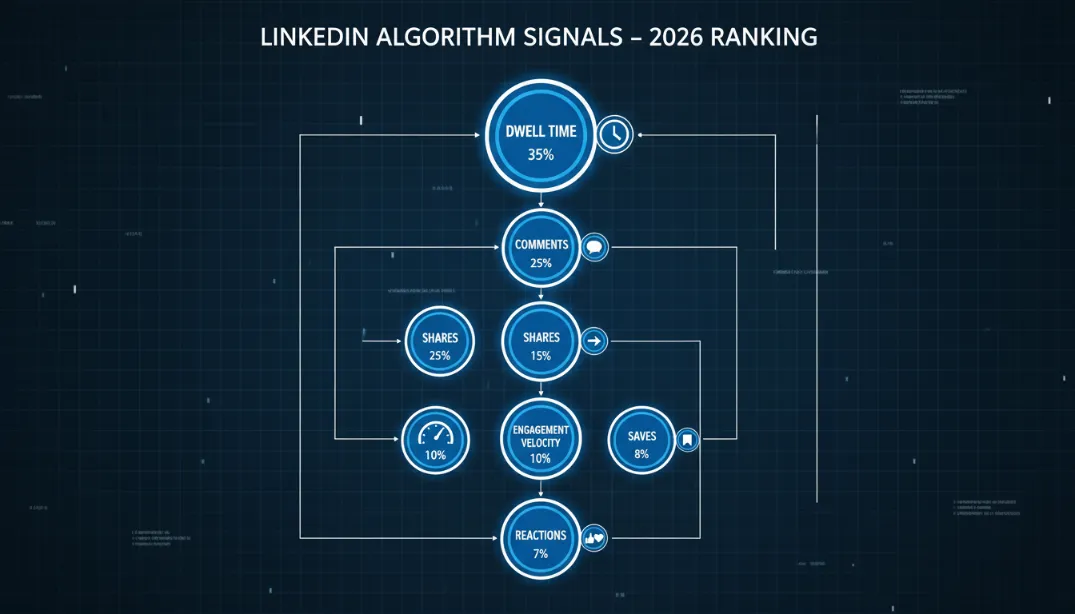
Dwell Time
Highest ImpactHow long people spend reading your post and its comments. Optimise by writing 1,300–2,000 character posts, creating compelling hooks that make people click "see more," and asking questions that extend comment discussions.
Comments
Very High ImpactTotal comments, quality of comments, conversation depth, and how quickly they arrive. A post with 15 comments and 40 likes will outperform a post with 5 comments and 200 likes every time.
Shares
High ImpactShares expose content to entirely new networks and signal that content is valuable enough for someone to stake their reputation on. Create shareable insights, data, or frameworks and include "What do you think?" to invite shares with commentary.
Engagement Velocity
High ImpactHow quickly engagement happens in the first 1–3 hours. Post when your audience is most active, engage immediately with early commenters, and have your network ready to engage quickly.
Saves / Bookmarks
Moderate ImpactSaves signal long-term value. Educational content, lists, frameworks, and how-to posts get saved more. Explicitly mention "Save this for later" when relevant.
Reactions Beyond "Like"
Moderate ImpactInsightful, Love, Celebrate, Support, and Curious reactions signal emotional resonance. Helpful content triggers Insightful; vulnerable stories trigger Support; celebrations trigger Celebrate.
Views and impressions alone (algorithm input, not output). Total follower count (network quality beats size). Passive likes without comments (minimal algorithmic value). Post length alone — long posts only work if they maintain genuine engagement throughout.
Content Types That Perform Best in 2026
Different content formats perform very differently on LinkedIn's current algorithm. Here's what's working — and what's dragging reach down.
Top Performing Content Types
Storytelling Posts
Personal stories with lessons, challenges overcome, behind-the-scenes experiences. High dwell time as people read the entire narrative, emotional connection drives comments, relatable experiences generate engagement. End with "What's a mistake you've learned from?"
Controversial / Debate-Sparking Takes
Opinions that go against conventional wisdom. Generates comments from agreement and disagreement, people tag others to debate, extended conversations = algorithmic gold. Use "Unpopular opinion:" or "Here's why I believe [X]..." structures. Stay thoughtful, not just inflammatory.
Data-Driven Insights
Sharing research findings, statistics, industry insights. High save rate for reference value, gets shared by others citing data, positions you as authority. Structure: "We analysed 10,000 [X] and found these patterns..."
Educational How-To / Frameworks
Teaching something practical with clear steps. Valuable and shareable, people save for later reference, builds authority. Comments asking clarifying questions extend dwell time. Numbered steps format performs well.
Native Video (Under 2 Minutes)
Video uploaded directly to LinkedIn, not YouTube links. Auto-plays in feed, higher dwell time, algorithm preference. Keep under 90 seconds, add captions (most watch muted), hook in first 3 seconds.
External Links in Post Body
LinkedIn penalises posts with external links in the main text. Put links in the first comment instead. Posting natively — then immediately commenting with the link — can increase reach by 50–200%.
Generic motivational quotes (overdone, low engagement, seen as low-effort). Pure self-promotion ("Check out my new service!"). Company news without audience value ("We won an award!"). Overly corporate/formal content that reads like a press release with no personality or conversation hooks.
Engagement Tactics That Actually Work
Beyond content creation, how you engage matters enormously for algorithmic distribution. These tactics have a direct impact on reach.
The Power of the First Hour
The algorithm tests your post with a small audience first. If engagement is strong in the first 1–3 hours, distribution expands dramatically. If weak, the post dies immediately.
Post During Peak Activity Times
Tuesday, Wednesday, Thursday 8–10 AM generates the highest engagement. The lunch window (12–1 PM) and end-of-day (5–6 PM) also perform well. Avoid early mornings before 7 AM, evenings after 8 PM, and weekends unless your audience skews differently.
Engage Before You Post
30 minutes before posting, comment on 5–10 posts in your feed. This signals to the algorithm that you're an active user, not just a broadcaster. Active users get preferential distribution — prime the algorithm by being genuinely engaged first.
Build Your Engagement Network
Develop a group of trusted connections who genuinely engage with each other's content — not artificial pods, but people who are genuinely interested in each other's perspectives. The key is substantive comments, not just "Great post!"
Be Online and Active for the First 2 Hours
Respond to every comment in the first 2 hours. Ask follow-up questions in replies: "That's interesting — what made you try that approach?" Tag relevant people: "@[Name] has experience with this — what's your take?" Each response creates a new comment, extending the thread and algorithmic signal.
Make Every Response Substantive
Bad: "Thanks!" — Better: "Thanks, Sarah! Have you found [related question]?" Substantive replies create threads, extend dwell time, and show you're investing in the conversation — not just broadcasting.
A post with 15 comments and 40 likes will consistently outperform a post with 5 comments and 200 likes in algorithmic distribution. Every time. Focus on generating conversations, not collecting silent approval.
Posting Strategy for Maximum Reach
Beyond individual posts, your overall strategy and consistency pattern directly affects algorithmic distribution.
Optimal Posting Frequency
For personal profiles in 2026, 3–5 posts per week is optimal. Daily posting can work if you maintain quality. Less than twice per week makes it hard to build and sustain momentum. For company pages, 1–2 posts per week with high quality consistently outperforms frequent low-effort posts.
Content Mix Strategy
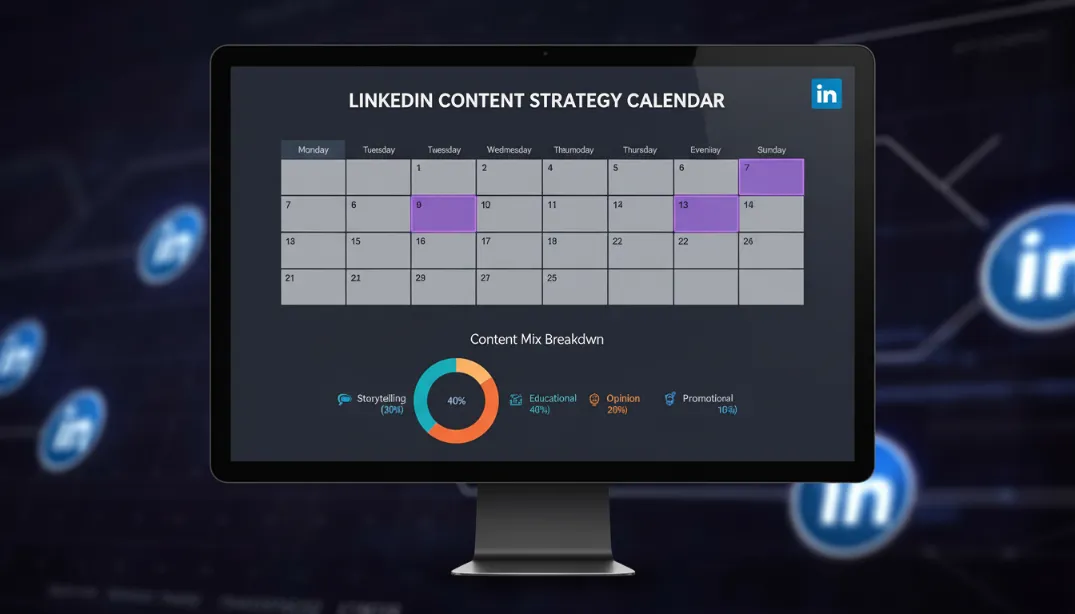
Posting the same type of content repeatedly causes "predictability fatigue" — your audience stops engaging because they know exactly what to expect. A healthy mix prevents this:
- 40% Educational/valuable insights — builds authority and saves
- 30% Personal stories/experiences — builds connection and dwell time
- 20% Thought leadership/opinion — generates comments and shares
- 10% Company news/offerings — made relevant to the audience, not just self-promotional
Post Timing Strategy
Best performing windows based on 2026 data: Tuesday–Thursday 8–10 AM (start-of-workday scroll), 12–1 PM (lunch break), and 5–6 PM (end-of-workday check). Lower engagement windows: before 7 AM, after 8 PM, and weekends (unless your audience skews B2C or lifestyle content).
Check LinkedIn Analytics → Followers → Demographics to see when your specific followers are online. Test different times and track performance. Your specific audience might differ significantly from the averages — and your own data always beats generic advice.
Common Mistakes Killing Your LinkedIn Reach
These mistakes silently destroy algorithmic performance — and most people making them have no idea they're the source of the problem.
LinkedIn penalises posts with external links in the main text because it wants people to stay on LinkedIn, not leave for your website or blog.
Posting content then disappearing for hours or days. No responses to comments means conversation dies quickly, the algorithm sees low engagement velocity, and you signal to your audience that you don't care about their responses.
Using 10–20 hashtags like Instagram. On LinkedIn this looks spammy, doesn't significantly increase reach, and can actively decrease engagement because it signals low-effort content.
Overly formal, corporate language without personality. LinkedIn users engage with people, not faceless corporations — generic corporate speak doesn't generate comments or emotional connection.
Posting 5 times one week, then nothing for three weeks. The algorithm favours consistent accounts, your audience forgets about you, and momentum dies completely between gaps.
Only showing up to promote your content, never engaging with others. LinkedIn values reciprocal engagement — active community participants get preferential algorithmic treatment.
"Please like and comment!" or "Hit the like button if you agree!" LinkedIn explicitly penalises engagement bait, and it signals desperation rather than confidence in your content.
The GTR Socials Perspective: Working With LinkedIn's Algorithm
At GTR Socials, we work with professionals and businesses trying to grow their LinkedIn presence, and we're transparent about what actually drives success on the platform.
LinkedIn's algorithm rewards genuine engagement and conversation — but getting initial traction when you're starting from zero is brutally difficult.
Post to your 500 connections → get 30 views, 2 likes, 0 comments → algorithm sees low engagement → stops distribution → even excellent content dies at 50 impressions → frustrating cycle repeats. The challenge isn't creating good content — it's getting the initial algorithmic signals that trigger broader distribution.
What We're Honest About
LinkedIn's algorithm can be gamed, but it shouldn't be broken. Low-quality engagement services harm more than help. Fake comments are obvious and damage credibility. Bot engagement triggers platform penalties. Sustainable success requires real value and real engagement — and our services provide real interactions from actual LinkedIn users in relevant industries.
Phase 1 (Months 1–2): Build engagement foundation — initial traction on posts (first 10–20 comments), train algorithm to recognise your content as valuable, build initial momentum. Phase 2 (Months 3–6): Transition to organic + strategic support — primarily organic engagement from growing audience, strategic support for important posts or campaigns. Phase 3 (Ongoing): Self-sustaining presence — engaged network that shows up naturally, occasional support only when needed, real community built from genuine value creation.
We're not right for everyone: if you can already generate 50+ comments organically, you don't need us. If you're unwilling to create valuable content, we can't help. Our services — including LinkedIn followers, LinkedIn reactions, and LinkedIn comments — are built for genuine professionals with valuable expertise who are getting buried by the cold start barrier, not for accounts looking to substitute engagement for substance.
Your LinkedIn Algorithm Action Plan
Here's your practical, week-by-week strategy for working with LinkedIn's algorithm — built for sustainable growth, not viral lottery tickets.
Foundation Building
Establish consistent presence and baseline engagement patterns.
- Audit current content performance — what's worked, what hasn't
- Identify your content strengths (storytelling, data, education?)
- Create a content calendar with varied post types
- Post 3x per week minimum, Tuesday–Thursday mornings
- Engage with others' content 10 minutes before posting your own
- Respond to every comment within 2 hours
Optimisation
Identify what resonates with your specific audience.
- Review analytics — what posts got the best engagement?
- Double down on formats that work for you specifically
- Test different hooks and post structures
- Experiment with posting times against your analytics
- Build reciprocal engagement relationships
- Focus on generating comments, not just likes
Momentum Building
Accelerate algorithmic distribution through proven tactics.
- Post 4–5x per week if sustainable for your schedule
- Incorporate native video content 1–2x per month
- Share more controversial or debate-sparking content (thoughtfully)
- Tag relevant people to expand reach strategically
- Write longer-form posts (1,500+ characters)
- Engage more extensively — comment threads, not just replies
Sustainable Strategy
Sustain growth without burnout.
- Maintain 3–4 posts per week consistently
- Track monthly growth in reach and engagement
- Refine content based on performance data
- Build genuine relationships through engagement
- Test new content formats quarterly
- Stay informed on algorithm changes
FAQ: LinkedIn Algorithm 2026
Final Thoughts: The Algorithm Rewards Conversation, Not Broadcasting
Consultant A — the one whose valuable post got 47 likes while Consultant B's controversial take got 2,400? Three months later, she adjusted her approach. Started ending posts with questions. Shared more personal stories. Occasionally posted thoughtful controversial takes. Responded to every single comment.
Her average post now gets 400–600 likes and 40–80 comments. Her reach increased 10x. Not because she compromised her values or went full rage bait. Because she learned to work with the algorithm instead of against it.
It's designed to promote content that keeps people on LinkedIn, engaged in conversations, and scrolling for longer. You can be frustrated by this, or you can use it strategically. Your choice isn't between "gaming the algorithm" and "ignoring it" — it's between understanding how it works and using that knowledge to amplify your valuable content, or stubbornly ignoring it and watching your valuable content die at 200 views.
The smartest approach: create genuinely valuable content that serves your audience, then structure and post it in ways the algorithm will amplify. It's not selling out — it's being strategic about getting your message heard. Master the basics: write hooks that make people click "see more," structure posts for engagement, end with questions that generate comments, post when your audience is active, engage extensively in the first 1–3 hours, be consistent over weeks and months, and add value to others' content, not just your own.
Do this well, and the algorithm becomes your amplifier, not your obstacle. Now stop complaining that it's unfair and start creating content structured to win within the system that exists. Your network, your expertise, and your message deserve to be seen. Make it happen.
🚀 Ready to Break Through the LinkedIn Cold Start Barrier?
GTR Socials helps professionals with valuable expertise get past the initial algorithmic barrier — so your content reaches the audience it deserves. Real engagement, real results, real LinkedIn users.
Comments (0)