

I saw two creators with almost the same style of content last month, but they had very different ideas about how often to post on TikTok. Creator A posted 8-12 times daily. Creator B posted once daily. After 90 days: Creator A got 47,000 total views on 800+ videos. Creator B got 340,000 views on 78 videos.
📋 Table of Contents
The Creator Comparison: Volume vs. Quality
Creator A (8-12 posts daily):
- 800+ videos posted
- 47,000 total views
- 59 views per video average
- Result: Burnout and quit for a month
Creator B (1 post daily):
- 78 videos posted
- 340,000 total views
- 4,359 views per video average
- Result: Still posting 6 months later with 42,000 followers
I asked Creator A what she had learned, and she said, "I thought that more posts would mean more chances to go viral. Instead, I burned out making content that nobody watched."
What does Creator B think? "I almost posted more often because everyone says to. But I tested it and found that the algorithm punished my rushed content. Every time, one great video outperformed five mediocre ones."
This shows the most important thing to remember about how often to post on TikTok: more isn't always better. The right frequency is the point at which you can keep up quality and consistency. This point is different for everyone.
There is no one right answer to the question "How often should you post on TikTok?" But it does give you a structure to help you figure out the best time for you to post.
This guide has everything you need to know, including what the data really says about posting frequency and views, why the TikTok algorithm rewards (or punishes) different posting patterns, how to test and find your own best frequency, content planning tips that keep you from getting burned out, and the GTR Socials view on sustainable growth.
No matter if you're just starting out, trying to get past a plateau, or trying to make an already successful account even better, you'll know exactly how to plan your posting frequency.
Let's work out the best time for you to post.
What the Research Really Says About How Often to Post
Before we get into strategy, let's look at what the data says about how often people post on TikTok and how many views they get.
The Common Sense (And Why It's Not Enough)
What you'll hear all the time:
- "Post 3 to 5 times a day for the best growth!"
- "Don't skip a day; consistency is key!"
- "The more you post, the better your chances of going viral!"
Why it's too simple:
This advice doesn't take into account important factors like:
- Quality of content and engagement
- Your target audience and niche
- The algorithm's real way of judging your account
- Ability to create things that last
- Planning content strategically
The truth is more complicated.

Data shows quality content at sustainable frequency outperforms high-volume rushed content
What Several Studies Have Found
Looking at successful TikTok accounts of all sizes shows some interesting patterns:
For accounts with fewer than 10,000 followers:
- Posting once to three times a day gives the best results.
- If you post more than five times a day, you often get fewer views per video.
- Posting every day is more important than how much you post.
- Accounts that post good content three to four times a week often do better than those that post bad content every day.
For accounts with between 10,000 and 100,000 followers:
- For long-term growth, 2 to 4 posts a day seem to be the best number.
- Accounts can handle a little more frequency without losing quality.
- Strategic posting times are becoming more important.
- A mix of trending and evergreen content works best.
For accounts with more than 100,000 followers:
- Most top performers post 3 to 5 times a day.
- More ability to make a lot of high-quality content (often teams, not individuals)
- Brand recognition lets some posts that aren't very good go without a big penalty.
- It becomes very important to have a lot of different types of content and to try new things.
A key point for all sizes is that average views per video is a better measure than total views. Putting a lot of content on the platform that doesn't get a lot of engagement is bad for your account health.
How Often the Algorithm Thinks You Should Post
Posting a lot doesn't directly help TikTok's algorithm. It gives points for good engagement.
What the algorithm really looks at:
- Percentage of time people watch your video (how much of it they watch)
- Completion rate (do they watch the whole thing?)
- The number of likes, comments, and shares compared to views is the engagement rate.
- Rate of re-watching (do people watch it more than once?)
- Visits and follows to your profile from the video
How often you post affects these numbers:
Too many posts:
- You can't keep the same level of quality in all of your videos.
- People watch less of content that is rushed.
- Algorithm sees signs of bad performance
- Videos that come out later get less initial distribution.
- You teach the algorithm that your content isn't very good.
Posting too little:
- The algorithm has fewer data points to figure out what your content is about.
- You miss out on trending topics and good chances when they come up.
- People forget about you between posts.
- Less momentum for growth
Often enough to stay relevant and collect data, but not too often to keep quality.
The Quality vs. Quantity Argument (Settled)
This is the main problem with TikTok's posting strategy. Let's fix it.
Why "Just Post More" Doesn't Work
The volume theory makes sense:
- More posts mean more chances to go viral.
- More chances mean a better chance of success.
- So, post as much as you can.
Why it doesn't work in real life:
1. The algorithm doesn't treat all of your videos the same.
TikTok's algorithm notices when you post bad content:
- A lack of engagement means that trust is going down across the board.
- The next video you make will have a smaller test audience.
- Your account's bad reputation hurts even good content.
2. You're up against yourself
Post three videos one after the other:
- They often try to reach the same audience at the same time.
- Each one makes the others less likely to reach people.
- Better to spread them out so they stay visible for a long time
3. Making something of good quality takes time.
Making hooks, filming, editing, writing captions, and doing trend research all take time to make good content. This process will not work as well if you rush it.
Why Quality Always Wins (Eventually)
High-quality content leads to compound growth:
- Video 1: Great hook, lots of engagement → Algorithm spreads it widely
- Video 2: A strong start because the first video did well
- Video 3: Distribution is even better because the account has a good signal history.
- Result: A pattern of exponential growth
Low-quality volume causes decay:
- Videos 1–5: Not very engaging → Algorithm cuts back on distribution
- Videos 6–10: Even less reach at first because the account history is bad
- Videos 11–15: Almost no one saw them.
- Result: Less and less return on effort
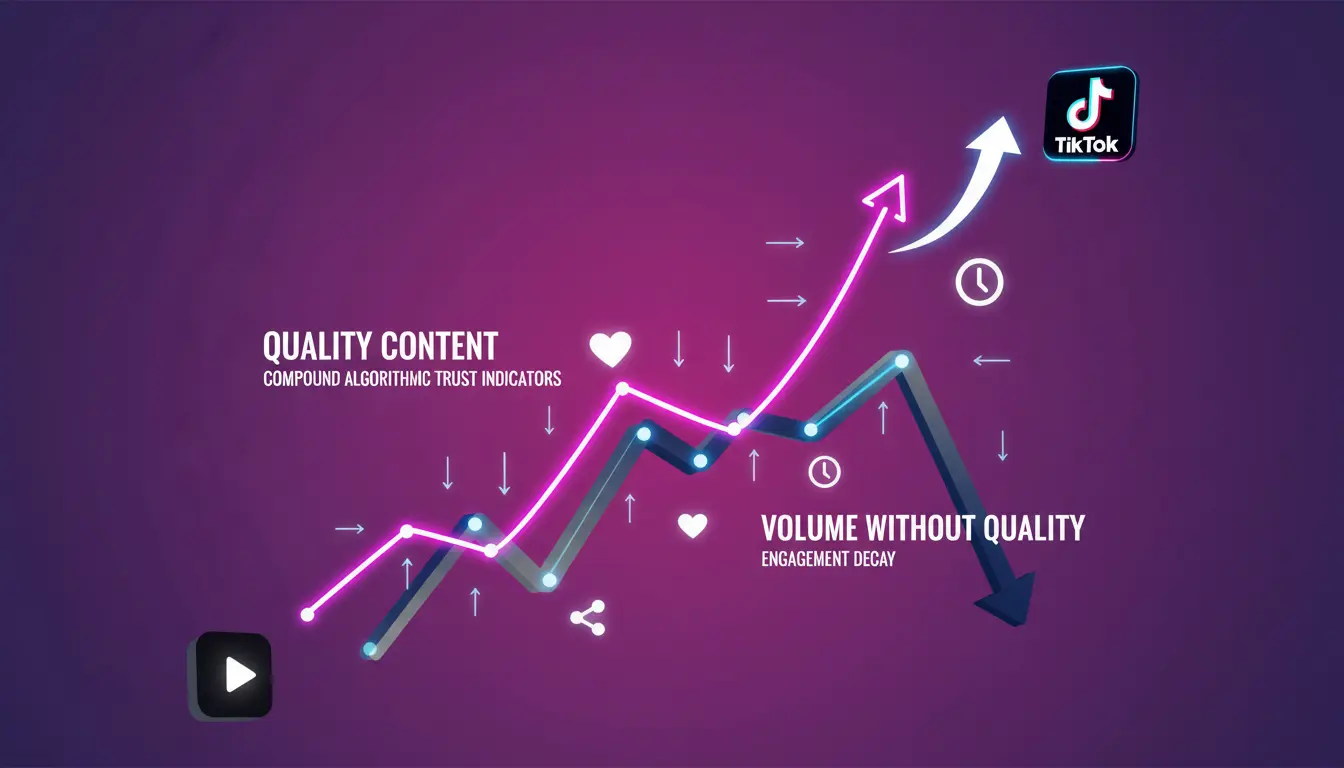
Quality content creates compound algorithmic growth while volume without quality leads to decay
The Best Balance Framework
It's not "quality OR quantity," it's "quality AT sustainable quantity."
Search for the frequency where:
- You can make content that makes you proud.
- Your average watch time is still over 60%.
- Your engagement rate is still good (3–5% or more for smaller accounts).
- You don't feel like you've run out of ideas or energy.
- You can keep things the same for months, not weeks.
For most creators, this means posting 1 to 3 times a day. For some, it's every other day. For people with teams or systems, it could be four to five times a day. The number isn't as important as how long it lasts and how well it is kept up.
Finding the Best Frequency for YOUR Posts (The Testing Framework)
You can't get very far with general advice. This is how to figure out what really works for your account.
The Test for Posting Frequency Every 30 Days
Week 1: Baseline (one post every day)
- Post once a day at the best time for you
- Make sure that every video is as good as it can be.
- Track: views, percentage of watch time, engagement rate, and follower growth
Week 2: More posts (2–3 times a day)
- Put space between posts of at least 4 to 6 hours.
- Keep up the quality standards
- Keep an eye on the same metrics
- Look at the Week 1 baseline
Week 3: More posts (4–5 per day)
- Post all day long
- Keep an eye on the quality to see if it drops.
- Keep an eye on the numbers
- Pay close attention to how many views each video gets on average.
Week 4: Review and Improve
- Look over all the data
- Find the frequency that gave the best average views per video.
- Stick to that frequency for the next 60 days.
Important Metrics
Don't just look at the views. Keep an eye on these:
- Average views per video: More important than total views.
- Percentage of watch time: Shows how good the content is
- The engagement rate: Shows how connected the audience is.
- Follower conversion: The number of viewers who become followers
- Rate your energy and creativity: On a scale of 1 to 10 to find out how burned out you are as a creator.
Most views per video is the most common, the watch time stays above 60%, and you can keep it up without getting tired.
The Test for Quality Threshold
Before posting more often, make sure:
- ✓ Current videos get watched for an average of 60% of the time
- ✓ Your engagement rate is good for the size of your account
- ✓ You have ways to make content quickly and easily
- ✓ A content calendar with planned ideas
- ✓ Enough creative energy to keep up with standards
If you can't check all of these boxes, work on making things better before making more.
Things to Think About When It Comes to Account Size
If you have less than 1,000 followers:
- One post a day is a good place to start.
- Obsess over quality
- Every video is a vote on whether or not people want more from you.
- At this point, rushing content hurts your algorithmic reputation.
If you have between 1,000 and 10,000 followers:
- Test one to three posts every day
- You have more information to figure out what works.
- Can try out different frequencies without causing too much damage
- Find a balance between quality and speed
If you have more than 10,000 followers:
- 2 to 4 posts a day becomes doable
- You probably have systems and ways of doing things.
- The audience wants new content all the time.
- Can afford to post lower-quality content every now and then without too much damage
Strategic Posting: It's Not Just About How Often
One factor is how often you post. Strategic posting takes a lot of things into account.
Best Times to Post
When you post is almost as important as how often you do it.
The best times for TikTok in general (EST):
- 6 to 9 AM in the morning (people checking before work or school)
- Lunch is from 12 to 1 PM (scrolling in the middle of the day).
- Evening: 6 to 10 PM (the best time to use TikTok)
- Late night: 10 PM to 12 AM (scrolling before bed)
But your audience may be different.
How to find YOUR best times:
- Go to TikTok Analytics, then Followers, and then "Follower activity."
- Find out when your target audience is online.
- Post during those times to get the most immediate engagement.
Strategic spacing:
If you post more than once a day, space them out so that they hit different optimal times.
Here is an example schedule for three posts a day:
- 7 AM (people going to work in the morning)
- 1 PM (people who watch during lunch)
- 8 PM (the peak of the evening)
Type of Content and How Often It Is Posted
Different types of content should be posted at different times.
- Trending content: If you see a trend, post it right away (more than once a day if you need to).
- Evergreen content: 1–2 per day, with an emphasis on quality
- Educational content: Less often but better (every other day works)
- Entertainment and comedy: Can keep going at a higher frequency if the quality stays high
- Behind the scenes: 2–3 times a week, mixed in with the main content
60% trending or timely content, 30% evergreen or unique content, 10% experimental or personal content. This lets you post 2 to 3 times a day with different needs for production and content.
The Strategy for Batching Content
How successful creators keep up a high frequency without getting burned out:
The batching method:
- Set aside certain days to film (5 to 10 videos in one session)
- Edit in groups (work on more than one video at a time)
- Plan posts ahead of time
- Make sure to separate making and posting
Schedule for example batching:
- Monday: Make 6 to 8 videos
- Tuesday: Plan and edit for the week
- From Wednesday to Sunday, focus on getting people involved, not making things.
This makes it possible:
- Posting regularly (2 times a day = 14 videos a week)
- Sustainable workload (two days of focused work)
- Better quality (not rushed every day)
- Keeping creative energy
Mistakes People Make When Posting Often
Mistake #1: Posting More When Videos Aren't Doing Well
The wrong idea: "My videos aren't getting views, so I'll post more to improve my chances."
Why it doesn't work: You're giving the algorithm more of what it doesn't like. The problem gets worse with more bad content.
Fix: When your performance goes down, post less and work on making things better. Find out what's wrong before making more of it.
Mistake 2: Comparing Your Frequency to That of Big Creators
The issue: "This creator posts six times a day, so I should too."
Why it doesn't work: Big creators usually have teams, resources, established audiences, and algorithmic trust that you don't have yet.
Fix: Look at creators who are about the same size as you. Don't model practices that you want to do; model ones that are good for the environment.
Mistake 3: Posting Just to Get a Number
The problem: "I promised to post three times today, so I'll post this bad video to meet my goal."
Why it doesn't work: One bad video can hurt your account more than missing a day helps it.
Fix: Let yourself post less if it will hurt the quality. It's important to be consistent, but not if it means losing quality.
Mistake 4: Not Having a Content Calendar or Plan
The problem: You have to decide what to post every day when you wake up.
Why it doesn't work: It makes people rush their work, miss trends, and get burned out creatively.
Solution: Plan your content at least three to seven days ahead of time. Know what you're putting up and when.
Mistake 5: Not Paying Attention to Analytics Feedback
The problem: You post the same amount no matter what the performance data says.
Why it doesn't work: You're not making changes based on real results.
Fix: Check analytics every week. Change the frequency if the data shows clear patterns.
Mistake 6: Getting Burned Out and Then Leaving
The problem: You post every day for three weeks, then stop for two weeks because you're too tired.
Why it doesn't work: Being inconsistent is worse than being less frequent. Both the algorithm and the audience punish people who go missing.
Fix: Pick a frequency that will last from the beginning, even if it's lower.
Systems for Sustainable Content
People who successfully post a lot over a long period of time have systems, not just willpower.
The Idea Generation System
Never run out of ideas for content:
Capture ideas every day:
- Keep a list of all your content ideas.
- Save sounds and topics that are popular right away.
- Take a screenshot of any interesting formats you see.
- Write down random thoughts during the day
Meeting for ideas every week:
- Take 30 minutes to think of ideas.
- Look back at what worked well last week.
- Plan the themes for next week's content
- Batch research on popular topics
Content pillars:
Choose three to five main types of content that you switch between. For a fitness creator, this is an example:
- First pillar: Short workouts
- Nutrition tips are the second pillar.
- Pillar 3: Stories of change
- Pillar 4: Breaking Down Myths
- Pillar 5: Behind the scenes
This structure makes it easier to come up with ideas in a planned way instead of randomly.

Systematic content batching and planning enables sustainable high-frequency posting without burnout
The System for Production Efficiency
Make more in less time:
Make filming easier:
- Choose specific places to film
- Make sure the lighting is always the same.
- Make a template for your intro and outro
- Film videos that are similar one after the other.
Editing that works well:
- Make templates that can be used again and again
- Always use your favorite effects and transitions
- Make shortcuts for editing
- Think about hiring someone else to do the editing once you start making money.
Tools for scheduling:
- Use TikTok's built-in scheduling, which you can find in Creator Tools.
- Tools from other companies: Later, Hootsuite, and Buffer
- Schedule the whole week at once in a batch
The System for Managing Energy
Stop burnout:
Make sure to separate making and posting:
- If you can, don't make something and post it on the same day.
- Make movies when you feel creative.
- Set up posts ahead of time to keep things consistent.
- Take days off to be creative
Limits on making content:
- Set specific times for making things
- If you don't feel like it, don't film.
- Let things be imperfect (done > perfect)
- Add in breaks every three months.
Change the difficulty of the content:
- Not every video needs a lot of editing.
- Combine easy and hard productions
- Use formats that are popular right now (less creative lift)
- Reassign strong performers
The GTR Socials Point of View: Long-Term Growth Instead of Posting Sprints
We work with TikTok creators and businesses at every stage of growth at GTR Socials, and we're honest about how often you should post to be successful.
Posting often is one way to grow, but it's not the most important one, and it's not always what's stopping you.
The hardest thing for most TikTok accounts to do isn't post often. When they do post, it's getting some initial attention.
Here's the truth: You can post five times a day, but if each video only gets 200 views and little interaction, you're not making real progress—you're just making more content that the algorithm ignores.
To know that your content is worth sharing, TikTok's algorithm needs engagement signals. When you're just starting out or not very big:
- Your videos start out with small test audiences, usually 200 to 500 views.
- If you don't get involved right away, distribution stops.
- Even good content has a hard time getting through
- Posting more doesn't help; it just makes more videos stuck at 200 views.
Strategic growth support solves this by:
- Making initial engagement signals that start algorithmic distribution
- Helping good content get to the people who need it
- Getting the ball rolling so that organic growth can build on itself
- Letting your posting frequency really matter
Imagine it like starting a fire:
- Adding logs is posting often.
- Having dry, good logs is what makes content good.
- The first engagement is the spark.
- You can stack perfect logs all day without the spark, but they won't catch fire.
Our method is based on:
- First, find a sustainable frequency: Find the number of posts you can make every day that are always of good quality (usually 1–3).
- Never give up the value of your content: To meet your posting goals.
- Strategic amplification: Use initial engagement support to help great content get the attention it needs.
- Long-term building: Don't rely on a viral lottery to grow your business.
Not only do you want views, you also want to build a community that is involved and grows over time.
It's tiring and not useful to post five times a day to an audience that doesn't respond. Posting once or twice a day to an audience that is getting more involved and growing is a good way to keep things going.
If you're looking to amplify your best-performing content beyond organic distribution, GTR Socials' TikTok growth services offer a way to give strong videos an additional reach boost—particularly useful when a well-crafted post needs a push through TikTok's initial test distribution phase.
We help creators figure out what frequency works best for them:
- Ability to make content
- Standards of quality
- Goals for growth
- Time and resources that are available
The truth is that the "right" posting frequency doesn't matter if you get tired of it in six weeks. The frequency you can keep up for six months is much more valuable than the sprint you can't keep up.
Your Personalized Action Plan for Posting Frequency
Here's how to figure out your best schedule and put it into action:
Step 1: Assess the Current State (Week 1)
Check out where you are now:
- How often do you post now?
- How many views does each video get on average?
- Percentage of time watched?
- How long do you think this will last?
Be truthful about:
- The time you have
- Levels of creative energy
- The quality of the content at the current pace
- If you like the process
Step 2: Set the Limits for Your Tests (Weeks 2–4)
Do the 30-day test that was mentioned earlier:
- Week 1: Baseline (1 per day)
- Week 2: Moderate (2–3 times a day)
- Week 3: More (4–5 a day)
- Week 4: Study
Keep track of everything:
- How many views each video gets
- Time to watch
- Rate of engagement
- Your personal energy/pleasure
- Time spent making
Step 3: Find Your Sweet Spot (Week 5)
Look over the data and ask:
- What frequency had the most views on average?
- Where was the most engagement?
- Which one felt like it would last?
- Where did the quality start to go down?
The best frequency for you is where these two things meet.
Step 4: Set Up Your Systems (Week 6)
Make: Based on the frequency you chose,
- Template for a content calendar
- Schedule for batching
- Routine for coming up with ideas
- Workflow for production
- Plan B for days when you don't have much energy
Step 5: Make a Promise and Improve (Ongoing)
Stick to your schedule for at least 60 days.
- Let it take its time to work.
- When problems come up, change the systems, not the frequency.
- Keep an eye on how things are going each month.
- Refine after 60 days if the data shows a clear chance
How Often Do You Post on TikTok?
Q: Do I have to post on TikTok every day?
Posting every day helps keep things consistent, but posting every other day with better quality is better than posting every day with worse quality. As a rule of thumb, you should post 5 to 7 times a week.
Q: How often do you need to post to see growth?
At least three to four posts a week. If you don't have enough, it's hard to build momentum and the algorithm has trouble understanding your content.
Q: Can I post too much on TikTok?
Yes. If you post so often that the quality goes down, you're hurting your account. Most individual creators start to see less and less benefit from posting more than five times a day.
Q: How long should I wait between posts?
There should be at least three to four hours between posts. This lets each video finish its first algorithmic test without having to compete with your other videos.
Q: Is it more important to post at certain times than to post often?
Both are important, but frequency gives you more chances. If you can only optimize one thing, make sure to post when your target audience is most active.
Q: What if I don't post for a day?
You won't lose your account if you miss one day. But posting five times one week and none the next week hurts momentum. Even if the daily totals change, try to keep the weekly totals the same.
Q: Should new accounts post more often?
New accounts should put quality ahead of quantity. Start by posting once a day until you know what works, then think about posting more often while keeping the quality high.
Q: How long will it take for me to see results from posting regularly?
Most accounts notice changes that can be measured within 2 to 4 weeks of posting regularly at the best times. It usually takes 60 to 90 days for big growth to happen.
Q: Is it possible for me to change how often I post?
Yes, but take your time. If you want to go from posting three times a day to five, don't jump right in. Instead, add one post a week for a few weeks.
Q: Which is more important, how often you post or how often you use trending sounds?
Both are important, but high-frequency poor quality beats low-quality content. First, make sure your content is good, and then work on frequency.
Final Thoughts: Consistency is Better than Intensity
Creator A, who posted between 8 and 12 times a day? She was so burned out after 90 days of bad results that she stopped posting for a month.
Creator B, who posted every day? She is still going strong six months later, with 42,000 followers and an average of 15,000 views per video.
The lesson isn't "post less," it's "find what works for you while keeping the quality high."
The accounts that do well over time:
- Post often enough to stay relevant and get information
- Not too often to keep quality high and avoid burnout
- Over months and years, not weeks, all the time
- Strategically at times when their audience is most active
- With systems that make it possible to keep making things
The best frequency for posting is:
- You can make content that makes you proud.
- Your metrics stay in good shape.
- You don't hate making things
- You can keep it up for months, not weeks.
- The algorithm works well.
That's one to three posts a day for most creators. Some people do it every other day. For creators who have been around for a while and have systems in place, it could be 4–5 per day.
It's not about the number. The sustainability is.
Here's the truth: posting seven times a day for three weeks before you burn out will not help you grow as much as posting twice a day for six months straight.
It's not a race to grow on TikTok. Every time, consistency beats intensity in a marathon.
Post one good thing every day to begin with. Get that down. Then, if you have the time and the data backs it up, try more things.
But don't give up the quality that makes people want to watch in order to get more done.
Your audience can tell the difference. The algorithm can too.
Now, figure out how often you can post without hurting the environment, set up your systems, and promise to always show up with content that people want to watch.
Your growth is on hold—not because you need to post more, but because you need to post smart.
🚀 Ready to Maximize Your TikTok Growth with Smart Posting?
Combine strategic posting frequency with quality content and initial engagement support. GTR Socials helps you break through TikTok's test phase and build sustainable growth.
Comments (0)