

Strategic streaming schedule optimization can transform your Twitch growth trajectory
The 5-to-34 Viewer Story (Why Timing Matters)
Two weeks ago, I spoke with Marcus, a streamer who'd been grinding on Twitch for eight months.
His stream setup was professional. His personality was engaging. His schedule was consistent. His gameplay was solid. Yet no matter what he tried, his concurrent viewership stayed stuck between 3 and 8 viewers.
"I stream every day, 2 PM to 6 PM," he told me. "I never miss a stream. Why am I not growing?"
The problem became obvious the moment I looked at his analytics.
He was streaming Just Chatting content at 2:00 PM EST on weekdays — when his target audience (young professionals and college students) were either in class, at work, or commuting. Then he'd end at 6 PM, right before his target audience got home and opened Twitch.
He was consistent. He was committed. But he was streaming when nobody was watching.
Here's the truth about Twitch in 2026: Consistency matters. Content quality matters. But if you're streaming at the wrong times, you're fighting both the algorithm and viewer behavior patterns.
This guide covers what the data actually reveals about peak Twitch hours, daily breakdowns for different content types, game and category-specific timing strategies, time zone optimization, and most importantly — how to find the best streaming times for YOU based on your audience and goals.
Let's dive in.
What the Data Shows: Peak Twitch Hours 2026
Before making recommendations, let's examine what the numbers actually reveal.
📊Global Peak Hours Data
Based on Twitch viewership data across all categories in 2026:
Weekday peak viewer hours:
- 12 PM to 3 AM EST (9 AM to 12 AM PST)
Absolute peak window:
- 6 PM to 10 PM EST (3 PM to 7 PM PST) — Highest viewership across all categories
Weekend peak hours:
- 11 AM to 2 AM EST (8 AM to 11 PM PST) — Longer than weekdays, peak on Saturday evening
⚠️The Competition Reality Check
Most guides don't mention this: peak hours also mean peak competition.
When viewership is highest, most streamers are also live. For small streamers, going live during absolute peak hours means competing with thousands of other broadcasters fighting for discovery.
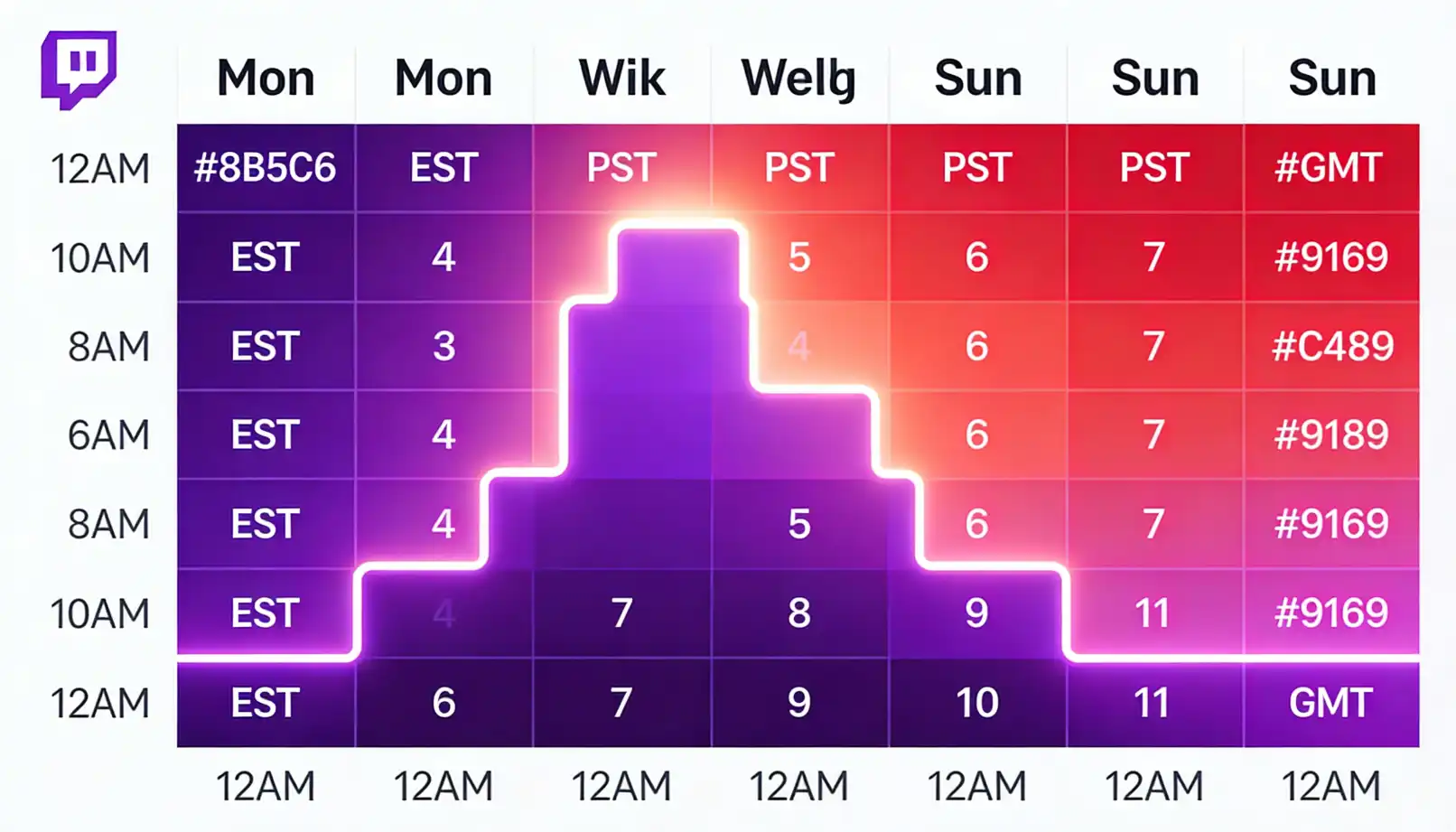
Visual breakdown of Twitch viewership patterns across the week reveals optimal streaming windows
Daily Breakdown: Best Times Each Day
Optimal windows shift day by day. Here's the complete breakdown:
The Slow Build
Viewer mindset: Recovering from weekend, easing into the week
Content that works: Comfort content (chill games, relaxing streams) · Series continuations · Community catch-up streams
Avoid: Frenetic, high-energy content
Why: Monday audiences prefer relaxation over intensity. They're transitioning from weekend to workweek — chill vibes outperform tryhard content.
Momentum Building Day
Viewer mindset: Fully settled into the week, ready for entertainment
Content that works: Competitive gameplay · New game releases (often Tuesday launches) · High-energy content · Multiplayer with audience participation
Why: Tuesday is when weekly rhythm solidifies. Audience is no longer recovering from Monday and ready for engaging content.
Peak Weekday Power
Viewer mindset: Seeking mid-week entertainment, highly likely to engage
Content that works: Your best content · Collaborations or special events · Tournament participation · Interactive community streams
Why: Wednesday represents mid-week peak. Weekend approaching creates entertainment appetite to break up the week.
Friday Eve Energy
Viewer mindset: Anticipating weekend, willing to stay up late
Content that works: Longer streams (viewers stay later Thursdays) · Weekend preview/hype content · Community game nights · Content building excitement for weekend plans
Why: Thursday feels like "Friday Eve." People start mentally checking out of workweek, more willing to engage and watch longer.
The Tricky Day
Viewer mindset: Weekend excitement, less committed to routine
Content that works: Late-night streams post-10 PM excel · Social/party game content · Collaborations with other streamers
Why: Friday is complicated. Early Friday evening (6-8 PM) sees lower traffic than other weeknights as people go out. Many go out 6-10 PM, return home, open Twitch 10 PM-3 AM.
Late-night streamers:10 PM-3 AM EST (catch returning-home audience)
Avoid:7-9 PM EST (lowest Friday engagement window)
The Golden Day
Viewer mindset: Maximum free time, seeking entertainment
Content that works: Anything (Saturday is most flexible) · Long marathon streams · Special events · Major tournaments · Community-focused content
Why: Saturday has highest total viewership hours of any day. People have time. They're seeking entertainment. They'll watch for hours.
Saturday peak windows:
- Morning: 11 AM–2 PM EST (surprisingly strong for weekend morning routines)
- Afternoon: 2 PM–6 PM EST (solid, though some people are out)
- Evening: 7 PM–1 AM EST (highest viewership, most competition)
- Late night: 1 AM–4 AM EST (less competition, dedicated viewers)
The Relaxation Day
Viewer mindset: Relaxing before week starts, beginning Sunday anxiety
Content that works: Chill and cozy content · Completion streams (finishing games, wrapping storylines) · Community building and viewer interaction · Prep content for the week ahead
Why: Sunday 11 AM–6 PM is strong. Sunday evening gets complicated as people mentally prepare for Monday.
Sunday strategy:Start streaming early (1-2 PM EST), stream 4-6 hours, end before Sunday Scaries hit hard.
Game & Category-Specific Timing
Optimal streaming times vary by category. Here's the breakdown:
🎮Competitive Games (League, CS2, Apex, Valorant)
Best times: Weekdays 5 PM–1 AM EST · Weekends 1 PM–3 AM EST
Why: Competitive game audiences are typically:
- Ages 16-28
- In school or early-career
- Most active post-school/work
Sweet spot: 7-11 PM EST for high-level gameplay when both East and West Coast competitive players are online.
Avoid: Weekday daytime (10 AM–4 PM EST) when target audience is at school/work.
📖Story-Driven Single-Player (RPGs, Adventures, Indies)
Best times: Weekdays 6 PM–12 AM EST · Weekends 12 PM–2 AM EST
Why: Story game viewers are more likely to commit to longer viewing sessions. They want to follow narratives, which requires time.
Sweet spot: Evening when viewers can watch story unfold for 2-4 hours uninterrupted.
Weekend advantage: Story game streams perform exceptionally well Saturday/Sunday afternoons (2-6 PM EST) when people want to relax and watch narratives unfold.
💬Just Chatting, IRL, Talk Shows
Best times: Weekdays 8 PM–2 AM EST · Weekends 10 AM–3 AM EST
Why: Just Chatting success relies on personality and connection. People often watch while doing other things during their free time.
Optimal windows:
- Dinner time: 6-8 PM EST (casual watching)
- Late night: 10 PM-2 AM EST (parasocial connection, winding down)
- Weekend mornings: 10 AM-1 PM EST Saturday/Sunday (coffee and conversation)
⚡Speedrunning & Retro Games
Best times: Weekdays 6 PM–11 PM EST · Weekends 11 AM–11 PM EST
Why: While speedrunning/retro communities are dedicated and will find your content anytime, you still need discoverability pathways for new viewers.
Best approach: For these niche communities, consistency matters more than timing. Pick a schedule and stick to it.
🎨Creative, Art, Music
Best times: Weekdays 6 PM–12 AM EST · Weekends 12 PM–12 AM EST
Why: Creative streams work well as "hang out" content. People watch while working on their own projects or relaxing.
Peak windows:
- Weekday evenings: 7-10 PM EST (post-work creative community)
- Weekend afternoons: 1-5 PM EST Saturday/Sunday (long creative sessions)
Time Zone Optimization Strategy
Your location matters, but you can strategically plan for different time zones.
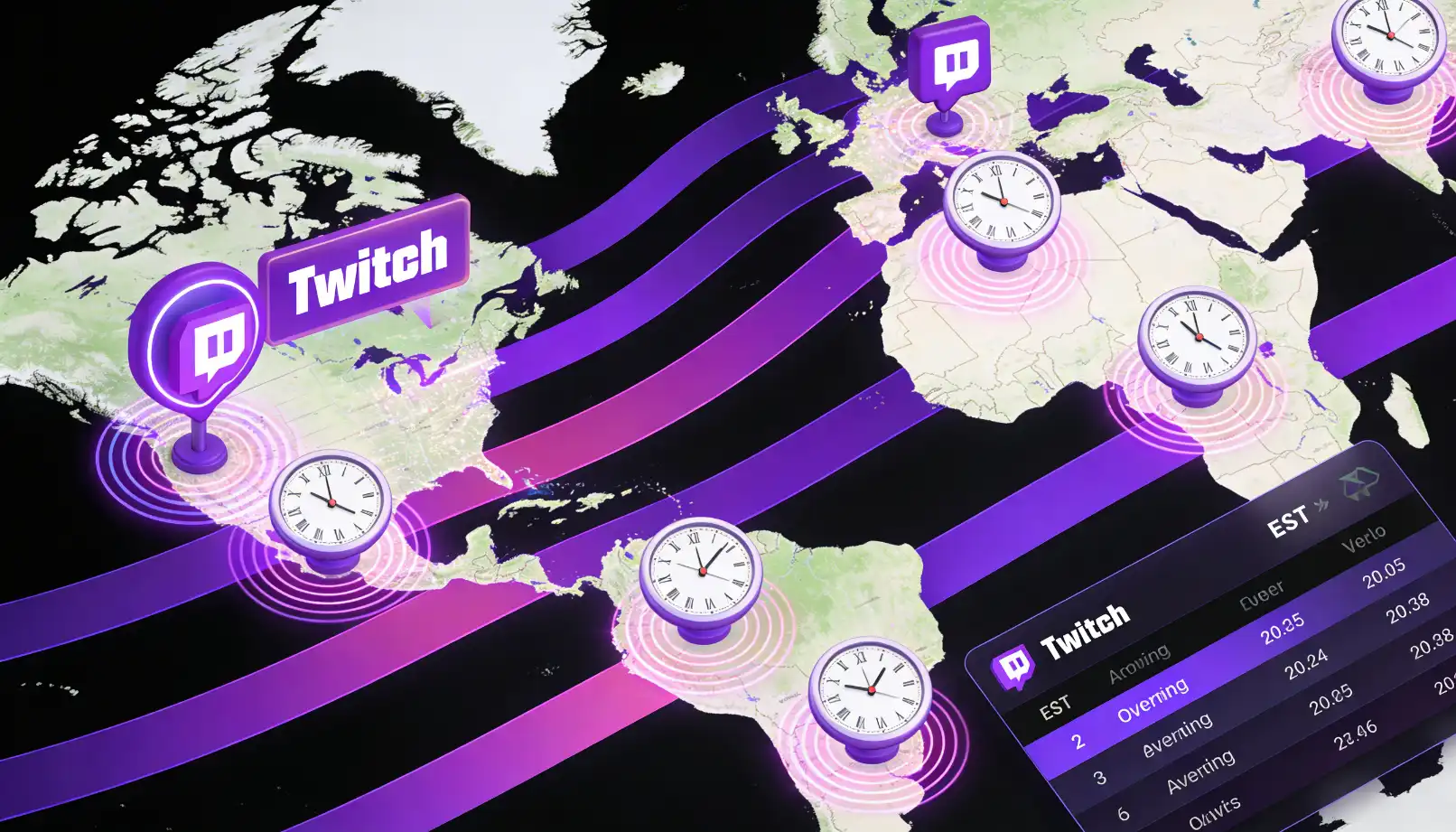
Strategic time zone planning allows streamers worldwide to maximize reach across different global audiences
🌍Streaming from U.S. Eastern Time (EST/EDT)
Advantages:
- Your evening prime time (6-11 PM EST) is peak hours
- Able to catch West Coast audience in afternoon
- Late streams (11 PM-2 AM) cover West Coast prime time
Optimal window: 7-11 PM EST to maximize U.S. reach
🌅Streaming from U.S. Pacific Time (PST/PDT)
Advantages:
- Your afternoon (3-6 PM PST) aligns with East Coast prime time (6-9 PM EST)
- Late streams catch global audiences
Optimal window: 5-10 PM PST (8 PM-1 AM EST)
Challenge: Morning and early afternoon streams miss East Coast work hours
🌍Streaming from Europe (GMT/CET)
Advantages:
- Evening streams catch U.S. East Coast afternoon/evening
- Large European audience in same time zone
Optimal window: 7-11 PM local time (works for both European evenings and U.S. afternoons)
Alternative strategy: Late-night streams (11 PM-3 AM local) capture U.S. prime time (6-10 PM EST) with less European competition
🌏Streaming from Asia/Australia
Challenge: Major time zone disconnect from bulk of Twitch viewers
Strategic options:
- Option 1:Stream 7-11 PM local time for primarily local/regional viewers
- Option 2:Stream during U.S. prime time (early morning your time: 5-10 AM in many Asian time zones) to maximize reach
- Option 3:Split schedule: weekdays local evening audience, weekends early morning for U.S. audience
How to Find YOUR Optimal Streaming Time
Generic advice only goes so far. Here's how to discover your personal optimal times:
Analyze Your Current Data
If already streaming, check Twitch analytics:
- Which streams had highest average viewers?
- When were peak viewer times?
- When did viewers stay longest?
- What days had best follower conversion?
Look for patterns: Focus on 4-6 weeks of data to find recurring trends rather than one-off spikes.
Run Controlled Experiments
Test method:
Weeks 1-2: Stream similar content at different times
- Monday 6 PM EST
- Tuesday 8 PM EST
- Wednesday 3 PM EST
- Thursday 9 PM EST
Weeks 3-4: Focus only on top 2 performing times, ignore rest
Track these metrics:
- Average concurrent viewers
- Peak concurrent viewers
- Total unique viewers
- Chat messages per hour
- Follower conversion rate
Consider Your Target Audience
Who are you trying to reach?
- High school/college students: Stream weekdays 6 PM-12 AM EST, weekends 12 PM-2 AM
- Working professionals (20s-30s): Stream weekdays 7 PM-11 PM EST, weekends 10 AM-1 AM
- Stay-at-home/flexible schedules: Afternoon streams (2-6 PM EST) work well
- Global audience: Adjust to their time zone, not yours
Analyze Your Competition
Find similar streamers:
- What times do streamers in your game/category stream?
- Are there coverage gaps or times with less competition?
- Is there an underserved time slot?
Use TwitchTracker, SullyGnome, or Twitch Strike to analyze category streaming patterns.
Consider the "Off-Peak" Strategy
Instead of streaming during peak hours, try streaming 1-2 hours before peak.
Examples:
- Instead of 7 PM EST (high competition), try 5 PM EST (early arrivers)
- Instead of 9 PM EST (highest competition), try 11 PM EST (dedicated late-night audience)
This works especially well for smaller streamers seeking discoverability.
6 Timing Mistakes That Kill Growth
❌Mistake #1: Inconsistent Schedule
The problem: Streaming Tuesday 6 PM, Thursday 9 PM, Saturday 2 PM with no pattern
Why it doesn't work: Your audience can't build viewing habits around your streams. Finding the right time matters less than being consistent.
The fix: Pick 3-4 specific times and stick to them for minimum 4-6 weeks. Your audience needs to know when to expect you.
❌Mistake #2: Streaming When YOU Want, Not When Audience Is Available
The problem: "I can stream 11 AM-3 PM weekdays because that's when I'm free"
Why it doesn't work: Your availability doesn't align with your audience's availability
The fix: If serious about growth, adjust your schedule to match when your audience is most available — even if uncomfortable
❌Mistake #3: Only Streaming Peak Hours (Too Much Competition)
The problem: Only going live 7-9 PM EST "because that's when most viewers are online"
Why it doesn't work: Small streamers get buried by thousands of competitors during absolute peak hours
The fix: Test slightly off-peak times (5-6 PM EST or 10-11 PM EST) where you can gain more visibility without losing viewership
❌Mistake #4: Ignoring Weekend Potential
The problem: Only streaming Monday-Friday "because that's a work week schedule"
Why it doesn't work: Saturday has highest overall viewership and best growth potential for new streamers
The fix: Make Saturday one of your core streaming days. Even just one Saturday per week significantly impacts growth
❌Mistake #5: Ending Too Early
The problem: Streaming 7-9 PM EST and ending right as momentum builds
Why it doesn't work: Many streams take 90 minutes to gain traction. Ending at 2 hours cuts off momentum
The fix: Plan for minimum 3-4 hour streams during prime time. Your final hour often has highest viewership
❌Mistake #6: Not Considering Game-Specific Patterns
The problem: Streaming single-player RPGs at 6 PM when they peak at 8 PM
Why it doesn't work: Different categories have different optimal windows
The fix: Use SullyGnome or TwitchTracker to research when your specific game/category peaks before setting schedule
The GTR Socials Perspective: Timing as Growth Component
At GTR Socials, we work with Twitch streamers at all growth stages, and we're transparent about what timing can and can't do for growth.
You need the complete picture:
- 1. Optimal timing(covered in this guide)
- 2. Consistent schedule(showing up at those optimal times reliably)
- 3. Quality content(entertainment, skill, personality, or value)
- 4. Discoverability(clips, highlights, social media, networking)
- 5. Community building(engaging with viewers, creating connections)
🔄The Cold Start Problem for New Streamers
If you're new to Twitch, you might have 0-3 viewers even at optimal times. The algorithm doesn't promote you. You're not discoverable. Even with perfect timing, that initial barrier remains.
This is where strategic growth support becomes relevant.
The goal of strategic growth is building enough viewership to make your stream appear active and worth joining. That initial momentum, combined with good timing, quality content, and consistency, can lead to sustainable organic growth.
The goal is never replacing genuine community development. It's making your genuine value visible enough to overcome the initial discovery barriers that keep most new streamers stuck in the 0-5 viewer range.
Ready to Optimize Your Twitch Growth Strategy?
GTR Socials helps streamers overcome the cold start problem with strategic growth services that complement your quality content and optimal timing — creating momentum that leads to sustainable, organic channel growth.
Explore Twitch Growth Services →Your Streaming Schedule Action Plan
Here's your complete roadmap for optimizing your Twitch timing:
Weeks 1-2: Research & Analysis
- Analyze your category's viewership patterns using TwitchTracker
- Review your own analytics if already streaming for performance patterns
- Research when similarly-sized streamers in your category stream
- Identify 3-4 potential time slots that work for your audience AND your schedule
Weeks 3-4: Initial Testing
- Test your selected time slots with consistent content
- Stream minimum 3-4 times per week
- Track average, peak, and follower growth for each slot
- Monitor viewer retention and chat activity
Weeks 5-6: Optimization
- Select your top 2 time slots based on data
- Commit to those times for 2 weeks
- Announce your schedule in Twitch bio and on social media
- Set audience expectations around consistent timing
Week 7 & Beyond: Commitment & Optimization
- Finalize your streaming schedule based on data
- Stick to that schedule for minimum 6-8 weeks (consistency is critical)
- Continue monitoring analytics and make minor adjustments
- Build community through reliable presence
Final Thoughts: Timing Opens Doors, Content Keeps Them Open
Remember Marcus, the streamer I mentioned at the beginning?
Changing his streaming time didn't make him successful by itself. When he shifted from 2-6 PM EST to 7-11 PM EST, his target audience was actually home and on Twitch. But he also:
- Improved his first 15 minutes to increase viewer retention
- Engaged more actively in chat
- Created clips and highlights that encouraged discovery
- Built genuine connections with community members
- Showed up consistently every week at the same times
Success on Twitch comes from combining optimal timing with quality content, consistency, and genuine community building
The timing change opened the door. His content and community building kept people coming back.
If you're streaming at terrible times — like 3 AM EST weekdays when nobody's awake, or 11 AM EST weekdays when your target audience is at work/school — adjusting your schedule can transform your growth trajectory.
If you're already streaming at good times and still not growing, timing isn't the problem. Look at content, community engagement, and discoverability.
The best time to stream on Twitch is when:
- Your target audience is online, engaged, and seeking content like yours
- You can be consistent, deliver your best effort, and connect with whoever shows up
- For most streamers, that's 6 PM-12 AM EST weekdays, slightly later weekends
But the RIGHT time?
The time when you can be dependable, bring your best, and connect with the people who do show up. Find the optimal viewing window that works with your schedule AND your audience. Commit to it. Show up. Build community.
The rest will follow.
Check your analytics now, choose a time that works, and start showing up when people are actually looking.
Your future viewers are waiting.
Comments (0)