

What is Bluesky? It's a short-post social network that looks and feels like X, but it runs on an open protocol, so you pick your own feeds and moderation instead of accepting one company's defaults. More than 46 million accounts have signed up. Far fewer people use it on any given day, and that gap matters more than the headline number. If you want text-first conversation and control over what you see, it's worth an afternoon. If you need a big, dependable audience for a brand, treat it as a side bet. Here's how it works, who's actually there, and what to check before you spend posting time on it.
What is Bluesky, in plain terms
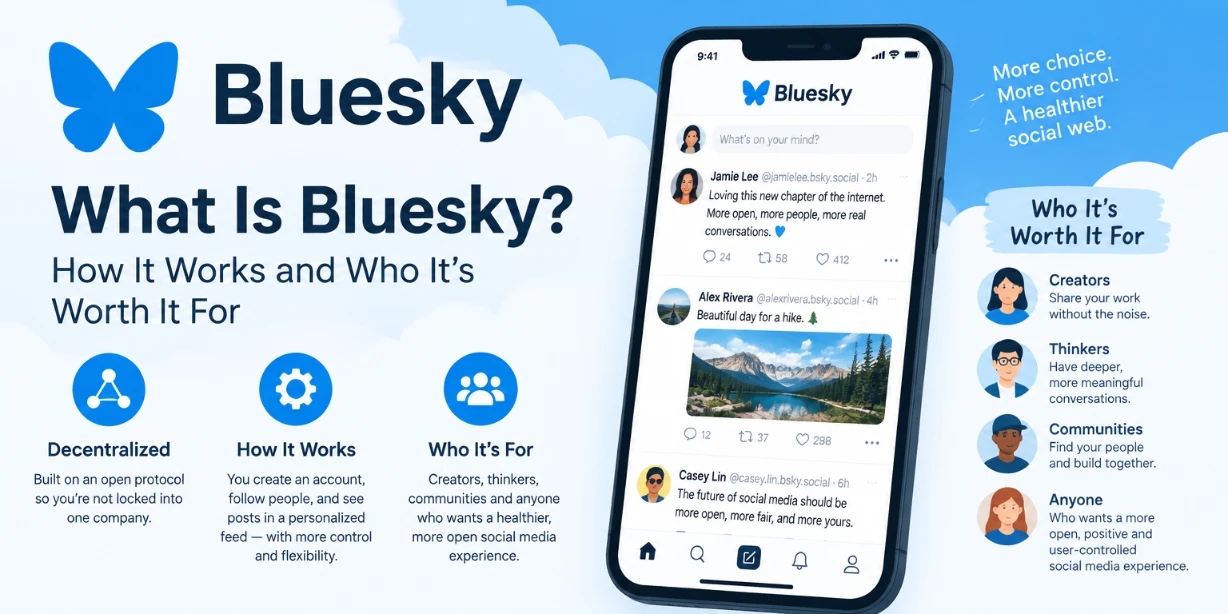
Bluesky is a microblogging app. You write posts of up to 300 characters, add images or video, and reply, repost, like and follow, exactly as you would on X. Video can run up to three minutes, and there are direct messages. If you've used X, the timeline will make sense within about ten seconds.
The company started in 2019 as a research project inside Twitter, then spun out on its own. It's now run by Bluesky Social, a public benefit corporation. That structure obliges the company to weigh a stated public mission alongside profit, though it doesn't make Bluesky a nonprofit.
The format is the part it shares with X. The machinery underneath is where it differs. A creator who posts short opinions or links will feel at home here. One who lives on vertical video won't.
Custom feeds are the real difference
By default you get a Following feed in time order and a Discover feed that recommends popular posts. Past that, anyone can build a custom feed, which is a set of rules published as a feed other people can subscribe to and pin as a tab. Feeds exist for mutuals only, quiet posters, news outlets, a single topic, a single country, cat photos.
Mechanically, a feed generator reads the network's public posts, applies its rules and hands your app a list to display. Custom feeds also have "Show more" and "Show less" buttons, so you can tune one without leaving it.
For you as a poster, this changes what reach means. There's no single For You page deciding most of who sees you. Discover exists, but it's one feed among many. People see your posts because they follow you, because a feed they've pinned includes you, or because someone reposts you. The upside is that a niche feed can put a post in front of people who don't follow you. The downside is that there's no one algorithm to study, so there's no one trick.
Starter packs fix the empty timeline
A new account follows nobody, so the timeline is blank. Starter packs are the fix. A starter pack is a shareable list of accounts, sometimes with feeds, that a new user can follow in one tap. Independent directories list tens of thousands, from major news outlets to cargo bikes.
If you run a niche account, getting into one or two packs for your topic is probably the fastest way to be found by people who just arrived and have nobody to follow yet. There's a catch. Someone who follows a pack of thirty accounts didn't pick you specifically, so expect fewer replies from those followers than from people who found you through a post.
The AT Protocol without the jargon
Underneath the app is the AT Protocol, an open standard for social apps. Three parts matter to a normal user.
- Your posts and profile sit in a data repository tied to your account, and the design lets you move it to another host.
- Your handle can be a domain you own, such as yourbrand.com. Proving you control the domain is how the handle verifies who you are.
- Feeds and moderation are separate services you can mix. You can subscribe to labeling services from other groups on top of Bluesky's own moderation, and mute, block or hide categories of content yourself.
Now the tradeoff. Open doesn't mean spread out yet. Most people still use Bluesky's own app and servers, so today it's closer to a company with an open door than a fully distributed network. The portability is insurance: if the company ever changes direction, your account isn't locked inside it.
How many people actually use Bluesky
This is where the headline number misleads. The most recent count I found, from mid-August 2026, was more than 46 million registered accounts. Registered means someone signed up once. It includes people who tried Bluesky during a news spike and never came back. About 3 million people joined in the week after X was suspended in Brazil in 2024, and sign-ups arrive in waves like that.
Similarweb's figures put Bluesky's mobile monthly actives down 27.2% from a year earlier, and daily actives down 25.6%. Third-party numbers are estimates, and these only count the mobile app, so read them as a direction, not a headcount. Even if the real figures were several times higher, Bluesky would still be far smaller than X or Threads.
What that means for you is that reach depends on your topic. Some topics have an active crowd on Bluesky and feel busy. Others feel empty. Search your subject and see how many posts from the last day have real replies. That check takes five minutes and tells you more than the registered-user count does.
What Bluesky is building next
Leadership changed this year. On March 9, 2026, Jay Graber, who led Bluesky from the start, said she was stepping back as CEO to become Chief Innovation Officer. Toni Schneider, a former CEO of Automattic, joined as interim CEO.
The product direction is laid out in Bluesky's own 2026 roadmap post: a smarter Discover feed, real-time curation around live events like sports and elections, and fixes to basics. Drafts, a feature most social apps already had, only arrived at the start of 2026. There's also a "Live Now" integration in beta for streamers, and since July a "Beta features" section in Settings for early access to new tools.
How Bluesky pays for itself
It's free to use, and as far as I can tell the money so far has come mostly from investors. A $15 million Series A in October 2024 was led by Blockchain Capital. Bluesky has said it plans an optional subscription for extras like higher-quality video uploads and profile customization such as colors and avatar frames, along with ways for creators to get paid directly. It has also said the core app stays free and that it won't fill feeds with posts from people who pay.
Ads aren't the core of the pitch, but that isn't the same as ruled out forever. A free network funded by investors will need revenue eventually, which is both a reason it may last and a reason to watch what changes. Check Settings in your app for what's actually live today.
Who should bother joining
Bluesky suits someone who likes text-first conversation, wants control over what they see, and writes about a topic that already has people on the network. It suits a brand less, especially one whose customers spend their time on TikTok, Instagram or YouTube, where vertical video is the format.
The cheapest way to find out is a two-week test. Post once a day about your topic, reply to a few people a day, and compare replies and reposts with what the same effort earns elsewhere. If you skip a day, skip the post and keep the replies, because replies put your handle in front of people who don't follow you yet. Silence after two weeks tells you your niche isn't there yet, and it cost you a couple of weeks.
Do
- Set your handle to a domain you own.
- Pin three feeds that match your topic and read them for a week before you post.
- Follow one or two starter packs, then prune.
- Write posts that fit 300 characters, or clips under three minutes.
Skip
- Pasting the same post from X or Instagram with no edit.
- Counting registered accounts as your audience.
- Judging success by follower count from starter packs alone.
- Planning around features that haven't launched.
Starting from zero is slow on any network, and Bluesky's active audience is small. GTR Socials works with plenty of networks (see our services by platform), but Bluesky isn't one of them, and followers wouldn't replace a post worth replying to anyway.
FAQ
Is Bluesky free?
Yes. Signing up and using the app costs nothing, and Bluesky has said the core product will stay free. A paid tier for extras like better video uploads and profile customization has been discussed since 2024, so check Settings to see whether it's live when you read this.
Do you need an invite to join Bluesky?
No. Bluesky dropped invite codes when it opened to everyone in February 2024. Go to bsky.app or install the app, tap create account, and pick Bluesky Social as your hosting provider unless you have a reason to choose another. You can also browse public posts without an account.
Is Bluesky private?
Not in the way a private Instagram account is. Bluesky was built as a public network, so posts and profiles are visible to anyone. Muting only changes what you see, and blocking limits who can interact with you. Neither makes your posts private.
Private membership-based spaces were reported as in development in August 2026, so treat everything you post as public until that ships.
Does Bluesky have an algorithm?
Yes, several. The Discover feed recommends popular posts, and every custom feed is an algorithm someone wrote. What's different is that you choose which ones to use, and your Following feed stays in time order. Bluesky's 2026 roadmap says Discover is getting smarter, so expect that feed to change.
Is Bluesky the same as Twitter?
No. Bluesky began as a research project funded by Twitter and spun out as a separate company, and Twitter has since become X. The format is similar, with short posts, replies and reposts, but Bluesky runs on the AT Protocol and lets you pick feeds and moderation services. The audience is also much smaller.
Comments (0)