

Affiliate marketers face a familiar question whenever they launch a new campaign: should they prioritize inexpensive traffic and higher volume, or pay more for visitors who may be genuinely interested in the offer?
That decision often comes down to two popular advertising formats: popunder traffic and native traffic.
Both can generate profitable affiliate campaigns. Both can reach international audiences, support testing across different GEOs, and provide opportunities for scaling. Yet they approach user acquisition in fundamentally different ways.
Popunder advertising emphasizes reach and cost efficiency. Native advertising focuses on attracting attention through content relevance and voluntary engagement.
So which format actually produces better results?
The answer depends less on the advertising format itself and more on the relationship between traffic cost, user intent, conversion rate, and affiliate payout.
Two Advertising Formats, Two Different User Journeys
The most important difference between popunder and native advertising is how the visitor enters the funnel.
With popunder advertising, an advertiser's page typically opens behind the active browser window following a qualifying interaction. The user may discover the page when switching or closing browser windows.
The visitor did not necessarily express interest in the advertised offer before encountering it.
Native advertising works differently.
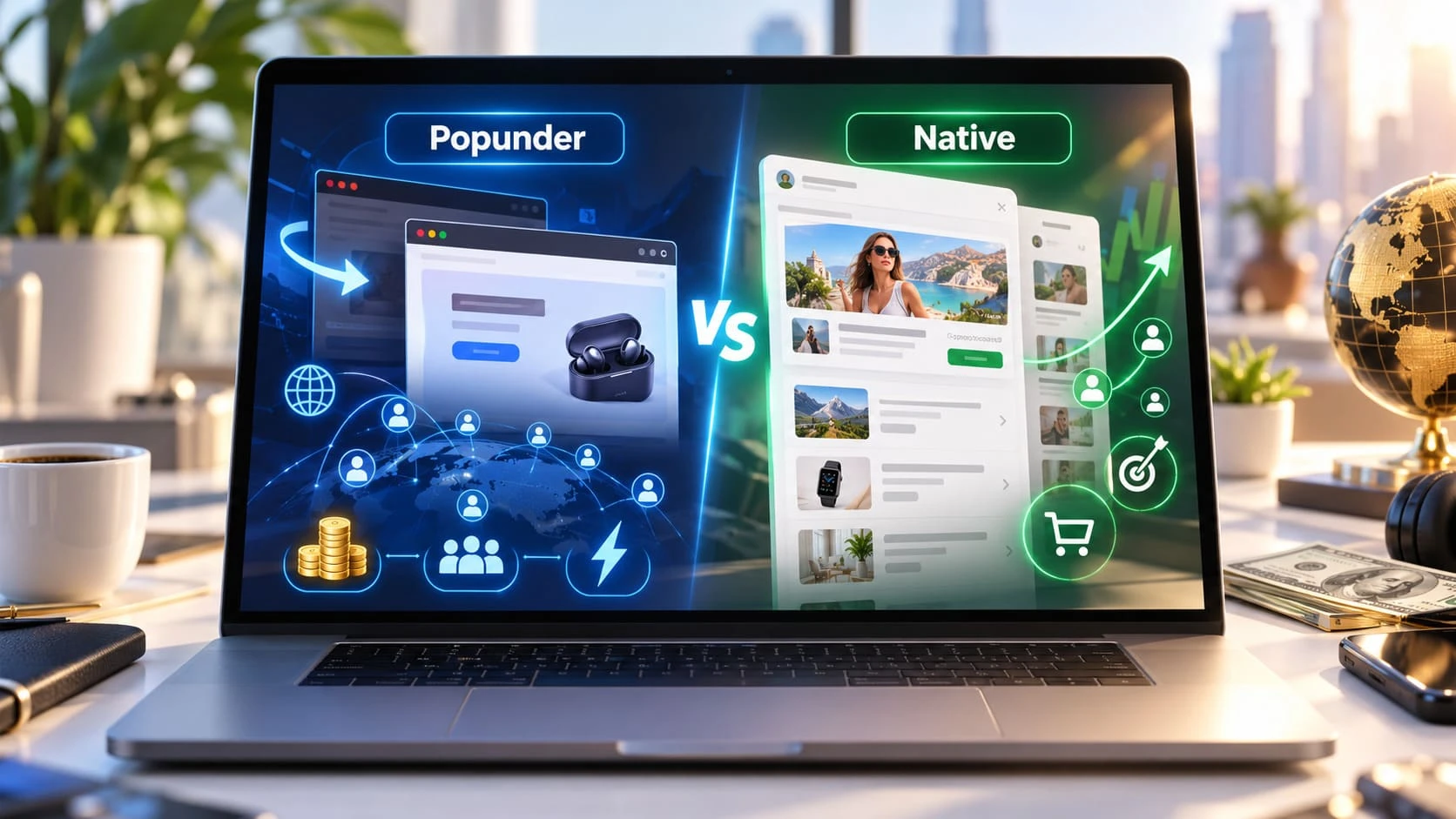
A sponsored recommendation appears within a content environment, often alongside articles, news feeds, or editorial recommendations. The user chooses whether to click based on the headline, image, and perceived relevance.
That distinction creates two different acquisition models.
Popunder: Generate exposure at a low cost and convert a small percentage of a broad audience.
Native: Attract visitors through relevant messaging and convert an audience that has already demonstrated some interest.
Neither approach guarantees profitability. Each creates different opportunities and challenges.
Traffic Costs: Why Cheap Doesn't Always Mean Better
Popunder traffic is generally associated with lower acquisition costs.
For affiliate marketers working with limited testing budgets, this can be attractive. Lower prices make it possible to evaluate more traffic sources and collect data without committing large amounts of money to individual clicks.
Native advertising often requires higher bids, particularly in competitive GEOs and commercial verticals.
However, the difference in traffic price tells only part of the story.
Consider a hypothetical comparison:
|
Metric |
Popunder |
Native |
|---|---|---|
|
Cost per visitor |
$0.02 |
$0.30 |
|
Visitors acquired |
10,000 |
1,000 |
|
Advertising spend |
$200 |
$300 |
|
Conversion rate |
0.5% |
3% |
|
Conversions |
50 |
30 |
|
Cost per acquisition |
$4 |
$10 |
In this example, popunder produces a lower CPA.
But change the offer, audience, or landing page, and the results might reverse.
If the affiliate payout is $8 per conversion, popunder is profitable while native is not.
If native visitors generate higher-value customers or stronger downstream revenue, however, the comparison becomes more complicated.
These numbers are illustrative, not industry benchmarks.
The correct comparison is not CPC versus CPC. It is the cost of generating a profitable conversion.
When Popunder Traffic Makes More Sense
Popunder advertising is often worth testing when the offer has a straightforward conversion process.
Examples include:
- mobile app installations;
- gaming offers;
- software utilities;
- VPN subscriptions;
- sweepstakes and promotional registrations;
- selected entertainment services;
- simple lead-generation funnels.
These offers tend to share one characteristic: users can understand the value proposition quickly.
A visitor does not necessarily need to read a lengthy educational article before deciding whether to proceed.
That creates opportunities for direct-response landing pages with clear messaging and minimal friction.
Popunder can also be useful when advertisers need substantial testing volume.
Instead of waiting for a smaller number of expensive clicks, media buyers can collect data across GEOs, devices, operating systems, and traffic placements.
For affiliate marketers evaluating this approach, GTaro Ads popunder traffic provides access to popunder and clickunder advertising, with CPC and CPM pricing options and campaign targeting capabilities.
The primary advantage is not simply inexpensive traffic. It is the opportunity to identify profitable combinations of audience, offer, and landing page through controlled testing.

When Native Traffic Has the Advantage
Native advertising becomes particularly interesting when an offer requires additional explanation or trust.
Consider affiliate campaigns promoting:
- SaaS products;
- financial comparison services;
- educational platforms;
- premium subscription products;
- higher-value consumer purchases;
- complex software solutions.
These offers may require visitors to understand a problem before becoming interested in the solution.
Native advertising allows marketers to introduce that problem through a headline and then continue the conversation on a landing page or advertorial.
For example, a campaign promoting a productivity application could begin with an article explaining common workflow inefficiencies.
Instead of immediately asking visitors to subscribe, the funnel first establishes relevance.
This approach can work well because the visitor has voluntarily engaged with the topic.
However, native advertising creates another challenge: creative performance.
Headlines, images, landing-page consistency, and content quality all influence whether the campaign generates qualified visitors.
A high click-through rate means little if those visitors are attracted by misleading promises and leave without converting.
The Landing Page Strategy Should Be Different
One of the biggest mistakes in affiliate marketing is using the same landing page for every traffic format.
Popunder and native visitors often arrive with different expectations.
A popunder landing page typically needs to communicate the offer almost immediately.
The visitor should understand:
- What is being offered?
- Why is it relevant?
- What action should be taken next?
Long introductions can create unnecessary friction.
Native visitors, on the other hand, may expect the content promised by the advertisement.
If someone clicks a headline about improving business productivity, arriving at an aggressive sales page can break that expectation.
An effective native funnel may follow this structure:
Native Ad → Educational Content → Product Explanation → Conversion
A popunder funnel may be more direct:
Popunder → Focused Landing Page → Conversion
These are not fixed rules, but they illustrate why matching the landing page to traffic intent is essential.
GEO and Device Targeting Can Change the Winner
An advertising format that performs well in one country may produce completely different results elsewhere.
Traffic pricing, consumer behavior, payment preferences, and competition all vary by market.
A mobile utility might convert profitably through popunder traffic in one GEO but struggle in another because of different device distributions or user expectations.
Likewise, a native campaign targeting desktop users in the United States may require a different bidding and funnel strategy from a mobile campaign targeting Southeast Asia.
Successful comparisons therefore require segmentation.
At minimum, affiliate marketers should examine:
- country;
- device type;
- operating system;
- browser;
- traffic source;
- conversion rate;
- CPA;
- revenue per visitor.
Comparing one broad popunder campaign against one broad native campaign rarely provides enough information to identify the better long-term channel.
The Creative Testing Difference
Native campaigns depend heavily on their advertising creatives.
Advertisers must continually evaluate headline and image combinations, content angles, and audience relevance.
Creative fatigue can become a significant issue when the same message reaches the same audience repeatedly.
Popunder advertising generally places less emphasis on the initial advertising creative because the destination page itself becomes the main acquisition experience.
That shifts more responsibility toward landing-page design, offer presentation, loading speed, and conversion optimization.
For media buyers, this difference affects operational workload.
Native may require more ongoing creative production.
Popunder may require more intensive traffic-source filtering and landing-page testing.
Both require optimization, but the work is distributed differently.
Can Affiliate Marketers Use Both Formats?
Absolutely.
In fact, testing both formats can help advertisers understand their offers more deeply.
A popunder campaign might be used to evaluate initial demand, compare GEOs, and identify promising conversion funnels.
Native advertising can then be tested with content-driven messaging designed for audiences that respond better to education or product comparisons.
Alternatively, native may prove profitable first, while popunder becomes an additional acquisition channel for simpler variations of the same offer.
Multi-format platforms such as GTaro Ads can support this approach by offering advertisers access to different advertising formats within a broader performance marketing environment.
The important point is to avoid assuming that success with one format automatically translates to another.
Each format should have its own budget, conversion tracking, performance targets, and optimization strategy.
A Practical Decision Framework
Before choosing between native and popunder traffic, answer five questions.
1. How complicated is the offer?
Simple registrations, installs, and direct-response actions may be suitable for popunder testing. Products requiring more explanation may benefit from native advertising.
2. What is the allowable CPA?
Low-payout offers often require especially inexpensive acquisition. Higher-value offers may support more expensive traffic.
3. Does the visitor need education?
If understanding the product is part of the conversion process, native advertising provides more opportunities to build context.
4. How much testing volume is required?
Popunder can provide cost-efficient volume where suitable inventory is available.
5. Which format delivers stronger profit after optimization?
Ultimately, actual conversion data should determine the decision.
A campaign should not be scaled merely because the traffic is cheap or the CTR looks impressive.
Final Verdict: Popunder or Native?
There is no universal winner.
Popunder traffic can be a strong choice for affiliate marketers prioritizing lower acquisition costs, broad reach, fast testing, and relatively simple conversion actions.
Native advertising may be better suited to campaigns where relevance, content engagement, and pre-conversion education play a larger role.
The distinction becomes clearer when comparing typical strengths:
|
Factor |
Popunder Traffic |
Native Traffic |
|---|---|---|
|
Typical traffic cost |
Lower |
Higher |
|
User-initiated engagement |
Lower |
Higher |
|
Traffic volume potential |
High |
Varies by inventory |
|
Creative requirements |
Landing-page focused |
Headline, image, and content focused |
|
Suitable funnels |
Direct response |
Content-driven or direct response |
|
Main optimization focus |
Sources, targeting, landing pages |
Creatives, targeting, landing pages |
|
Best use case |
Cost-efficient acquisition and testing |
Interest-driven acquisition |
These are general tendencies, not guarantees.
For affiliate marketers, the most effective strategy is to evaluate both formats against the same business objective: profitable conversions.
The best traffic source is not the cheapest one or the one generating the most clicks. It is the one that consistently delivers the strongest return after advertising costs, conversion rates, and affiliate payouts are taken into account.
Comments (0)