

In the hyper-competitive digital economy, the software infrastructure powering your business is no longer just a supportive utility; it is the central nervous system of your entire operation. Yet, an alarming number of growing enterprises find themselves trapped in a paradox. They invest heavily in off-the-shelf Enterprise Resource Planning (ERP) software, expecting a unified panacea for their operational bottlenecks, only to discover they must overhaul their established business processes to fit the strict confines of a rigid application. This friction inevitably leads to poor user adoption, fractured data silos, and stagnant growth. This is why forward-thinking organizations are increasingly bypassing the constraints of generic SaaS models and partnering with a dedicated ERP development company to engineer tailor-made, modular ecosystems. By commissioning bespoke software architectures that mirror their unique operational DNA, businesses can achieve unparalleled supply chain visibility, automated workflows, and a profound return on investment that outpaces any generic legacy system.
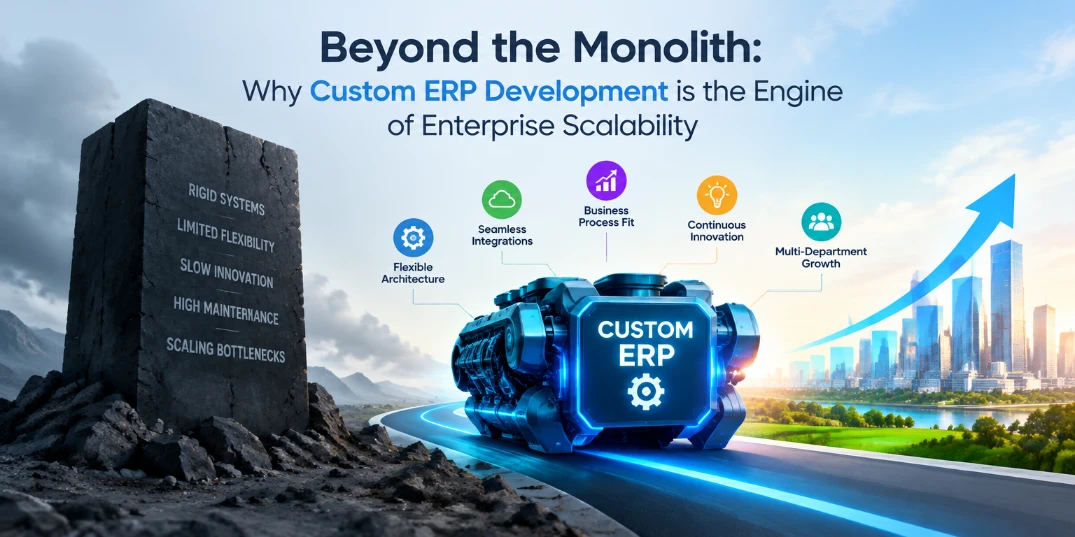
The shift from commercial off-the-shelf (COTS) products to custom-built enterprise platforms is not merely a technical preference - it is a strategic necessity. Recent projections indicate that the global ERP market will surpass an astounding $192 billion by 2035. However, alongside this immense growth lies a sobering reality: industry analysts, including Gartner, predict that by 2027, more than 70% of recently implemented ERP initiatives will fail to fully meet their original business goals. The root cause of these failures rarely lies in the technology itself, but rather in the mismatch between a vendor’s pre-packaged feature set and the nuanced realities of the enterprise deploying it. When your software dictates how you operate - rather than the other way around - the result is an expensive, bloated monolith that actively hinders digital transformation.
The Hidden Crisis of the "Out-of-the-Box" Illusion
Many business leaders are initially seduced by the promises of traditional, out-of-the-box ERP solutions. The marketing brochures promise instant deployment, "best-practice" templates, and immediate cost savings. However, beneath the surface of this convenience lies a landscape fraught with hidden expenses, chronic workarounds, and integration failures.
The Trap of Feature Bloat and Licensing Constraints
Generic platforms are built to serve the widest possible demographic across multiple industries. Consequently, they are loaded with features, modules, and complex UI dashboards that your team will never use. Not only does this feature bloat steepen the learning curve and destroy user adoption rates, but you are effectively paying a premium for dead code. Furthermore, as your enterprise scales, per-user licensing fees transform into a staggering financial drain. What initially seemed like a cost-effective subscription rapidly balloons, punishing your company for the very growth the software was supposed to support.
Integration Bottlenecks and Data Silos
Modern business processes rely on a delicate web of interconnected tools—from CRM platforms and HR portals to warehouse management and business intelligence suites. Legacy systems frequently struggle to communicate with third-party applications seamlessly. When your finance department’s data doesn't automatically sync with your procurement team’s inventory system, employees are forced back into manual data entry. This introduces human error, severely compromises real-time reporting, and effectively nullifies the primary purpose of investing in an ERP in the first place: absolute data unification.
The Strategic Superiority of Custom ERP Architecture
Choosing to architect a custom Enterprise Resource Planning system represents a shift from renting an operational bottleneck to owning a proprietary competitive advantage. Tailor-made solutions are engineered precisely around the way your supply chain moves, your financial approvals flow, and your human resources operate.
Modular, Cloud-Native Scalability
One of the most profound benefits of custom software engineering is the ability to adopt a microservices-based, modular architecture. Unlike traditional monolithic systems where updating one module risks breaking the entire application, custom cloud-native ERPs allow you to deploy, scale, and update independent components flawlessly. If your e-commerce division experiences a massive holiday spike, you can scale the server capacity for your inventory and order management modules independently without disrupting your payroll or CRM databases.
Hyper-Targeted Automation and Real-Time Business Intelligence
Custom platforms are built to automate the exact repetitive tasks that drain your team’s productivity. Whether it is automatically routing purchase orders for multi-tiered executive approval based on specific financial thresholds, or triggering automated restocking algorithms when warehouse supplies dip below a defined metric, the system works for you. Coupled with bespoke business intelligence dashboards, C-suite executives gain a 360-degree, real-time view of enterprise health, enabling data-driven decision-making rather than relying on retrospective, month-old spreadsheets.
Uncompromising Cybersecurity and Data Sovereignty
In an era where ransomware attacks and corporate data breaches make daily headlines, cybersecurity cannot be relegated to an afterthought. Widely distributed commercial ERPs represent massive targets for malicious actors; a single zero-day vulnerability can compromise thousands of companies simultaneously. A bespoke ERP, however, significantly reduces your attack surface. Because the codebase is proprietary and unique to your organization, it is inherently more resilient. Furthermore, you can engineer precise role-based access controls and customized encryption protocols that seamlessly comply with the specific regulatory frameworks of your industry—be it HIPAA, GDPR, or SOC 2.
4 Core Trends Shaping the Future of Enterprise Software
To maximize the ROI on a bespoke platform, development must anticipate the future of digital business operations. By observing current market trajectories, forward-thinking enterprises are integrating several advanced capabilities into their custom builds:
-
AI-Driven Predictive Analytics: Machine learning algorithms are no longer theoretical. Custom ERPs are increasingly leveraging AI to forecast demand spikes, optimize supply chain logistics, and perform predictive maintenance on manufacturing equipment before costly breakdowns occur.
-
Hybrid Deployment Models: While cloud-native solutions dominate the enterprise resource planning landscape, hybrid architectures are seeing an explosive compound annual growth rate (CAGR). Many enterprises prefer keeping highly sensitive intellectual property or compliance data on-premise, while utilizing the cloud for heavy computing tasks and distributed workforce access.
-
The Rise of "Headless" ERP: Decoupling the backend data processing engine from the frontend user interface allows businesses to deploy highly customized applications across different devices. A warehouse worker might interact with the ERP via a simplified mobile barcode scanner app, while a financial analyst accesses the same unified backend through a complex desktop visualization dashboard.
-
Enhanced Interoperability via API-First Design: Rather than relying on fragile, bolt-on integrations, modern custom solutions are built from the ground up with robust, RESTful APIs. This ensures that as new technologies—like IoT sensors or advanced robotics—enter your workflow, your core software can seamlessly ingest and process their data streams without costly overhauls.
Navigating the Implementation Minefield: Best Practices for Success
The journey of deploying a custom enterprise solution is complex, but the overwhelming majority of project failures stem from poor planning, not bad code. According to industry data, the top causes of ERP implementation failures are poor data migration, inadequate change management, and inexperienced teams.
To ensure success, your organization must rigorously prioritize the Discovery and Business Analysis phase. Before a single line of code is written, a reputable development partner will conduct deep-dive audits of your existing workflows, mapping out every process, pain point, and edge case. Building custom software without this step is akin to pouring a foundation without a blueprint.
Secondly, never underestimate data hygiene. Migrating decades of redundant, error-riddled, and duplicated legacy data into a pristine new system is a recipe for disaster. Dedicate serious resources to data cleansing and deduplication long before the final migration occurs. An ERP is only as powerful as the integrity of the data housed within it.
Finally, champion agile implementation. Rather than enduring a massive, multi-year "big bang" launch that disrupts the entire company simultaneously, deploy the system in iterative phases. Start with a Minimum Viable Product (MVP) focusing on your most critical operational bottleneck - such as procurement, customer relationship management, or inventory control. Launch it, gather real-world user feedback, ensure absolute system stability, and then seamlessly roll out the next modular component.
Final Thoughts on Securing Your Digital Future
Transitioning from an inadequate legacy system to a bespoke, enterprise-grade architecture is arguably the most impactful technological investment a scaling company can make. The total cost of ownership (TCO) for a custom build consistently proves more favorable over the long term, liberating organizations from predatory licensing fees, forced upgrade cycles, and productivity-draining workarounds.
By taking ownership of your digital infrastructure, you eliminate data silos, empower your workforce with hyper-targeted automation tools, and secure the agility required to dominate your market. While the deployment process demands strategic foresight and robust change management, the resulting operational harmony is the definitive catalyst for sustainable, long-term growth. When your software is built explicitly around your enterprise's unique vision, there is no limit to how far you can scale.
Comments (0)